
Pulp Fiction, 1920 · page 58 of 164
All-Story Weekly, Vol. 112, No. 1 — page 58: what you’re looking at
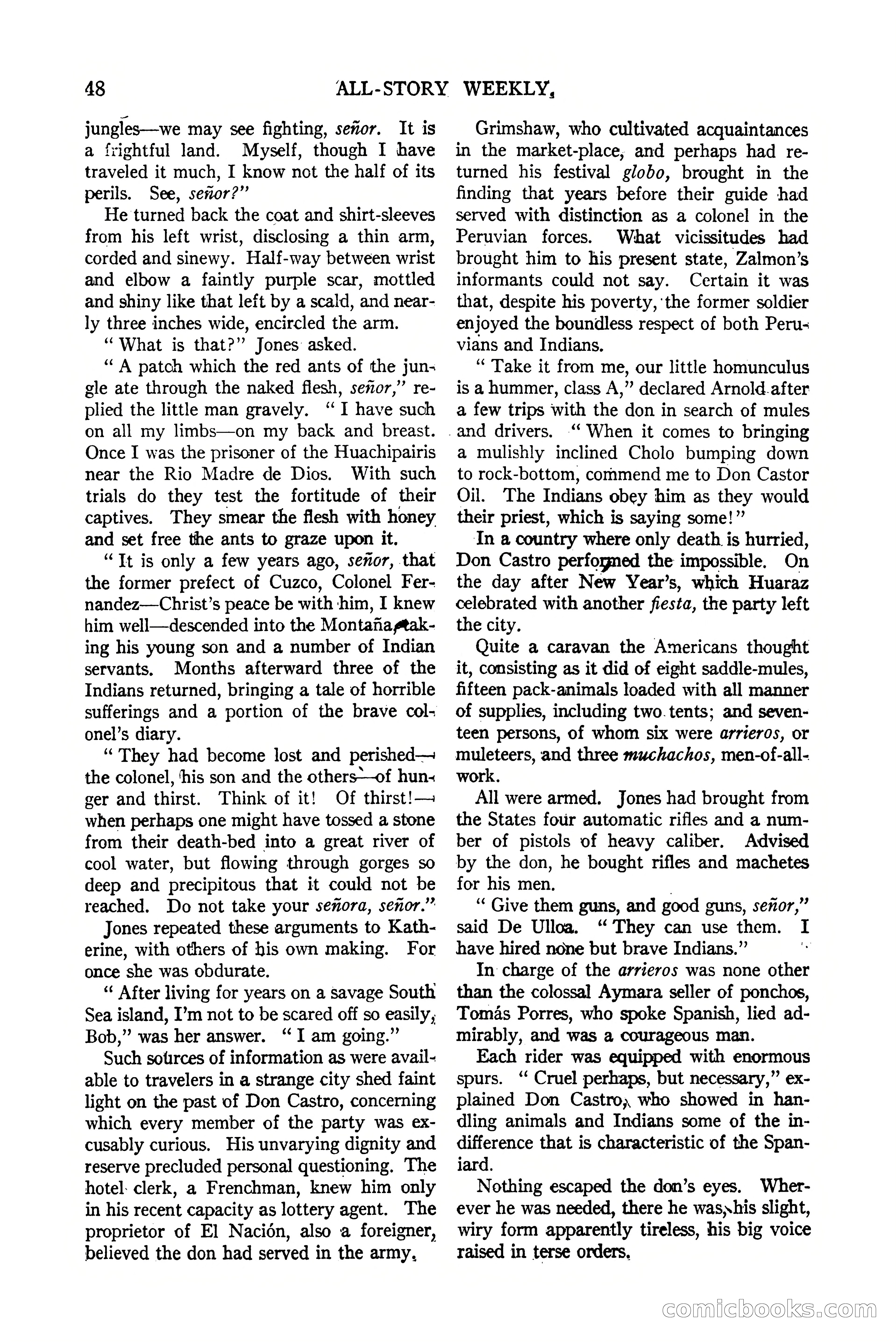
A restored page from Pulp Fiction, 1920. Page through the whole issue in the reader above.
📄 Transcribed text from this page (OCR, searchable)
Machine-transcribed from the original scan — historical spelling and the odd misread are preserved.
48 jungles—we may see fighting, senor. It is a frightful land. Myself, though I have traveled it much, I know not the half of its perils. See, senor?” He turned back the coat and shirt-sleeves from his left wrist, disclosing a thin arm, corded and sinewy. Half-way between wrist and elbow a faintly purple scar, mottled and shiny like that left by a scald, and near- ly three inches wide, encircled the arm. ‘“‘ What is that?’ Jones asked. ‘“‘ A patch which the red ants of the jun- gle ate through the naked flesh, senor,” re- plied the little man gravely. ‘‘ I have such on all my limbs—on my back and breast. Once I was the prisoner of the Huachipairis near the Rio Madre de Dios. With such trials do they test the fortitude of their captives. They smear the flesh with honey and set free the ants to graze upon it. “It is only a few years ago, senor, that the former prefect of Cuzco, Colonel Fer- nandez—Christ’s peace be with ‘him, I knew him well—descended into the Montanagtak- ing his young son and a number of Indian servants. Months afterward three of the Indians returned, bringing a tale of horrible sufferings and a portion of the brave col- onel’s diary. “They had become lost and perished— the colonel, ‘his son and the others—of hun- ger and thirst. Think of it! Of thirst!— when perhaps one might have tossed a stone from their death-bed into a great river of cool water, but flowing through gorges so deep and precipitous that it could not be reached. Do not take your senora, senor.” Jones repeated these arguments to Kath- erine, with others of his own making. For once she was obdurate. “ After living for years on a savage South Sea island, I’m not to be scared off so easily, Bob,” was her answer. “I am going.” Such sotirces of information as were avail- able to travelers in a strange city shed faint light on the past of Don Castro, concerning which every member of the party was ex- cusably curious. His unvarying dignity and reserve precluded personal questioning. The hotel: clerk, a Frenchman, knew him only in his recent capacity as lottery agent. The proprietor of El Nacion, also a foreigner, believed the don had served in the army, ALL-STORY WEEKLY, Grimshaw, who cultivated acquaintances in the market-place, and perhaps had re- turned his festival globo, brought in the finding that years before their guide had served with distinction as a colonel in the Peruvian forces. What vicissitudes had brought him to his present state, Zalmon’s informants could not say. Certain it was that, despite his poverty, the former soldier enjoyed the boundless respect of both Peru- vians and Indians. “Take it from me, our little homunculus is a hummer, class A,” declared Arnold.after a few trips with the don in search of mules _and drivers. “‘ When it comes to bringing a mulishly inclined Cholo bumping down to rock-bottom, commend me to Don Castor Oil. The Indians obey him as they would their priest, which is saying some!”’ In a country where only death is hurried, Don Castro perfoyned the impossible. On the day after New Year’s, which Huaraz celebrated with another fiesta, the party left the city. Quite a caravan the Americans thought it, consisting as it did of eight saddle-mules, fifteen pack-animals loaded with all manner of supplies, including two.tents; and seven- teen persons, of whom six were arrieros, or muleteers, and three muchachos, men-of-all- work. All were armed. Jones had brought from the States four automatic rifles and a num- ber of pistols of heavy caliber. Advised by the don, he bought rifles and machetes for his men. . ‘“‘ Give them guns, and good guns, senor,” said De Ulloa. “They can use them. I have hired none but brave Indians.” In charge of the arrieros was none other than the colossal Aymara seller of ponchos, Tomas Porres, who spoke Spanish, lied ad- mirably, and was a courageous man. Each rider was equipped with enormous spurs. ‘ Cruel perhaps, but necessary,” ex- plained Don Castro; who showed in han- dling animals and Indians some of the in- difference that is characteristic of the Span- lard. Nothing escaped the don’s eyes. Wher- ever he was needed, there he waswshis slight, wiry form apparently tireless, his big voice raised in terse orders, comiclboolk C©