
Pulp Fiction, 1920 · page 51 of 164
All-Story Weekly, Vol. 112, No. 1 — page 51: what you’re looking at
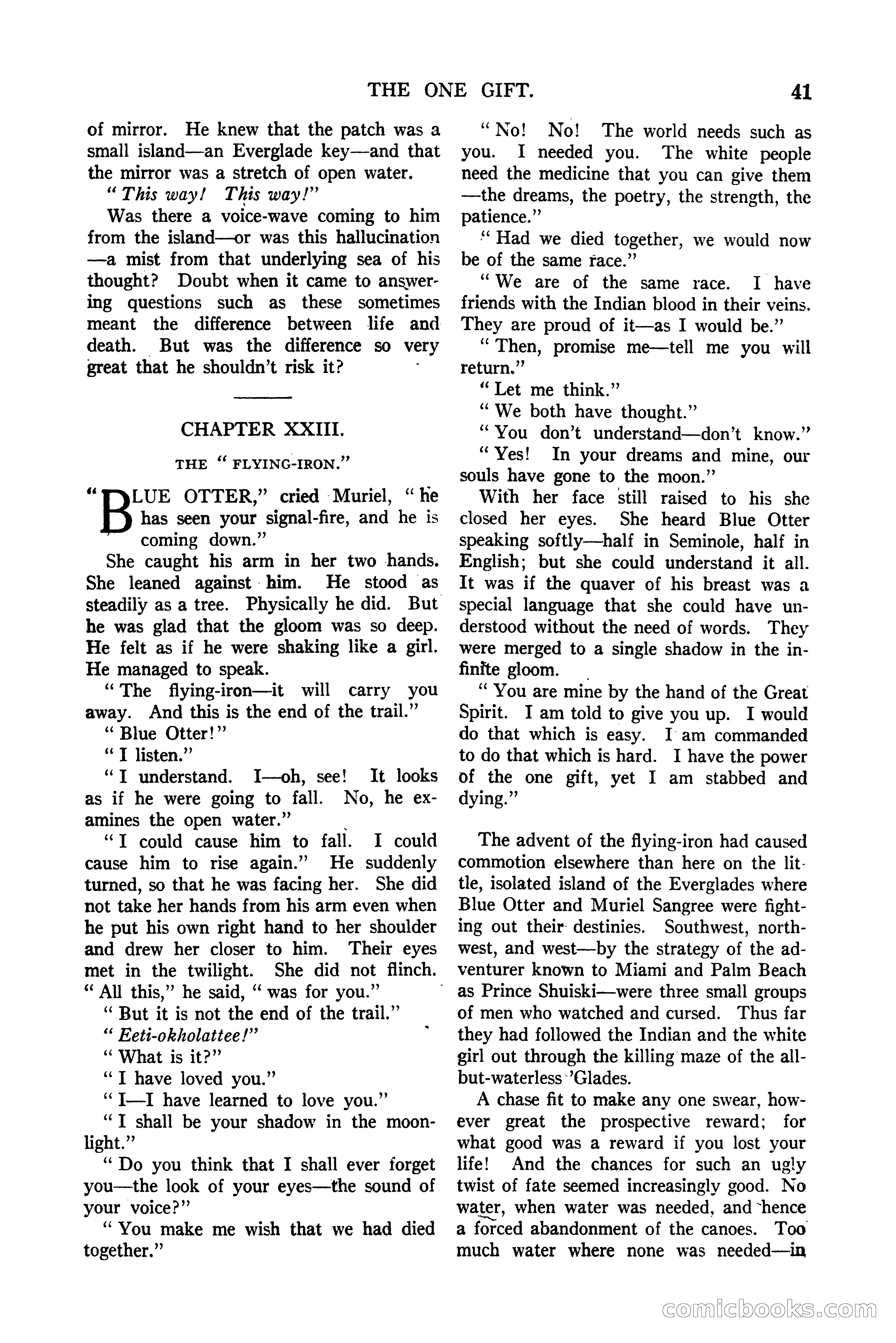
A restored page from Pulp Fiction, 1920. Page through the whole issue in the reader above.
📄 Transcribed text from this page (OCR, searchable)
Machine-transcribed from the original scan — historical spelling and the odd misread are preserved.
THE ONE GIFT. of mirror. He knew that the patch was a small island—an Everglade key—and that the mirror was a stretch of open water. “This way! This way!” Was there a voice-wave coming to him from the island—or was this hallucination —a mist from that underlying sea of his thought? Doubt when it came to answer- ing questions such as these sometimes meant the difference between life and death. But was the difference so very great that he shouldn’t risk it? CHAPTER XXIII. THE “ FLYING-IRON.”’ “FLUE OTTER,” cried Muriel, “ he B has seen your signal-fire, and he is coming down.”’ She caught his arm in her two hands. She leaned against: him. He stood as steadily as a tree. Physically he did. But he was glad that the gloom was so deep. He felt as if he were shaking like a girl. He managed to speak. “The flying-iron—it will carry you away. And this is the end of the trail.” ‘“* Blue Otter!” ‘T listen.” “IT understand. as if he were going to fall. amines the open water.” “T could cause him to fall. I could cause him to rise again.” He suddenly turned, so that he was facing her. She did not take her hands from his arm even when he put his own right hand to her shoulder and drew her closer to him. Their eyes met in the twilight. She did not flinch. ‘* All this,” he said, ‘“‘ was for you.” ‘But it is not the end of the trail.” “ Fett-okholattee!”’ “What is it?” ‘“‘T have loved you.” ‘‘J—I have learned to love you.” ‘“‘T shall be your shadow in the moon- light.” “Do you think that I shall ever forget you—the look of your eyes—the sound of your voice?”’ ‘You make me wish that we had died together.” I—oh, see! It looks No, he ex- 41 ‘No! No! The world needs such as you. I needed you. The white people need the medicine that you can give them —the dreams, the poetry, the strength, the patience.” ““ Had we died together, we would now be of the same race.” ‘““We are of the same race. I have friends with the Indian blood in their veins. They are proud of it—as I would be.” “ Then, promise me—tell me you will return.” “Let me think.” “We both have thought.” “You don’t understand—don’t know.” “Yes! In your dreams and mine, our souls have gone to the moon.” With her face still raised to his she closed her eyes. She heard Blue Otter speaking softly—half in Seminole, half in English; but she could understand it all. It was if the quaver of his breast was a special language that she could have un- derstood without the need of words. They were merged to a single shadow in the in- finite gloom. | ‘You are mine by the hand of the Great Spirit. I am told to give you up. I would do that which is easy. I am commanded to do that which is hard. I have the power of the one gift, yet I am stabbed and dying.” The advent of the flying-iron had caused commotion elsewhere than here on the lit- tle, isolated island of the Everglades where Blue Otter and Muriel Sangree were fight- ing out their destinies. Southwest, north- west, and west—by the strategy of the ad- venturer known to Miami and Palm Beach ~ aS Prince Shuiski—were three small groups of men who watched and cursed. Thus far they had followed the Indian and the white girl out through the killing maze of the all- but-waterless ’Glades. A chase fit to make any one swear, how- ever great the prospective reward; for what good was a reward if you lost your life! And the chances for such an ugly twist of fate seemed increasingly good. No water, when water was needed, and “hence a forced abandonment of the canoes. Too much water where none was needed—in cCoOmiclbooks C©