
Pulp Fiction, 1920 · page 48 of 164
All-Story Weekly, Vol. 112, No. 1 — page 48: what you’re looking at
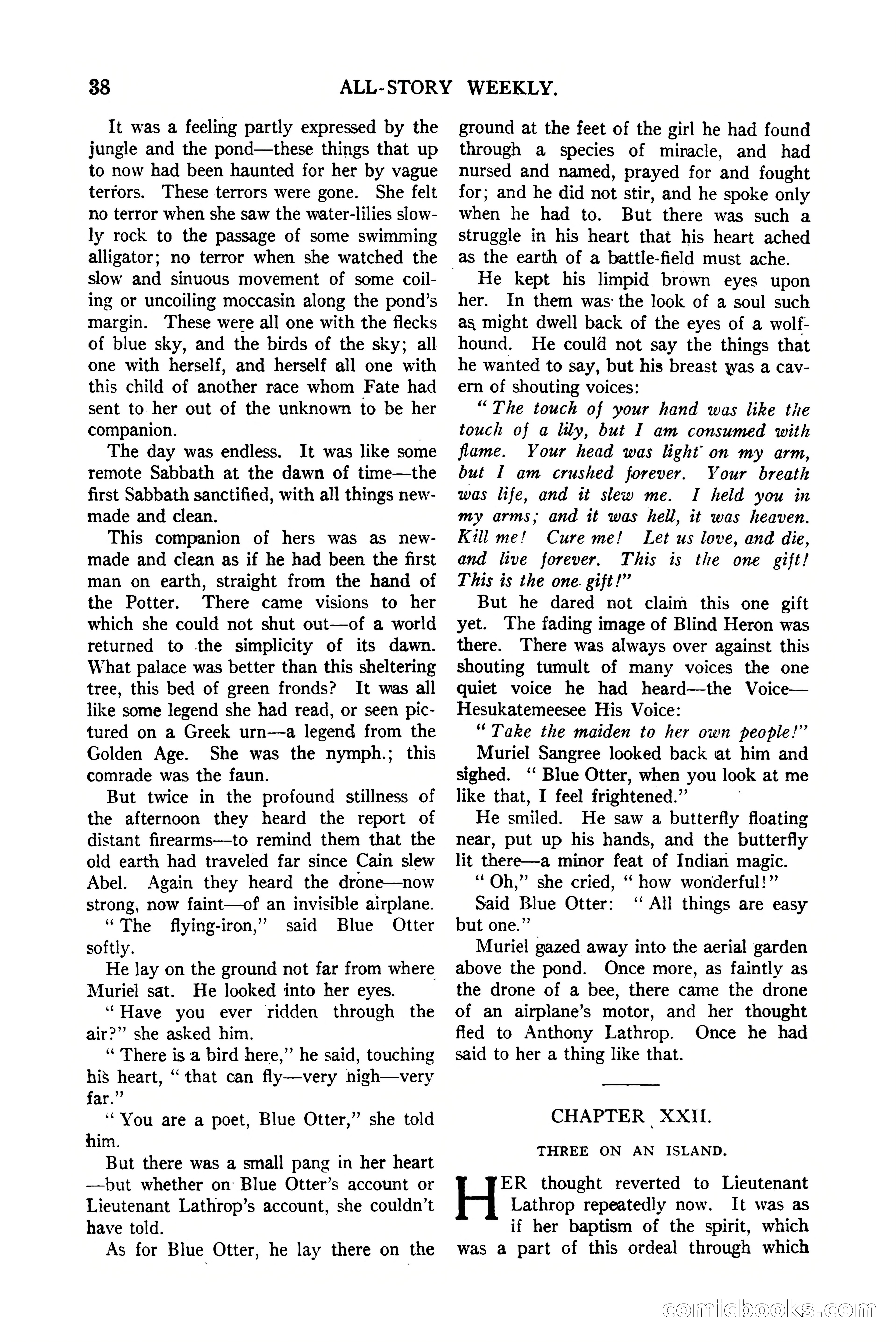
A restored page from Pulp Fiction, 1920. Page through the whole issue in the reader above.
📄 Transcribed text from this page (OCR, searchable)
Machine-transcribed from the original scan — historical spelling and the odd misread are preserved.
38 It was a feeling partly expressed by the jungle and the pond—these things that up to now had been haunted for her by vague terrors. These terrors were gone. She felt no terror when she saw the water-lilies slow- ly rock to the passage of some swimming alligator; no terror when she watched the slow and sinuous movement of some coil- ing or uncoiling moccasin along the pond’s margin. These were all one with the flecks of blue sky, and the birds of the sky; all one with herself, and herself all one with this child of another race whom Fate had sent to. her out of the unknown to be her companion. | The day was endless. It was like some remote Sabbath at the dawn of time—the first Sabbath sanctified, with all things new- made and clean. This companion of hers was as new- made and clean as if he had been the first man on earth, straight from the hand of the Potter. There came visions to her which she could not shut out—of a world returned to the simplicity of its dawn. What palace was better than this sheltering tree, this bed of green fronds? It was all like some legend she had read, or seen pic- tured on a Greek urn—a legend from the Golden Age. She was the nymph.; this comrade was the faun. But twice in the profound stillness of the afternoon they heard the report of distant firearms—to remind them that the old earth had traveled far since Cain slew Abel. Again they heard the drone—now strong, now faint—of an invisible airplane. “The flying-iron,’ said Blue Otter softly. He lay on the ground not far from where Muriel sat. He looked into her eyes. ‘““Have you ever ridden through the air?” she asked him. ‘There is a bird here,” he said, touching his heart, “‘ that can fly—very high—very far.” ‘“You are a poet, Blue Otter,” she told him. But there was a small pang in her heart —hbut whether on Blue Otter’s account or Lieutenant Lathrop’s account, she couldn’t have told. As for Blue Otter, he lay there on the ALL-STORY WEEKLY. ground at the feet of the girl he had found through a species of miracle, and had nursed and named, prayed for and fought for; and he did not stir, and he spoke only when he had to. But there was such a struggle in his heart that his heart ached as the earth of a battle-field must ache. He kept his limpid brown eyes upon her. In them was: the look of a soul such as might dwell back of the eyes of a wolf- hound. He could not say the things that he wanted to say, but his breast was a cav- ern of shouting voices: “The touch of your hand was like the touch of a lily, but I am consumed with flame. Your head was light’ on my arm, but I am crushed forever. Your breath was life, and it slew me. I held you in my arms; and it was hell, it was heaven. Kill me! Cure me! Let us love, and die, and live forever. This is the one gift! This is the one. gift!” But he dared not claim this one gift yet. The fading image of Blind Heron was there. There was always over against this shouting tumult of many voices the one quiet voice he had heard—the Voice— Hesukatemeesee His Voice: “ Take the maiden to her own people!” Muriel Sangree looked back at him and sighed. ‘‘ Blue Otter, when you look at me like that, I feel frightened. ” He smiled. He saw a butterfly floating near, put up his hands, and the butterfly lit there—a minor feat of Indian magic. “Oh,” she cried, ‘‘ how wonderful!” Said Blue Otter: ‘‘ All things are easy but one.” Muriel gazed away into the aerial garden above the pond. Once more, as faintly as the drone of a bee, there came the drone of an airplane’s motor, and her thought fled to Anthony Lathrop. Once he had said to her a thing like that. CHAPTER XXII. THREE ON AN ISLAND. ER thought reverted to Lieutenant Lathrop repeatedly now. It was as if her baptism of the spirit, which was a part of this ordeal through which COmiIclooOo SS C©