
Pulp Fiction, 1920 · page 46 of 164
All-Story Weekly, Vol. 112, No. 1 — page 46: what you’re looking at
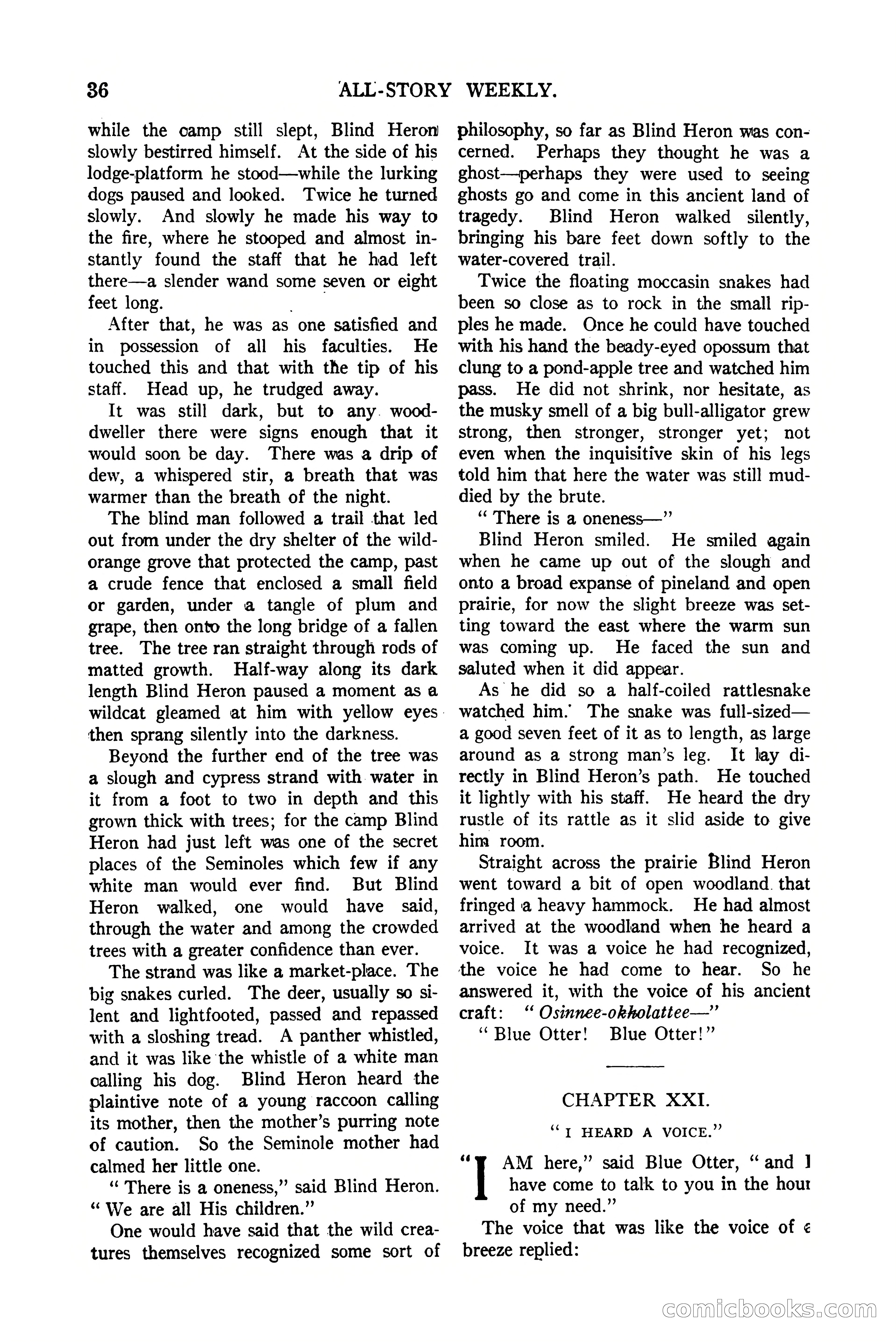
A restored page from Pulp Fiction, 1920. Page through the whole issue in the reader above.
📄 Transcribed text from this page (OCR, searchable)
Machine-transcribed from the original scan — historical spelling and the odd misread are preserved.
36 while the camp still slept, Blind Heron slowly bestirred himself. At the side of his lodge-platform he stood—while the lurking dogs paused and looked. Twice he turned slowly. And slowly he made his way to the fire, where he stooped and almost in- stantly found the staff that he had left there—a slender wand some seven or eight feet long. After that, he was as one satisfied and in possession of all his faculties. He touched this and that with the tip of his staff. Head up, he trudged away. It was still dark, but to any. wood- dweller there were signs enough that it would soon be day. There was a drip of dew, a whispered stir, a breath that was warmer than the breath of the night. The blind man followed a trail that led out from under the dry shelter of the wild- orange grove that protected the camp, past a crude fence that enclosed a small field or garden, under a tangle of plum and grape, then onto the long bridge of a fallen tree. The tree ran straight through rods of matted growth. Half-way along its dark length Blind Heron paused a moment as a wildcat gleamed at him with yellow eyes. then sprang silently into the darkness. Beyond the further end of the tree was a slough and cypress strand with water in it from a foot to two in depth and this grown thick with trees; for the camp Blind Heron had just left was one of the secret places of the Seminoles which few if any white man would ever find. But Blind Heron walked, one would have said, through the water and among the crowded trees with a greater confidence than ever. The strand was like a market-place. The big snakes curled. The deer, usually so si- lent and lightfooted, passed and repassed with a sloshing tread. A panther whistled, and it was like the whistle of a white man calling his dog. Blind Heron heard the plaintive note of a young raccoon calling its mother, then the mother’s purring note of caution. So the Seminole mother had calmed her little one. ‘“‘ There is a oneness,” said Blind Heron. ‘‘ We are all His children.” One would have said that the wild crea- tures themselves recognized some sort of the voice he had come to hear. ALL-STORY WEEKLY. philosophy, so far as Blind Heron was con- cerned. Perhaps they thought he was a ghost—perhaps they were used to seeing ghosts go and come in this ancient land of tragedy. Blind Heron walked silently, bringing his bare feet down softly to the water-covered trail. Twice the floating moccasin snakes had been so close as to rock in the small rip- ples he made. Once he could have touched with his hand the beady-eyed opossum that clung to a pond-apple tree and watched him pass. He did not shrink, nor hesitate, as the musky smell of a big bull-alligator grew strong, then stronger, stronger yet; not even when the inquisitive skin of his legs told him that here the water was still mud- died by the brute. ‘““ There is a oneness—”’ Blind Heron smiled. He smiled again when he came up out of the slough and onto a broad expanse of pineland and open prairie, for now the slight breeze was set- ting toward the east where the warm sun was coming up. He faced the sun and saluted when it did appear. As he did so a half-coiled rattlesnake watched him. The snake was full-sized— a good seven feet of it as to length, as large around as a strong man’s leg. It lay di- rectly in Blind Heron’s path. He touched it lightly with his staff. He heard the dry rustle of its rattle as it slid aside to give him room. Straight across the prairie Blind Heron went toward a bit of open woodland. that fringed a heavy hammock. He had almost arrived at the woodland when he heard a voice. It was a voice he had recognized, So he answered it, with the voice of his ancient craft: ‘ Osinnee-okholatiee—”’ ‘Blue Otter! Blue Otter!” CHAPTER XXII. ‘““Y HEARD A VOICE.” ‘“‘y AM here,” said Blue Otter, “ and ] have come to talk to you in the hour of my need.” The voice that was like the voice of ¢ breeze replied: CO DOOK nn C©