
Pulp Fiction, 1920 · page 41 of 164
All-Story Weekly, Vol. 112, No. 1 — page 41: what you’re looking at
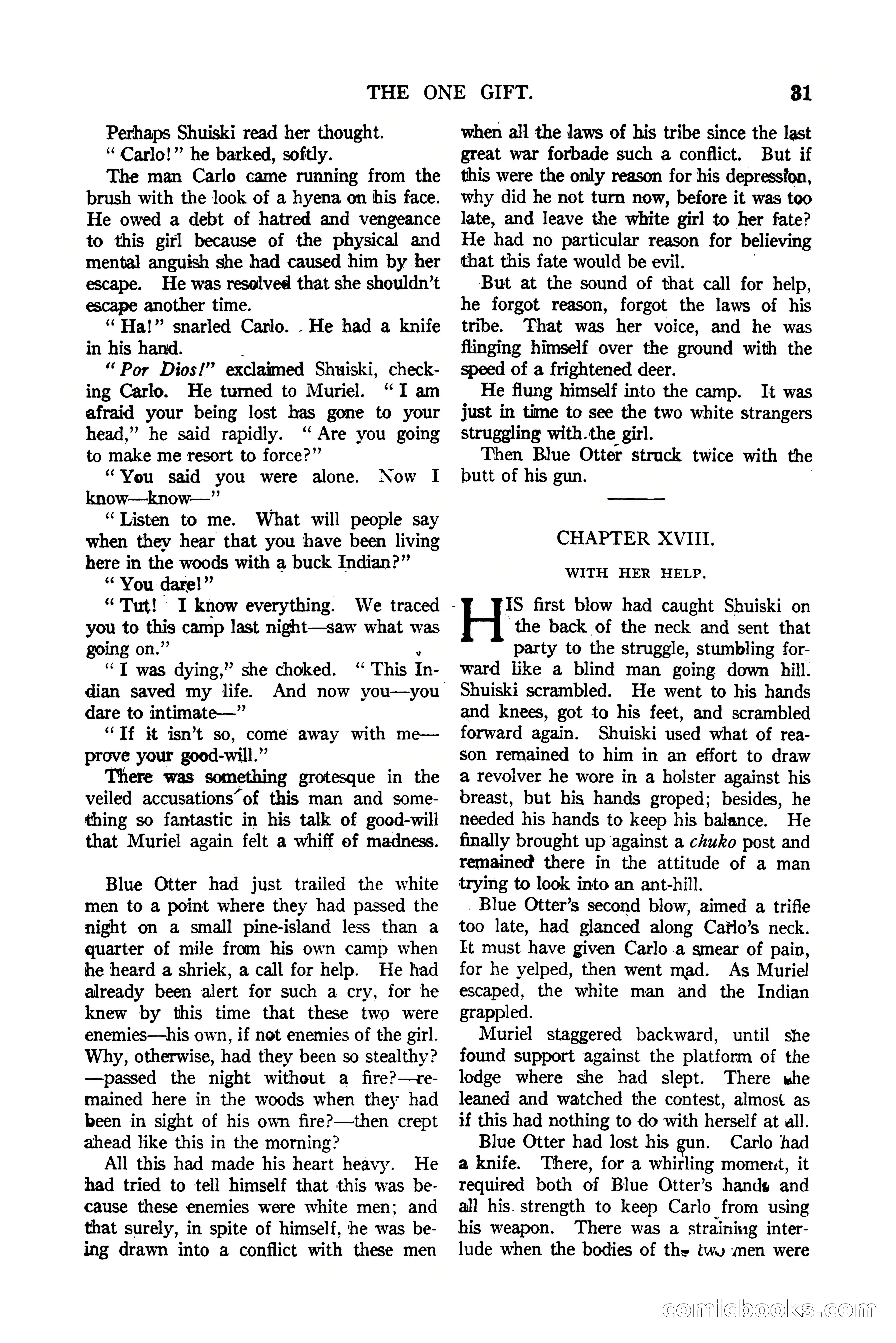
A restored page from Pulp Fiction, 1920. Page through the whole issue in the reader above.
📄 Transcribed text from this page (OCR, searchable)
Machine-transcribed from the original scan — historical spelling and the odd misread are preserved.
THE ONE GIFT. Perhaps Shuiski read her thought. “ Carlo!” he barked, softly. The man Carlo came running from the brush with the look of a hyena on his face. He owed a debt of hatred and vengeance to this girl because of the physical and mental anguish she had caused him by her escape. He was resolved that she shouldn’t escape another time. “Ha!” snarled Carlo. -He had a knife in his hand. _ “Por Dios!” exclaimed Shuiski, check- ing Carlo. He turned to Muriel. “I am afraid your being lost has gone to your head,” he said rapidly. ‘‘ Are you going to make me resort to force?”’ “You said you were alone. know—know—”’ “Listen to me. What will people say when they hear that you have been living here in the woods with a buck Indian?”’ “ You dare!” Now I “ Tut! I know everything. We traced - you to this camp last night—saw what was going on.” ‘“T was dying,” she choked. dian saved my life. dare to intimate—” “If it isn’t so, come away with me— prove your good-will.” There was something grotesque in the veiled accusations’ of this man and some- thing so fantastic in his talk of good-will that Muriel again felt a whiff of madness. “ This In- Blue Otter had just trailed the white men to a point where they had passed the night on a small pime-island less than a quarter of mile from his own camp when he heard a shriek, a call for help. He had already been alert for such a cry, for he knew by this time that these two were enemies—his own, if not enemies of the girl. Why, otherwise, had they been so stealthy? —passed the night without a fire?—+e- mained here in the woods when they had been in sight of his own fireP?—then crept ahead hke this in the morning? All this had made his heart heavy. He had tried to tell himself that this was be- cause these enemies were white men; and that surely, in spite of himself, he was be- ing drawn into a conflict with these men And now you—you 31 when all the laws of his tribe since the last great war forbade such a conflict. But if this were the only reason for his depression, why did he not turn now, before it was too late, and leave the white girl to her fate? He had no particular reason for believing that this fate would be evil. . But at the sound of that call for help, he forgot reason, forgot the laws of his tribe. That was her voice, and he was flinging himself over the ground with the speed of a frightened deer. He flung himself into the camp. It was just in time to see the two white strangers struggling with.the girl. Then Blue Otter struck twice with the butt of his gun. | ed CHAPTER XVIII. WITH HER HELP. IS first blow had caught Shuiski on "the back of the neck and sent that party to the struggle, stumbling for- ward like a blind man going down hill. Shuiski scrambled. He went to his hands and knees, got to his feet, and scrambled forward again. Shuiski used what of rea- son remained to him in an effort to draw a revoiver he wore in a holster against his breast, but his hands groped; besides, he needed his hands to keep his balance. He finally brought up ‘against a chuko post and remained there in the attitude of a man trying to look into an ant-hill. . Blue Otter’s second blow, aimed a trifle too late, had glanced along CatHo’s neck. It must have given Carlo.a smear of pain, for he yelped, then went mad. As Muriel escaped, the white man and the Indian grappled. Muriel staggered backward, until she found support against the platform of the lodge where she had slept. There she leaned and watched the contest, almost as if this had nothing to do with herself at all. Blue Otter had lost his gun. Carlo had a knife. There, for a whirling moment, it required both of Blue Otter’s hands and all his. strength to keep Carlo from using his weapon. There was a straining inter- lude when the bodies of the tww men were cCoOmiclbooks C©