
Pulp Fiction, 1920 · page 38 of 164
All-Story Weekly, Vol. 112, No. 1 — page 38: what you’re looking at
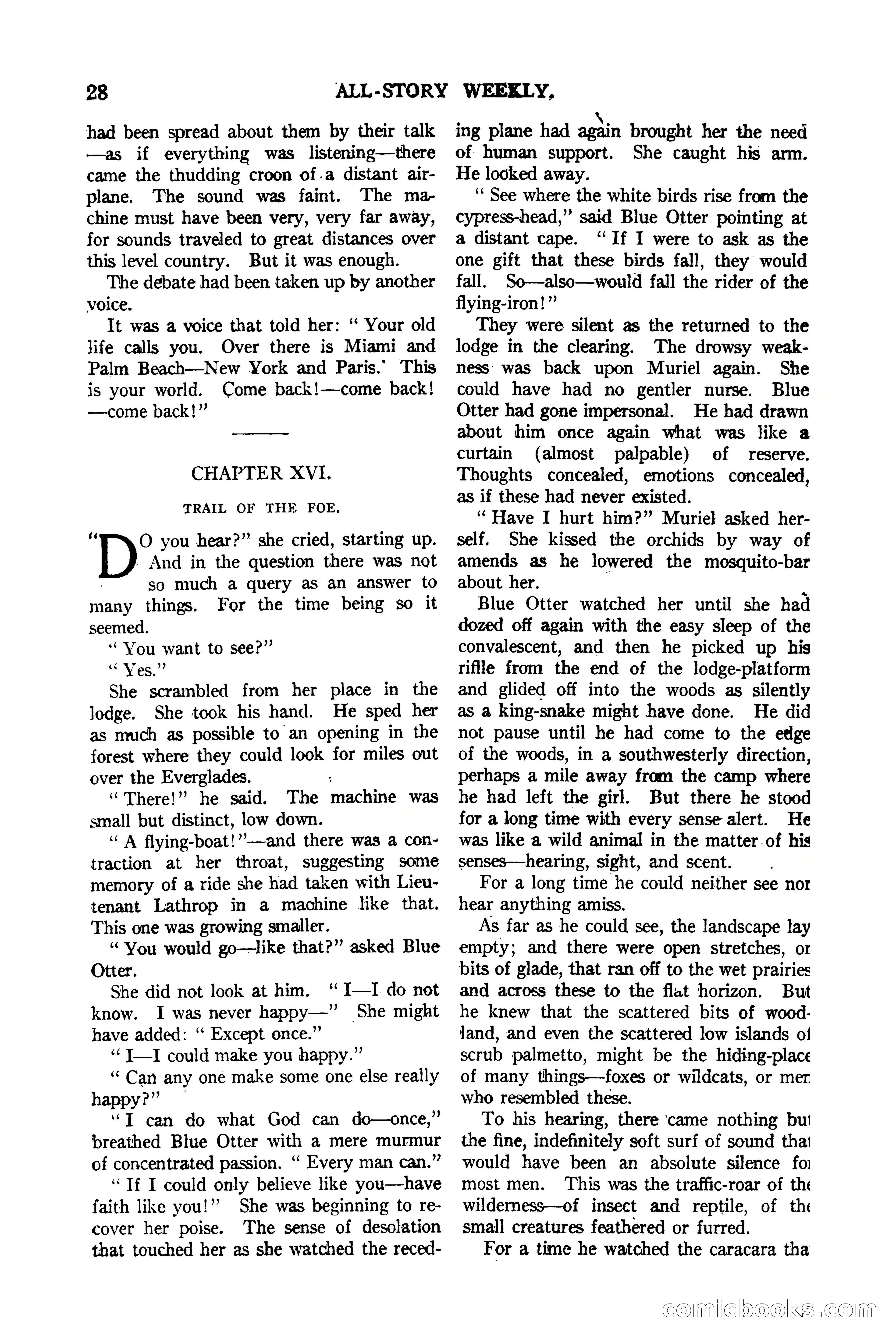
A restored page from Pulp Fiction, 1920. Page through the whole issue in the reader above.
📄 Transcribed text from this page (OCR, searchable)
Machine-transcribed from the original scan — historical spelling and the odd misread are preserved.
28 had been spread about them by their talk —as if everything was listening—there came the thudding croon of.a distant air- plane. The sound was faint. The ma- chine must have been very, very far away, for sounds traveled to great distances over this level country. But it was enough. The debate had been taken up by another voice. It was a voice that told her: “ Your old life calls you. Over there is Miami and Palm Beach—New York and Paris." This is your world. Come back!—come back! —come back!” ———————— CHAPTER XVI. TRAIL OF THE FOE. O you hear?” she cried, starting up. ' And in the question there was not so much a query as an answer to many things. For the time being so it seemed. ‘You want to see?”’ “Yes.” She scrambled from her place in the lodge. She took his hand. He sped her as mich as possible to an opening in the forest where they could look for miles out over the Everglades. “There!” he said. The imachiné was small but distinct, low down. “A flying-boat!’’—and there was a con- traction at her throat, suggesting some memory of a ride she had taken with Lieu- tenant Lathrop in a maohine like that. This one was growing smaller. | “Vou would go—like that?” asked Blue Otter. She did not look at him. ‘ I—I do not know. I was never happy—” She might have added: ‘‘ Except once.” ‘“‘ TT could make you happy.” ‘Can any one make some one else really happy?” “T can do what God can do—once,” breathed Blue Otter with a mere murmur of concentrated passion. “‘ Every man can.” “Tf I could only believe like you—have faith like you!’’ She was beginning to re- cover her poise. The sense of desolation that touched her as she watched the reced- ALL-STORY WEEKLY, ing plane had again brought her the need of human support. She caught his arm. He looked away. ‘“ See where the white birds rise from the cypress-head,” said Blue Otter pointing at a distant cape. ‘If I were to ask as the one gift that these birds fall, they would fall. So—also—would fall the rider of the flying-iron!” They were silent as the returned to the lodge in the clearing. The drowsy weak- ness’ was back upon Muriel again. She could have had no gentler nurse. Blue Otter had gone impersonal. He had drawn about him once again what was like a curtain (almost palpable) of reserve. Thoughts concealed, emotions concealed, as if these had never existed. ‘“ Have I hurt him?” Muriel asked her- self. She kissed the orchids by way of amends as he lowered the mosquito-bar about her. . Blue Otter watched her until she had dozed off again with the easy sleep of the convalescent, and then he picked up his rifile from the end of the lodge-platform and glided off into the woods as silently as a king-snake might have done. He did not pause until he had come to the edge of the woods, in a southwesterly direction, perhaps a mile away from the camp where he had left the girl. But there he stood for a long time with every sense alert. He was like a wild animal in the matter of his senses—hearing, sight, and scent. For a long time he could neither see nor hear anything amiss. As far as he could see, the landscape lay empty; and there were open stretches, or bits of glade, that ran off to the wet prairies and across these to the flat horizon. But he knew that the scattered bits of wood- Jand, and even the scattered low islands ot scrub palmetto, might be the hiding-place of many things—foxes or wildcats, or mer who resembled these. To his hearing, there ‘came nothing but the fine, indefinitely soft surf of sound that would have been an absolute silence fo. most men. This was the traffic-roar of the wilderness—of insect and reptile, of the small creatures feathered or furred. For a time he watched the caracara tha COMICOooe SS C©