
Pulp Fiction, 1920 · page 24 of 164
All-Story Weekly, Vol. 112, No. 1 — page 24: what you’re looking at
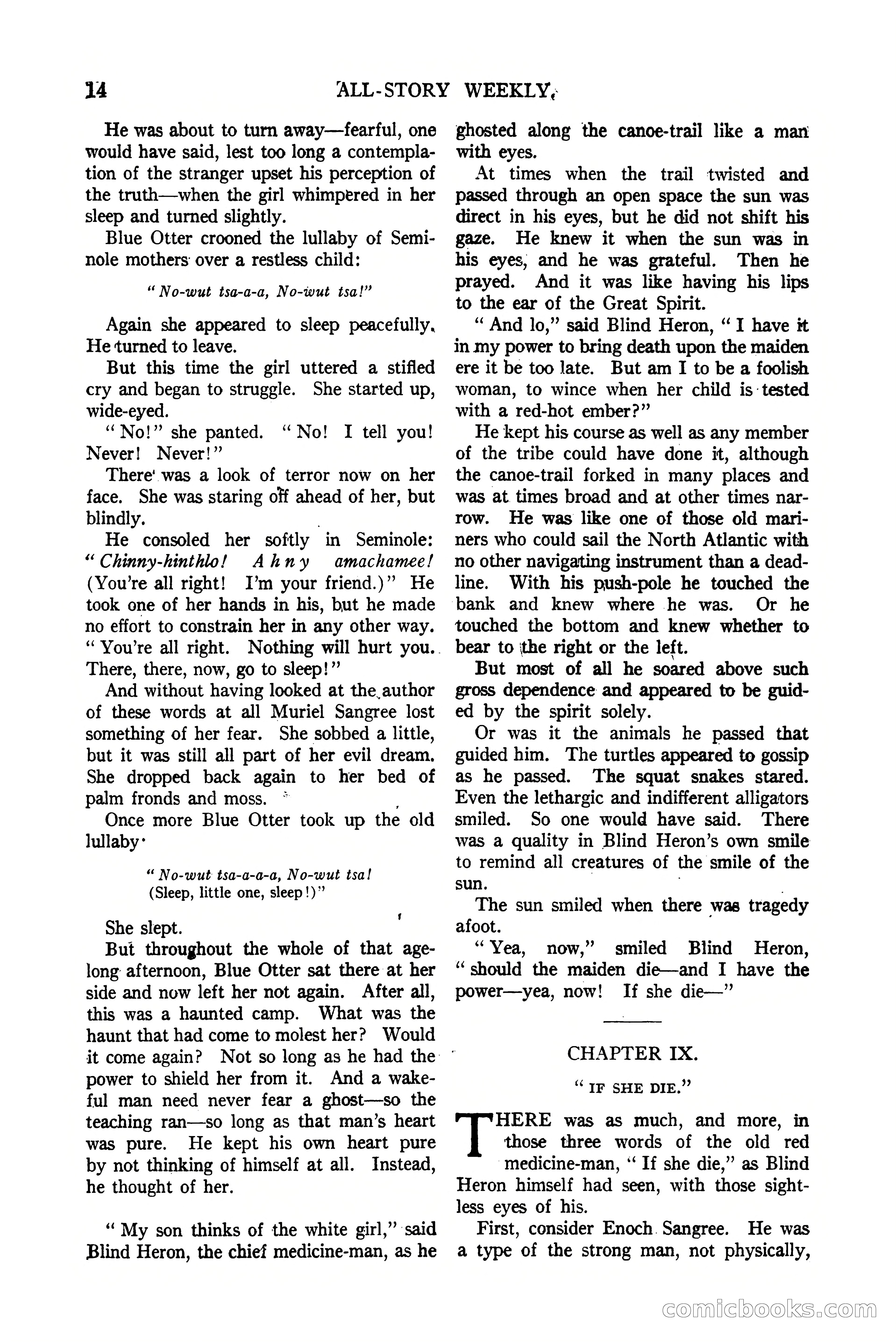
A restored page from Pulp Fiction, 1920. Page through the whole issue in the reader above.
📄 Transcribed text from this page (OCR, searchable)
Machine-transcribed from the original scan — historical spelling and the odd misread are preserved.
14 He was about to turn away—fearful, one would have said, lest too long a contempla- tion of the stranger upset his perception of the truth—when the girl whimpered in her sleep and turned slightly. Blue Otter crooned the lullaby of Semi- nole mothers over a restless child: “ No-wut tsa-a-a, No-wut tsa!” Again she appeared to sleep peacefully, He turned to leave. But this time the girl uttered a stifled cry and began to struggle. She started up, wide-eyed. | “No!” she panted. Never! Never!” There' was a look of terror now on her face. She was staring off ahead of her, but blindly. . He consoled her softly in Seminole: “Chinny-hinthlo! Ahny amachamee! (You're all right! I’m your friend.)” He took one of her hands in his, but he made no effort to constrain her in any other way. “Youre all right. There, there, now, go to sleep!”’ And without having looked at the,author of these words at all Muriel Sangree lost something of her fear. She sobbed a little, but it was still all part of her evil dream. She dropped back again to her bed of palm fronds and moss. * . Once more Blue Otter took up the old lullaby° “No! I tell you! “ No-wut tsa-a-a-a, No-wut tsa! (Sleep, little one, sleep!)” ‘ She slept. But throughout the whole of that age- long afternoon, Blue Otter sat there at her side and now left her not again. After all, this was a haunted camp. What was the haunt that had come to molest her? Would it come again? Not so long as he had the ~ power to shield her from it. And a wake- ful man need never fear a ghost—so the teaching ran—so long as that man’s heart was pure. He kept his own heart pure by not thinking of himself at all. Instead, he thought of her. “My son thinks of the white girl,” said Blind Heron, the chief medicine-man, as he Nothing will hurt you.. ALL-STORY WEEKLY, ghosted along the canoe-trail like a man with eyes. At times when the trail twisted and passed through an open space the sun was direct in his eyes, but he did not shift his gaze. He knew it when the sun was in his eyes, and he was grateful. Then he prayed. And it was like having his lips to the ear of the Great Spirit. ‘“ And lo,” said Blind Heron, “I have it In my power to bring death upon the maiden ere it be too late. But am I to be a foolish woman, to wince when her child is tested with a red-hot ember?” He kept his course as well as any member of the tribe could have done it, although the canoe-trail forked in many places and was at. times broad and at other times nar- row. He was like one of those old mari- ners who could sail the North Atlantic with no other navigating instrument than a dead- line. With his push-pole he touched the ‘bank and knew where he was. Or he touched the bottom and knew whether to bear to ‘the right or the left. But most of all he soared above such gross dependence and appeared to be guid- ed by the spirit solely. Or was it the animals he passed that guided him. The turtles appeared to gossip as he passed. The squat snakes stared. Even the lethargic and indifferent alligators smiled. So one would have said. There was a quality in Blind Heron’s own smile to remind all creatures of the smile of the sun. The sun smiled when there was tragedy afoot. “Yea, now smiled Blind Heron, ‘should the maiden die—and I have the power—yea, now! If she die—” bP] 3 CHAPTER IX. ‘CIF SHE DIE.” HERE was as much, and more, in those three words of the old red -mMedicine-man, ‘‘ If she die,” as Blind Heron himself had seen, with those sight- less eyes of his. First, consider Enoch. Sangree. He was a type of the strong man, not physically, COmiIclooOo SS C©