
Pulp Fiction, 1920 · page 135 of 164
All-Story Weekly, Vol. 112, No. 1 — page 135: what you’re looking at
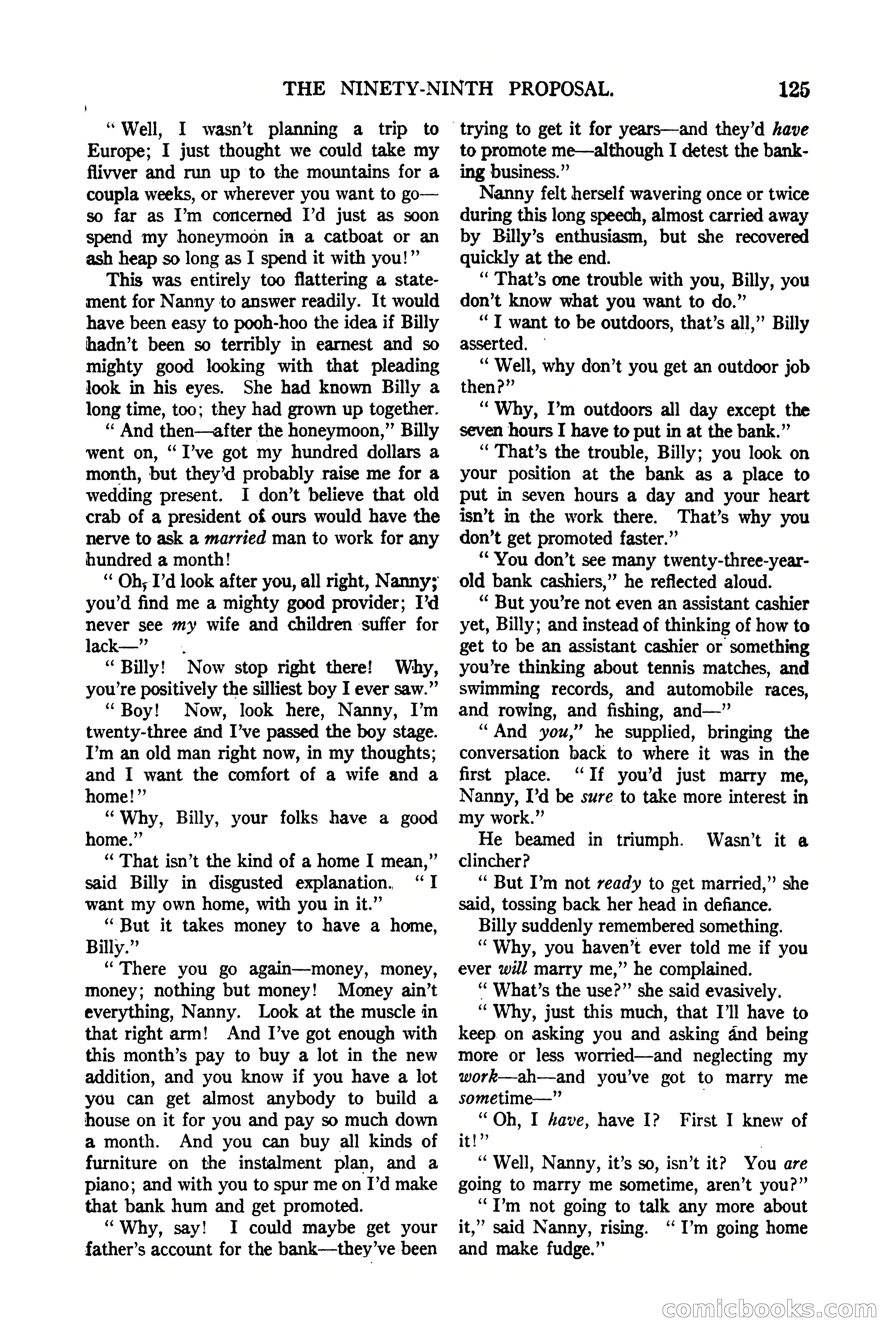
A restored page from Pulp Fiction, 1920. Page through the whole issue in the reader above.
📄 Transcribed text from this page (OCR, searchable)
Machine-transcribed from the original scan — historical spelling and the odd misread are preserved.
THE NINETY-NINTH PROPOSAL. ) “Well, I wasn’t planning a trip to Europe; I just thought we could take my flivver and run up to the mountains for a coupla weeks, or wherever you want to go— so far as I’m concerned I’d just as soon spend my honeymoon in a catboat or an ash heap so long as I spend it with you!” This was entirely too flattering a state- ment for Nanny to answer readily. It would have been easy to pooh-hoo the idea if Billy hadn’t been so terribly in earnest and so mighty good looking with that pleading look in his eyes. She had known Billy a long time, too; they had grown up together. “‘ And then—after the honeymoon,” Billy went on, “I’ve got my hundred dollars a month, but they’d probably raise me for a wedding present. I don’t believe that old crab of a president of ours would have the nerve to ask a married man to work for any hundred a month! “ Oh; I’d look after you, all right, Nanny; you’d find me a mighty good provider; I’d never see my wife and children suffer for lack—” ., “ Billy!’ Now stop right there! Why, youre positively the silliest boy I ever saw.” ‘Boy! Now, look here, Nanny, I’m twenty-three and I’ve passed the boy stage. I’m an old man right now, in my thoughts; and I want the comfort of a wife and a home!”’ “Why, Billy, your folks have a good home.”’ “That isn’t the kind of a home I mean,” said Billy in disgusted explanation. “TI want my own home, with you in it.” “But it takes money to have a home, Billy.” “There you go again—money, money, money; nothing but money! Money ain’t everything, Nanny. Look at the muscle in that right arm! And I’ve got enough with this month’s pay to buy a lot in the new addition, and you know if you have a lot you can get almost anybody to build a house on it for you and pay so much down a month. And you can buy all kinds of furniture on the instalment plan, and a piano; and with you to spur me on I’d make that bank hum and get promoted. “Why, say! I could maybe get your father’s account for the bank—they’ve been 125 trying to get it for years—and they’d have to promote me—although I detest the bank- ing business.” Nanny felt herself wavering once or twice during this long speech, almost carried away by Billy’s enthusiasm, but she recovered quickly at the end. ‘““That’s one trouble with you, Billy, you don’t know what you want to do.” “‘T want to be outdoors, that’s all,” Billy asserted. — “Well, why don’t you get an outdoor job then?” ‘Why, I’m outdoors all day except the seven hours I have to put in at the bank.” ‘“ That’s the trouble, Billy; you look on your position at the bank as a place to put in seven hours a day and your heart isn’t in the work there. That’s why you don’t get promoted faster.” “You don’t see many twenty-three-year- old bank cashiers,’’ he reflected aloud. “‘ But you're not even an assistant cashier yet, Billy; and instead of thinking of how to get to be an assistant cashier or something you're thinking about tennis matches, and swimming records, and automobile races, and rowing, and fishing, and—” “And you,” he supplied, bringing the conversation back to where it was in the first place. “If you’d just marry me, Nanny, I’d be sure to take more interest in my work.” He beamed in triumph. clincher? “But I’m not ready to get married,” she said, tossing back her head in defiance. Billy suddenly remembered something. “Why, you haven’t ever told me if you ever will marry me,” he complained. ‘‘ What’s the use?” she said evasively. ‘Why, just this much, that I’ll have to keep. on asking you and asking dnd being more or less worried—and neglecting my work—ah—and you’ve got to marry me sometime—” . “Oh, I have, have I? it!” | ‘Well, Nanny, it’s so, isn’t it? You are going to marry me sometime, aren’t you?” “Tm not going to talk any more about it,’ said Nanny, rising. “I’m going home and make fudge.”’ Wasn’t it a First I knew of comiclboolk C©