
Pulp Fiction, 1920 · page 125 of 164
All-Story Weekly, Vol. 112, No. 1 — page 125: what you’re looking at
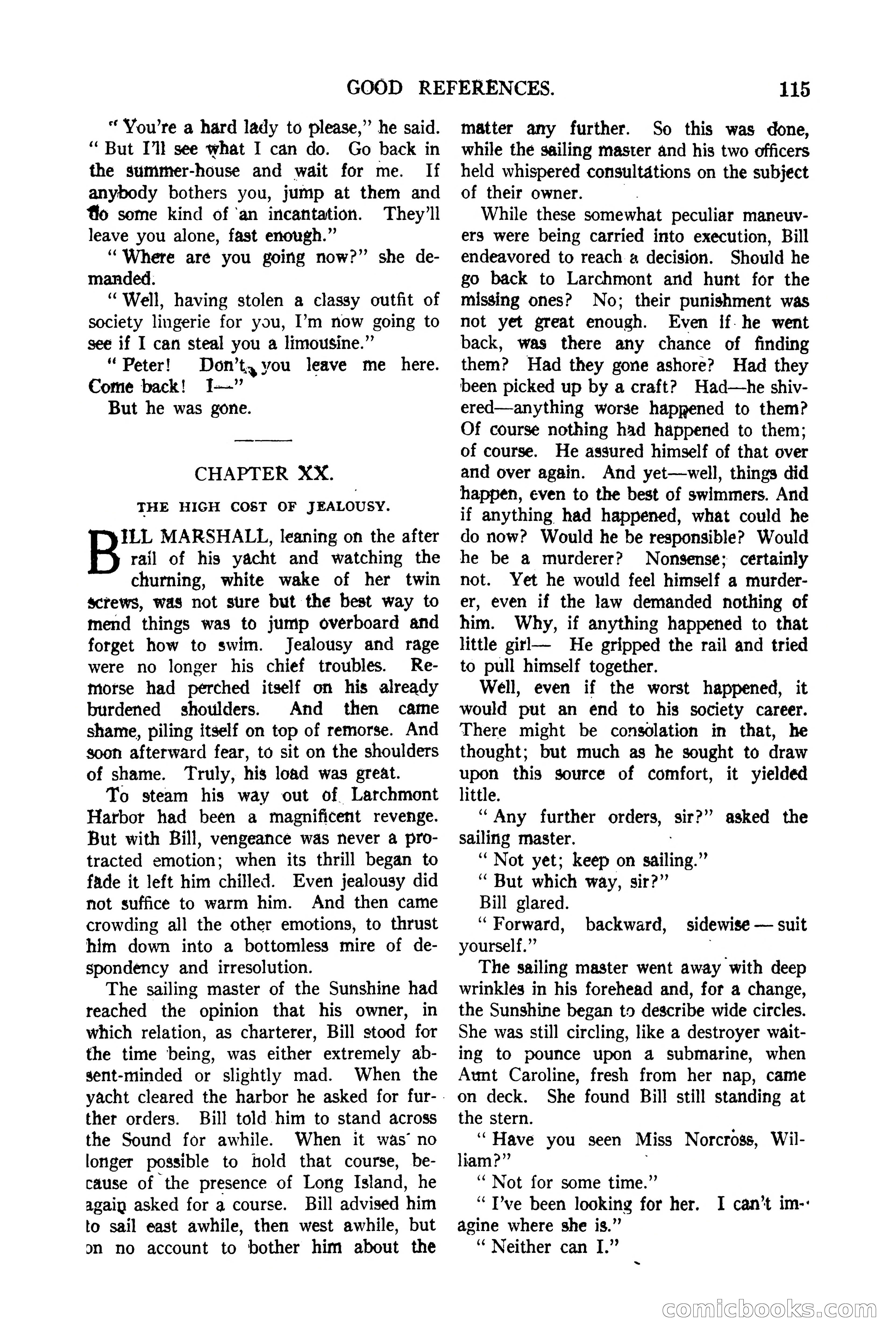
A restored page from Pulp Fiction, 1920. Page through the whole issue in the reader above.
📄 Transcribed text from this page (OCR, searchable)
Machine-transcribed from the original scan — historical spelling and the odd misread are preserved.
GOOD REFERENCES. Vou’re a hard lady to please,” he said. “ But Ill see what I can do. Go back in the summer-house and wait for me. If anybody bothers you, jump at them and flo some kind of ‘an incantation. They’ll leave you alone, fast enough.” ‘Where are you going now?” she de- manded. ‘Well, having stolen a classy outfit of society lingerie for you, I’m now going to see if I can steal you a limousine.” “Peter! Don’t,you leave me here. Come back! I~” But he was gone. ee ee CHAPTER XX. THE HIGH COST OF JEALOUSY. ILL MARSHALL, leaning on the after rail of his yacht and watching the churning, white wake of her twin screws, was not sure but the best way to mend things was to jump overboard and forget how to swim. Jealousy and rage were no longer his chief troubles. Re- morse had perched itself on his already burdened shoulders. And then came shame, piling itself on top of remorse. And soon afterward fear, to sit on the shoulders of shame. Truly, his load was great. To steam his way out of Larchmont Harbor had been a magnificent revenge. But with Bill, vengeance was never a pro- tracted emotion; when its thrill began to fade it left him chilled. Even jealousy did not suffice to warm him. And then came crowding all the other emotions, to thrust him down into a bottomless mire of de- Spondency and irresolution. The sailing master of the Sunshine had reached the opinion that his owner, in which relation, as charterer, Bill stood for the time being, was either extremely ab- gent-minded or slightly mad. When the yacht cleared the harbor he asked for fur- - ther orders. Bill told him to stand across the Sound for awhile. When it was’ no longer possible to hold that course, be- cause of the presence of Long Island, he again asked for a course. Bill advised him to sail east awhile, then west awhile, but on no account to bother him about the 115 matter any further. So this was done, while the sailing master and his two officers held whispered consultations on the subject of their owner. While these somewhat peculiar maneuv- ers were being carried into execution, Bill endeavored to reach a decision. Should he go back to Larchmont and hunt for the missing ones? No; their punishment was not yet great enough. Even if. he went back, was there any chance of finding them? Had they gone ashore? Had they been picked up by a craft? Had—he shiv- ered—anything worse happened to them? Of course nothing had happened to them; of course. He assured himself of that over and over again. And yet—well, things did happen, even to the best of swimmers. And if anything had happened, what could he do now? Would he be responsible? Would he be a murderer? Nonsense; certainly not. Yet he would feel himself a murder- er, even if the law demanded nothing of him. Why, if anything happened to that little girl— He gripped the rail and tried to pull himself together. Well, even if the worst happened, it would put an end to his society career. There might be consolation in that, he thought; but much as he sought to draw upon this source of comfort, it yielded little. ‘““Any further orders, sir?” asked the Sailing master. “é Not yet; keep on sailing.” “ But which way, sir?” Bill glared. ‘Forward, backward, yourself.” The sailing master went away with deep wrinkles in his forehead and, for a change, the Sunshine began to describe wide circles. She was still circling, like a destroyer wait- ing to pounce upon a submarine, when Aunt Caroline, fresh from her nap, came on deck. She found Bill still standing at the stern. ‘““Have you seen Miss Norcross, Wil- liam?” ‘““Not for some time.” sidewise — suit ‘““T’ve been looking for her. I can’t im-: agine where she is.” ‘“‘ Neither can J.” Conniclooolks.conn