
Pulp Fiction, 1920 · page 104 of 164
All-Story Weekly, Vol. 112, No. 1 — page 104: what you’re looking at
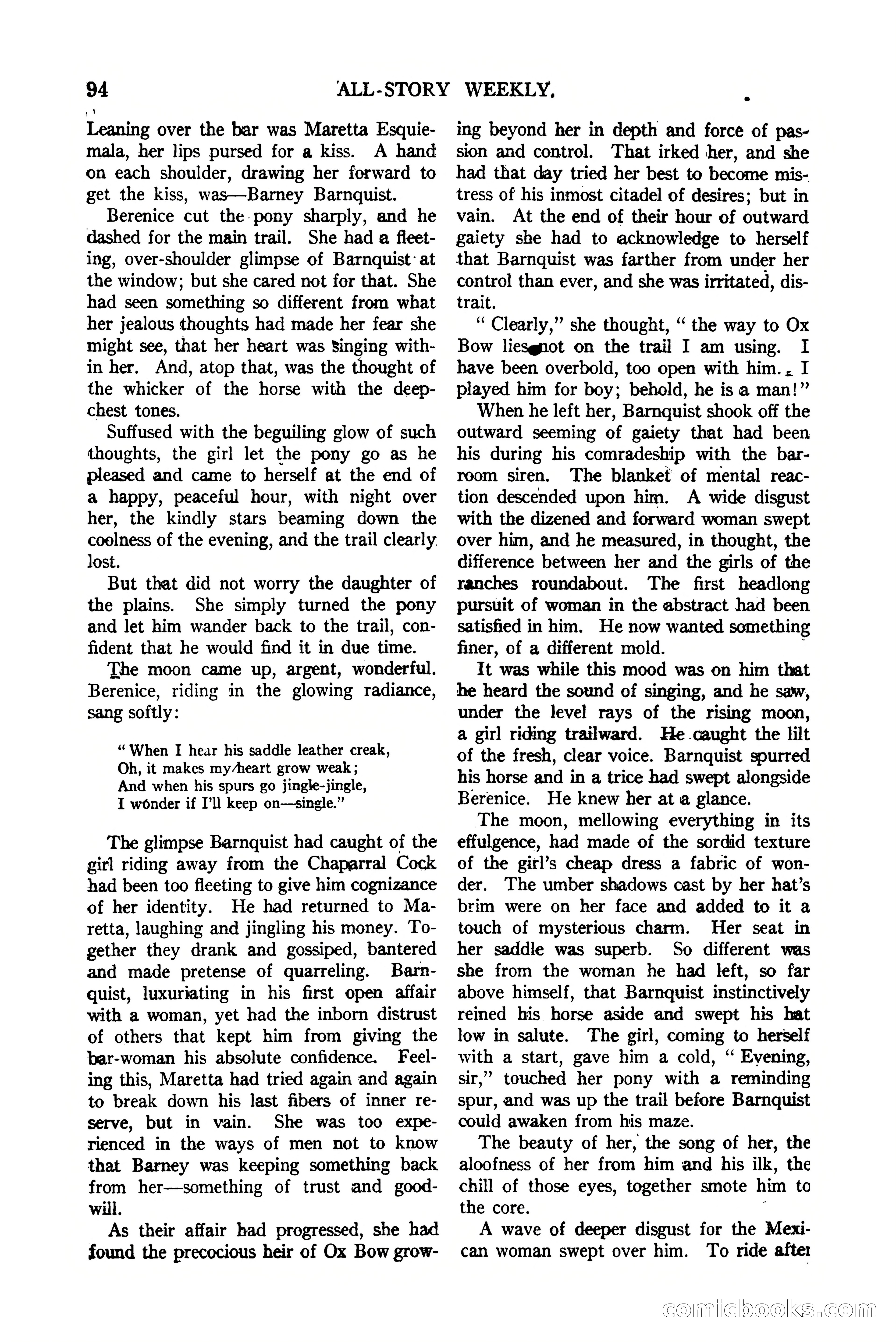
A restored page from Pulp Fiction, 1920. Page through the whole issue in the reader above.
📄 Transcribed text from this page (OCR, searchable)
Machine-transcribed from the original scan — historical spelling and the odd misread are preserved.
94 Leaning over the bar was Maretta Esquie- mala, her lips pursed for a kiss. A hand on each shoulder, drawing her forward to get the kiss, was—Barney Barnquist. Berenice cut the-pony sharply, and he dashed for the main trail. She had a fleet- ing, over-shoulder glimpse of Barnquist: at the window; but she cared not for that. She had seen something so different from what her jealous thoughts had made her fear she might see, that her heart was Singing with- in her. And, atop that, was the thought of the whicker of the horse with the deep- chest tones. Suffused with the beguiling glow of such thoughts, the girl let the pony go as he pleased and came to herself at the end of a happy, peaceful hour, with night over her, the kindly stars beaming down the coolness of the evening, and the trail clearly lost. But that did not worry the daughter of the plains. She simply turned the pony and let him wander back to the trail, con- fident that he would find it in due time. The moon came up, argent, wonderful. Berenice, riding in the glowing radiance, sang softly: ‘““When I hear his saddle leather creak, Oh, it makes my/heart grow weak ; And when his spurs go jingle-jingle, I wonder if I'll keep on—-single.”’ The glimpse Barnquist had caught of the girl riding away from the Chaparral Cock had been too fleeting to give him cognizance of her identity. He had returned to Ma- retta, laughing and jingling his money. To- gether they drank and gossiped, bantered and made pretense of quarreling. Barn- quist, luxuriating in his first open affair with a woman, yet had the inborn distrust of others that kept him from giving the bar-woman his absolute confidence. Feel- ing this, Maretta had tried again and again to break down his last fibers of inner re- serve, but in vain. She was too expe- rienced in the ways of men not to know that Barney was keeping something back from her—something of trust and good- will. As their affair had progressed, she had found the precocious heir of Ox Bow grow- ALL-STORY WEEKLY. ing beyond her in depth and force of pas- sion and control. That irked her, and she had that day tried her best to become mis- tress of his inmost citadel of desires; but in vain. At the end of their hour of outward gaiety she had to acknowledge to herself that Barnquist was farther from under her control than ever, and she was irritated, dis- trait. ‘“ Clearly,” she thought, ‘‘ the way to Ox Bow liesgnot on the trail I am using. I have been overbold, too open with him. . I played him for boy; behold, he is a man!” When he left her, Barnquist shook off the outward seeming of gaiety that had been his during his comradeship with the bar- room siren. The blanket of mental reac- tion descended upon him. A wide disgust with the dizened and forward woman swept over him, and he measured, in thought, the difference between her and the girls of the ranches roundabout. The first headlong pursuit of woman in the abstract had been satisfied in him. He now wanted something finer, of a different mold. It was while this mood was on him that he heard the sound of singing, and he saw, under the level rays of the rising moon, a girl riding trailward. He caught the lilt of the fresh, clear voice. Barnquist spurred his horse and in a trice had swept alongside Berenice. He knew her at a glance. The moon, mellowing everything in its effulgence, had made of the sordid texture of the girl’s cheap dress a fabric of won- der. The umber shadows cast by her hat’s brim were on her face and added to it a touch of mysterious charm. Her seat in her saddle was superb. So different was she from the woman he had left, so far above himself, that Barnquist instinctively reined his horse aside and swept his hat low in salute. The girl, coming to herself with a start, gave him a cold, ‘‘ Evening, sir,’ touched her pony with a reminding spur, and was up the trail before Barnquist could awaken from his maze. The beauty of her, the song of her, the aloofness of her from him and his ilk, the chill of those eyes, together smote him to the core. ; A wave of deeper disgust for the Mexi- can woman swept over him. To ride after COmiIclooOo SS C©