
Pulp Fiction, 1949 · page 98 of 132
All-Story Detective, October 1949 — page 98: what you’re looking at
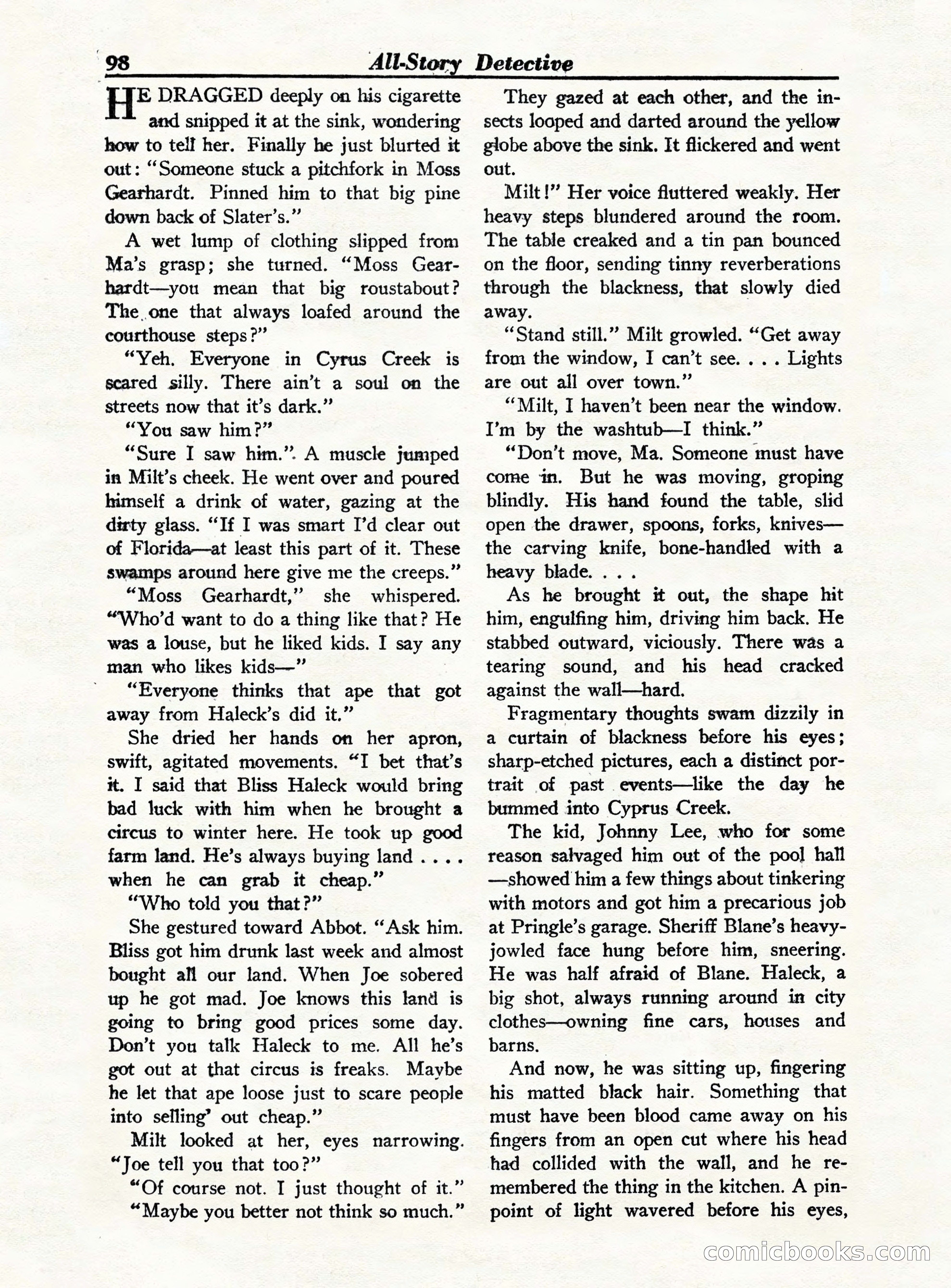
A restored page from Pulp Fiction, 1949. Page through the whole issue in the reader above.
📄 Transcribed text from this page (OCR, searchable)
Machine-transcribed from the original scan — historical spelling and the odd misread are preserved.
98 All-Story Detective 7 HE DRAGGED deeply on his cigarette and snipped it at the sink, wondering how to telf her. Finally he just blurted it out: “Someone stuck a pitchfork in Moss Gearhardt. Pinned him to that big pine down back of Slater’s.”’ A wet lump of clothing slipped from Ma’s grasp; she turned. “Moss Gear- hardt—you mean that big roustabout? The one that always loafed around the courthouse steps?” “Yeh. Everyone in Cyrus Creek is seared silly. There ain’t a soul on the streets now that it’s dark.” “You saw him?” “Sure I saw him.”. A muscle jumped in Milt’s cheek. He went over and poured himself a drink of water, gazing at the dirty glass. “If I was smart I’d clear out of Florida—at least this part of it. These swamps around here give me the creeps.” “Moss Gearhardt,” she whispered. “Who’d want to do a thing like that? He was a louse, but he liked kids. I say any man who likes kids—” “Everyone thinks that ape that got away from Haleck’s did it.” She dried her hands on her apron, swift, agitated movements. “I bet that’s it. I said that Bliss Haleck would bring bad luck with him when he brought a circus to winter here. He took up good farm land. He’s always buying land .... when he can grab it cheap.” “Who told you that?” She gestured toward Abbot. “Ask him. Bliss got him drunk last week and almost bought all our land. When Joe sobered up he got mad. Joe knows this land is going to bring good prices some day. Don’t you talk Haleck to me. All he’s got out at that circus is freaks. Maybe he let that ape loose just to scare people into selling’ out cheap.” Milt looked at her, eyes narrowing. “Joe tell you that too?” “Of course not. I just thought of it.” “Maybe you better not think so much.” They gazed at each other, and the in- sects looped and darted around the yellow globe above the sink. It flickered and went out. Milt!” Her voice fluttered weakly. Her heavy steps blundered around the room. The table creaked and a tin pan bounced on the floor, sending tinny reverberations through the blackness, that slowly died away. “Stand still.” Milt growled. “Get away from the window, I can’t see... . Lights are out all over town.” “Milt, I haven’t been near the window. I’m by the washtub—I think.” “Don’t move, Ma. Someone must have come in. But he was moving, groping blindly. His hand found the table, slid open the drawer, spoons, forks, knives— the carving knife, bone-handled with a heavy blade. . As he brought it out, the shape hit him, engulfing him, driving him back. He stabbed outward, viciously. There was a tearing sound, and his head cracked against the wall—hard. Fragmentary thoughts swam dizzily in a curtain of blackness before his eyes; sharp-etched pictures, each a distinct por- trait of past events—like the day he bummed into Cyprus Creek. The kid, Johnny Lee, who for some reason salvaged him out of the pool hall —showed him a few things about tinkering with motors and got him a precarious job at Pringle’s garage. Sheriff Blane’s heavy- jowled face hung before him, sneering. He was half afraid of Blane. Haleck, a big shot, always running around in city clothes—owning fine cars, houses and barns. . And now, he was sitting up, fingering his matted black hair. Something that must have been blood came away on his fingers from an open cut where his head had collided with the wall, and he re- membered the thing in the kitchen. A pin- point of light wavered before his eyes, COnnIECLO© S C©