
Pulp Fiction, 1949 · page 117 of 132
All-Story Detective, October 1949 — page 117: what you’re looking at
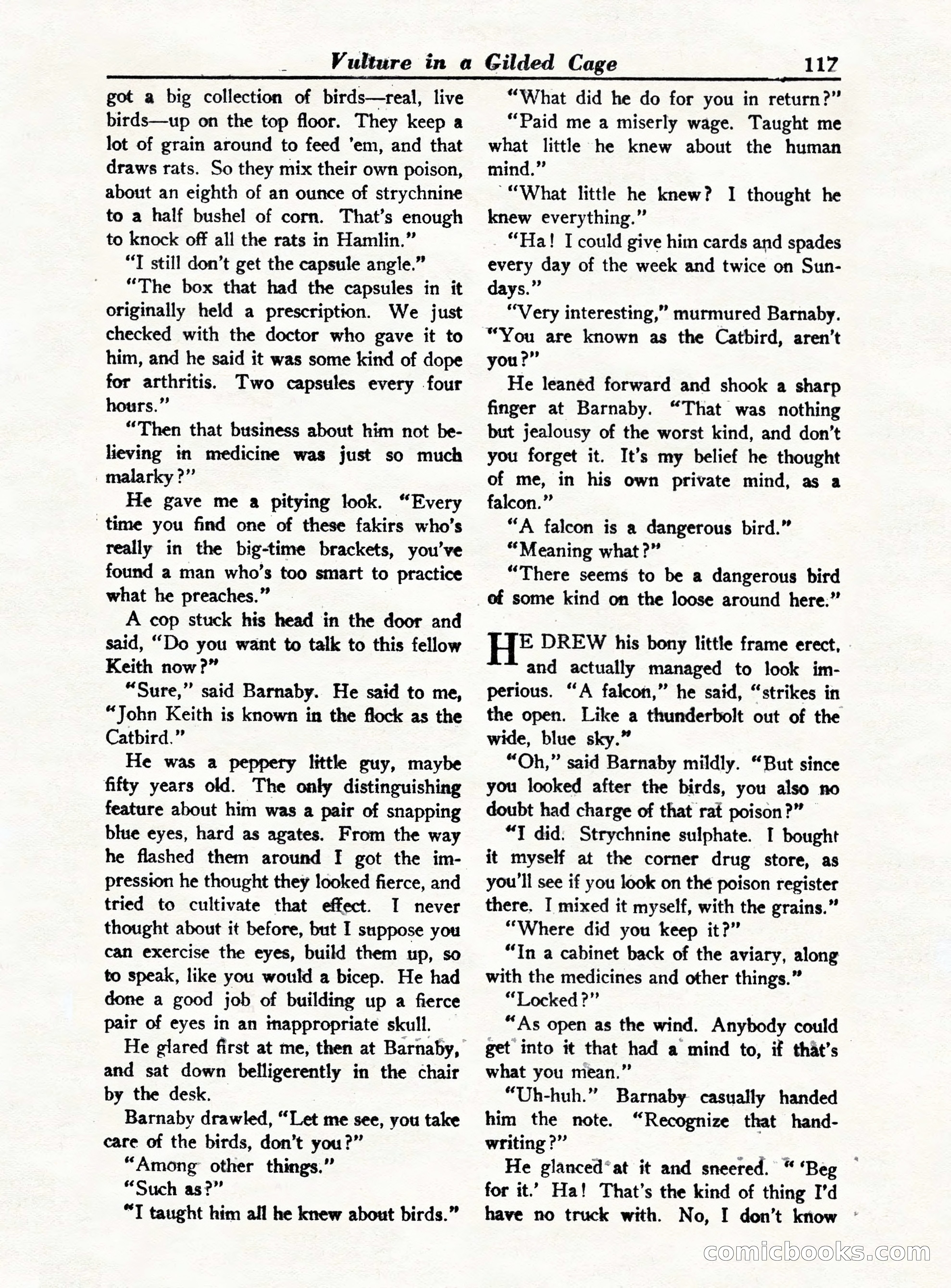
A restored page from Pulp Fiction, 1949. Page through the whole issue in the reader above.
📄 Transcribed text from this page (OCR, searchable)
Machine-transcribed from the original scan — historical spelling and the odd misread are preserved.
Vulture in a Gilded Cage got a big collection of birds—real, live birds—up on the top floor. They keep a lot of grain around to feed ’em, and that draws rats. So they mix their own poison, about an eighth of an ounce of strychnine to a half bushel of corn. That’s enough to knock off all the rats in Hamlin.” “T still don’t get the capsule angle.” “The box that had the capsules in it originally held a prescription. We just checked with the doctor who gave it to him, and he said it was some kind of dope for arthritis. Two capsules every four hours.” “Then that business about him not be- lieving in medicine was just so much -malarky ?”’ He gave me a pitying look. “Every time you find one of these fakirs who’s really in the big-time brackets, you’ve found a man who’s too smart to practice what he preaches.” A cop stuck his head in the door and said, “Do you want to talk to this fellow Keith now?” “Sure,” said Barnaby. He said to me, “John Keith is known in the flock as the Catbird.”’ He was a peppery little guy, maybe fifty years old. The only distinguishing feature about him was a pair of snapping blue eyes, hard as agates. From the way he flashed them around I got the im- pression he thought they looked fierce, and tried to cultivate that effect. I never thought about it before, but I suppose you can exercise the eyes, build them up, so to speak, like you would a bicep. He had done a good job of building up a fierce pair of eyes in an mappropriate skull. He glared first at me, then at Barnaby, and sat down belligerently in the chair by the desk. Barnaby drawled, “Let me see, you take care of the birds, don’t you?” “Among other things.” “Such as?” “TI taught him all he knew about birds.” 112 “What did he do for you in return?” “Paid me a miserly wage. Taught me what little he knew about the human mind.” “What little he knew? I thought he knew everything.” “Ha! I could give him cards and spades every day of the week and twice on Sun- days.” “Very interesting,” murmured Barnaby. “You are known as the Catbird, aren’t you?” He leaned forward and shook a sharp finger at Barnaby. “That was nothing but jealousy of the worst kind, and don’t you forget it. It’s my belief he thought of me, in his own private mind, as a falcon.” “A falcon is a dangerous bird.” “Meaning what ?” “There seems to be a dangerous bird of some kind on the loose around here.” HE DREW his bony little frame erect, and actually managed to look im- perious. “A falcon,” he said, “strikes in the open. Like a thunderbolt out of the wide, blue sky.” “Oh,” said Barnaby mildly. “But since you looked after the birds, you also no doubt had charge of that rat poison?” | “I did. Strychnine sulphate. I bought it myself at the corner drug store, as you'll see if you look on the poison register there. I mixed it myself, with the grains.” “Where did you keep it?” “In a cabinet back of the aviary, along with the medicines and other things.” “Locked ?” “As open as the wind. Anybody could get into it that had a mind to, if that’s what you mean.” “Uh-huh.” Barnaby casually handed him the note. “Recognize that hand- writing ?” He glanced*at it and sneered. “ ‘Beg — for it.’ Ha! That’s the kind of thing I'd have no truck with. No, I don’t know ° Conn (C NOOK C©