
Pulp Fiction, 1949 · page 113 of 132
All-Story Detective, October 1949 — page 113: what you’re looking at
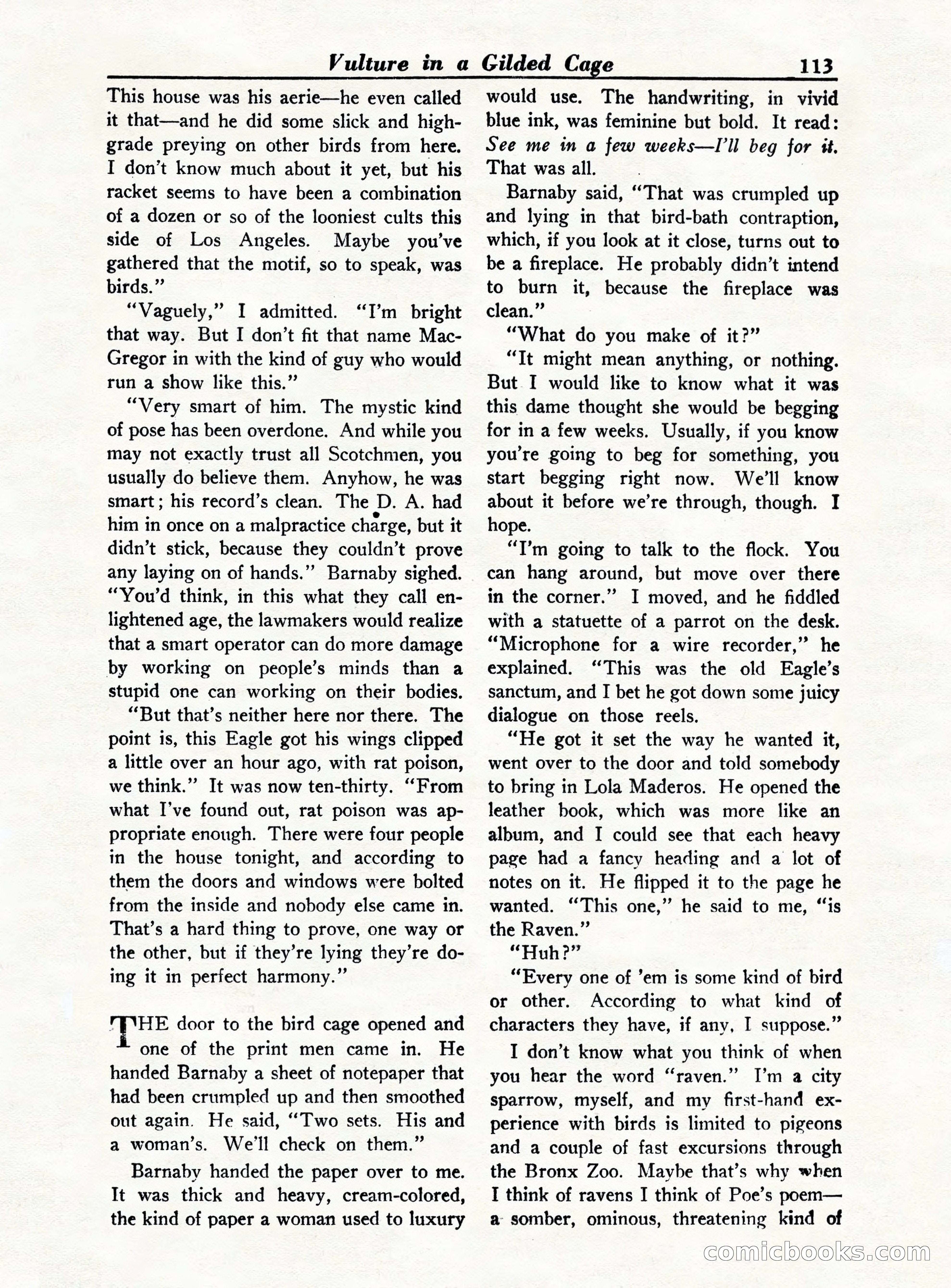
A restored page from Pulp Fiction, 1949. Page through the whole issue in the reader above.
📄 Transcribed text from this page (OCR, searchable)
Machine-transcribed from the original scan — historical spelling and the odd misread are preserved.
Vulture in a Gilded Cage 113 This house was his aerie—he even called it that—and he did some slick and high- grade preying on other birds from here. I don’t know much about it yet, but his racket seems to have been a combination of a dozen or so of the looniest cults this side of Los Angeles. Maybe you've gathered that the motif, so to speak, was birds.” “Vaguely,” I admitted. “I’m bright that way. But I don’t fit that name Mac- Gregor in with the kind of guy who would run a show like this.” “Very smart of him. The mystic kind of pose has been overdone. And while you may not exactly trust all Scotchmen, you usually do believe them. Anyhow, he was smart; his record’s clean. The D. A. had him in once on a malpractice charge, but it didn’t stick, because they couldn’t prove any laying on of hands.” Barnaby sighed. “You'd think, in this what they call en- lightened age, the lawmakers would realize that a smart operator can do more damage by working on people’s minds than a stupid one can working on their bodies. “But that’s neither here nor there. The point is, this Eagle got his wings clipped a little over an hour ago, with rat poison, we think.” It was now ten-thirty. “From what I’ve found out, rat poison was ap- propriate enough. There were four people in the house tonight, and according to them the doors and windows were bolted from the inside and nobody else came in. That’s a hard thing to prove, one way or the other, but if they’re lying they’re do- ing it in perfect harmony.” Lee door to the bird cage opened and one of the print men came in. He handed Barnaby a sheet of notepaper that had been crumpled up and then smoothed out again. He said, “Two sets. His and a woman’s. We'll check on them.” Barnaby handed the paper over to me. It was thick and heavy, cream-colored, the kind of paper a woman used to luxury would use. The handwriting, in vivid blue ink, was feminine but bold. It read: See me in a few weeks—I’ll beg for it. That was all. Barnaby said, “That was crumpled up and lying in that bird-bath contraption, which, if you look at it close, turns out to be a fireplace. He probably didn’t intend to burn it, because the fireplace was clean.” “What do you make of it?” “It might mean anything, or nothing. But I would like to know what it was this dame thought she would be begging for in a few weeks. Usually, if you know you're going to beg for something, you start begging right now. We'll know about it before we’re through, though. I hope. “T’m going to talk to the flock. You can hang around, but move over there in the corner.” I moved, and he fiddled with a statuette of a parrot on the desk. “Microphone for a wire recorder,” he explained. ‘This was the old Eagle’s sanctum, and I bet he got down some juicy dialogue on those reels. “He got it set the way he wanted it, went over to the door and told somebody to bring in Lola Maderos. He opened the leather book, which was more like an album, and I could see that each heavy page had a fancy heading and a lot of notes on it. He flipped it to the page he wanted. “This one,” he said to me, “is the Raven.” “Huh?” “Every one of ’em is some kind of bird or other. According to what kind of characters they have, if any, I suppose.” I don’t know what you think of when you hear the word “raven.” I’m a city sparrow, myself, and my first-hand ex- perience with birds is limited to pigeons and a couple of fast excursions through the Bronx Zoo. Maybe that’s why when I think of ravens I think of Poe’s poem— a somber, ominous, threatening kind of COMiICcloOO® (©