
Pulp Fiction, 1919 · page 93 of 192
All-Story Weekly, March 1, 1919 — page 93: what you’re looking at
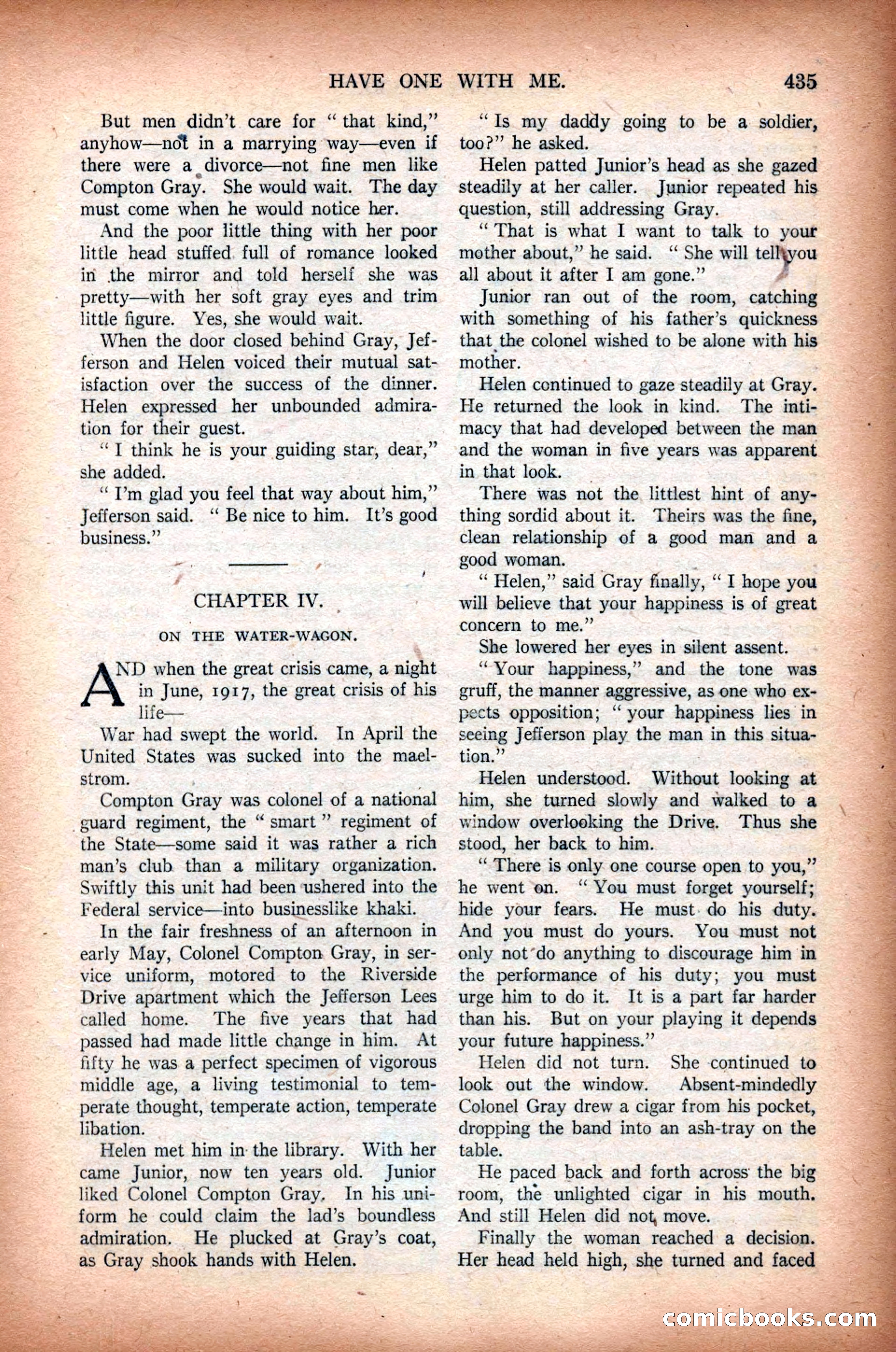
A restored page from Pulp Fiction, 1919. Page through the whole issue in the reader above.
📄 Transcribed text from this page (OCR, searchable)
Machine-transcribed from the original scan — historical spelling and the odd misread are preserved.
zt \ . \ » ef pay ry mi ab my | 3 a a as ay 2 shook hands with Helen. ONE WITH ME. But men didn’t care for “ that kind,” anyhow—not in a marrying way—even if there were a divorce—not fine men like Compton Gray. She would wait. The day must come when he would notice her. And the poor little thing with her poor little head stuffed. full of romance looked in the mirror and told herself she was pretty—with her soft gray eyes and trim little figure. Yes, she would wait. When the door closed behind Gray, Jef- ferson and Helen voiced their mutual sat- isfaction over the success of the dinner. Helen expressed her unbounded admira- tion for their guest. ‘“T think he is your guiding star, dear,” she added. “Tm glad you feel that way about him,” Jefferson said. ‘‘ Be nice to him. It’s good business.”’ 7 CHAPTER IV, ON THE WATER-WAGON, ND when the great crisis came, a night in June, 1917, the great crisis of his life— War had swept the world. In April the United States was sucked into the mael- strom. Compton Gray was colonel of a national guard regiment, the “smart” regiment of the State—some said it was rather a rich man’s club than a military organization. Swiftly this unit had been ‘ushered into the Federal service—into businesslike khaki. In the fair freshness of an afternoon in early May, Colonel Compton Gray, in ser- vice uniform, motored to the Riverside Drive apartment which the Jefferson Lees called home. The five years that had passed had made little change in him. At fifty he was a perfect specimen of vigorous middle age, a living testimonial to tem- perate thought, temperate action, temperate libation. Helen met him in:-the library. With her came Junior, now ten years old. Junior liked Colonel Compton Gray, In his uni- form he could claim the lad’s boundless admiration. He plucked at Gray’s coat, too?” he asked. Helen patted Junior’s head as she pant : 3 Junior repeated hig steadily at her caller. question, still addressing Gray. “That is what I want to talk to yout = mother about,” he said. “ She will tel all about it after I am gone.” Junior ran out of the room, catching with something of his father’s quickness © = that the colonel wished to be alone with his mother. Helen continued to gaze inal: at Gray. He returned the look in kind. The inti- macy that had developed between the man and the woman in five years was apnasees in that look. There was not the littlest hint of any- thing sordid about it. Theirs was the fine, clean relationship of a good man and a good woman. “ Helen,” said Gray finally, “I hope you will believe that your happiness is of great concern to me.” She lowered her eyes in silent assent. “Your happiness,” and the tone was gruff, the manner aggressive, as one who ex- pects opposition; sealing Jefferson play the man in this situa- tion.” him, she turned slowly and walked to a window overlooking the Drive. Thus she = stood, her back to him. “ There is only one course open to you,” he went on. ‘“ You must forget yourself; hide your fears. He must. do his duty. And you must do yours. You must not only not’do anything to discourage him in the performance of his duty; you must urge him to do it. It is a part far harder than his. But on your playing it depends your future happiness.” Helen did not turn. look out the window. Absent-mindedly Colonel Gray drew a cigar from his pocket, __ : dropping the band into an ash-tray on the table. He paced back and forth across the big room, the unlighted cigar in his mouth, And still Helen did not, move. Finally the woman reached a decinican. a Her head held high, she turned and faced “Ts my x going to be a soldier, a ‘“‘your happiness lies in — Helen understood. Without joabinas: at = She continued to = comicbooks.com