
Pulp Fiction, 1919 · page 183 of 192
All-Story Weekly, March 1, 1919 — page 183: what you’re looking at
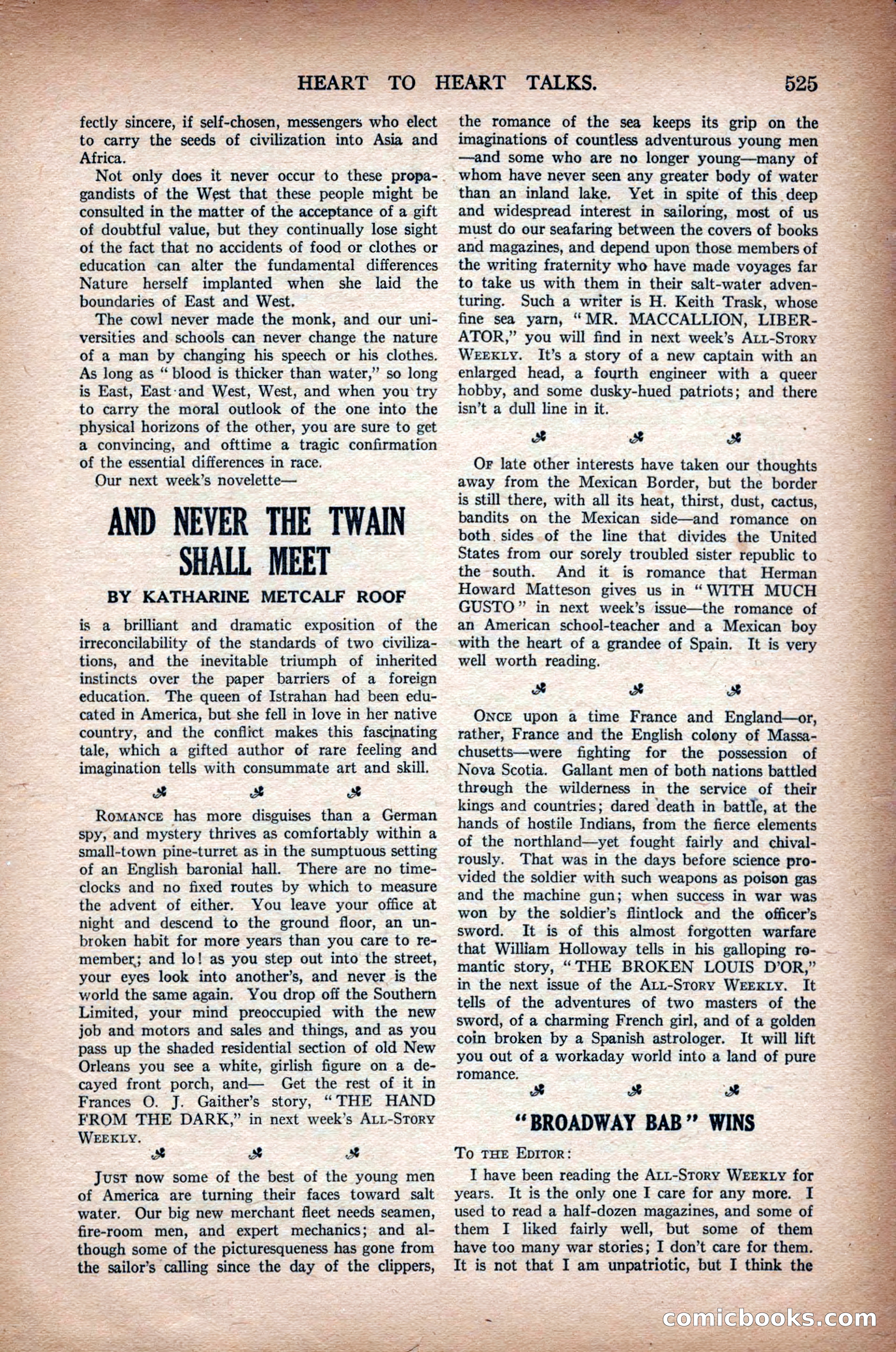
A restored page from Pulp Fiction, 1919. Page through the whole issue in the reader above.
📄 Transcribed text from this page (OCR, searchable)
Machine-transcribed from the original scan — historical spelling and the odd misread are preserved.
fectly sincere, if self-chosen, messengers who elect to carry the seeds of civilization into Asia and Africa. Not only does it never occur to these propa-. gandists of the West that these people might be consulted in the matter of the acceptance of a gift of doubtful value, but they continually lose sight of the fact that no accidents of food or clothes or education can alter the fundamental differences Nature herself implanted when she laid the boundaries of East and West. The cowl never made the monk, and our uni- versities and schools can never change the nature of a man by changing his speech or his clothes. As long as “ blood is thicker than water,” so long is East, East-and West, West, and when you try to carry the moral outlook of the one into the ' _ physical horizons of the other, you are sure to get a convincing, and ofttime a tragic confirmation of the essential differences in race. Our next week’s novelette— AND NEVER THE TWAIN “SHALL MEET BY KATHARINE METCALF ROOF is a brilliant and dramatic exposition of the irreconcilability of the standards of two civiliza- tions, and the inevitable triumph of inherited instincts over the paper barriers of a foreign education. The queen of Istrahan had been edu- cated in America, but she fell in love in her native country, and the conflict makes this fascinating tale, which a gifted author of rare feeling and imagination tells with consummate art and skill. & J re) Romance has more disguises than a German spy, and mystery thrives as comfortably within a small-town pine-turret as in the sumptuous setting of an English baronial hall. There are no time- clocks and no fixed routes by which to measure the advent of either. You leave your office at night and descend to the ground floor, an un- broken habit for more years than you care to re- member; and lo! as you step out into the street, your eyes look into another’s, and never is the world the same again. You drop off the Southern Limited, your mind preoccupied with the new job and motors and sales and things, and as you pass up the shaded residential section of old New Orleans you see a white, girlish figure on a de- cayed front porch, and— Get the rest of it in Frances O. J. Gaither’s story, “THE HAND FROM THE DARK,” in next week’s ALL-SToRY WEEKLY. & a Just now some of the best of the young men of America are turning their faces toward salt water. Our big new merchant fleet needs seamen, fire-room men, and expert mechanics; and al- though some of the picturesqueness has gone from the sailor’s calling since the day of the clippers, WS ee IO aw ne * a Se ; the romance of the sea keeps its grip on the : = : : imaginations of countless adventurous young men —and some who are no longer young—many of whom have never seen any greater body of water than an inland lake, Yet in spite of this deep and widespread interest in sailoring, most of us must do our seafaring between the covers of books and magazines, and depend upon those members of the writing fraternity who have made voyages far to take us with them in their salt-water adven- turing. Such a writer is H. Keith Trask, whose fine sea yarn, “MR. MACCALLION, LIBER- ATOR,” you will find in next week’s Att-Srory WEEKLY. It’s a story of a new captain with an enlarged head, a fourth engineer with a queer hobby, and some dusky-hued patriots; and there isn’t a dull line in it. wt & 4 Or late other interests have taken our thoughts away from the Mexican Border, but the border is still there, with all its heat, thirst, dust, cactus, bandits on the Mexican side—and romance on both. sides of the line that divides the United States from our sorely troubled sister republic to the south. And it is romance that Herman Howard Matteson gives us in “WITH MUCH GUSTO” in next week’s issue—the romance of an American school-teacher and a Mexican boy with the heart of a grandee of Spain. It is very well worth reading. & & & ONCE upon a time France and England—or, rather, France and the English colony of Massa- chusetts—were fighting for the possession of Nova Scotia. Gallant men of both nations battled threugh the wilderness in the service of their kings and countries; dared death in battle, at the hands of hostile Indians, from the fierce elements of the northland—yet fought fairly and chival- rously. That was in the days before science pro- vided the soldier with such weapons as poison gas and the machine gun; when success in war was — won by the soldier’s flintlock and the officer’s — sword. It is of this almost forgotten warfare that William Holloway tells in his galloping ro- mantic story, “THE BROKEN LOUIS D’OR,” in the next issue of the Arr-Story WeEEKLy. It tells of the adventures of two masters of the sword, of a charming French girl, and of a golden coin broken by a Spanish astrologer. It will lift you out of a workaday world into a land of pure romance. a oe ““BROADWAY BAB” WINS To THE EpITor: T have been reading the Att-Story WEEKLY for. years. It is the only one I care for any more. I used to read a half-dozen magazines, and some of them I liked fairly well, but some of them have too many war stories; I don’t care for them. It is not that I am unpatriotic, but I think the - 7 Ce )(@)) KS PP. = % —= — ene. —s os ag a : = > ee - = > i gee ee = i =. Bp re wt r= = = = (a a Se ee a > - ~ = rT2 fo > ow “< . = a1 — ae a 97 Get — ~ - : + <-> y o eet ef 7S m Se PS es eS a - eee eee SS Oe SORE Pd eo ne ET —— ae =z ae ws tS ate OS Ne. cae ee SS - Se A pe"~~ vo= Azer i 3 = a - ~—* ~ = - oar = 25 ae i —*z - os :