
Pulp Fiction, 1919 · page 177 of 192
All-Story Weekly, March 1, 1919 — page 177: what you’re looking at
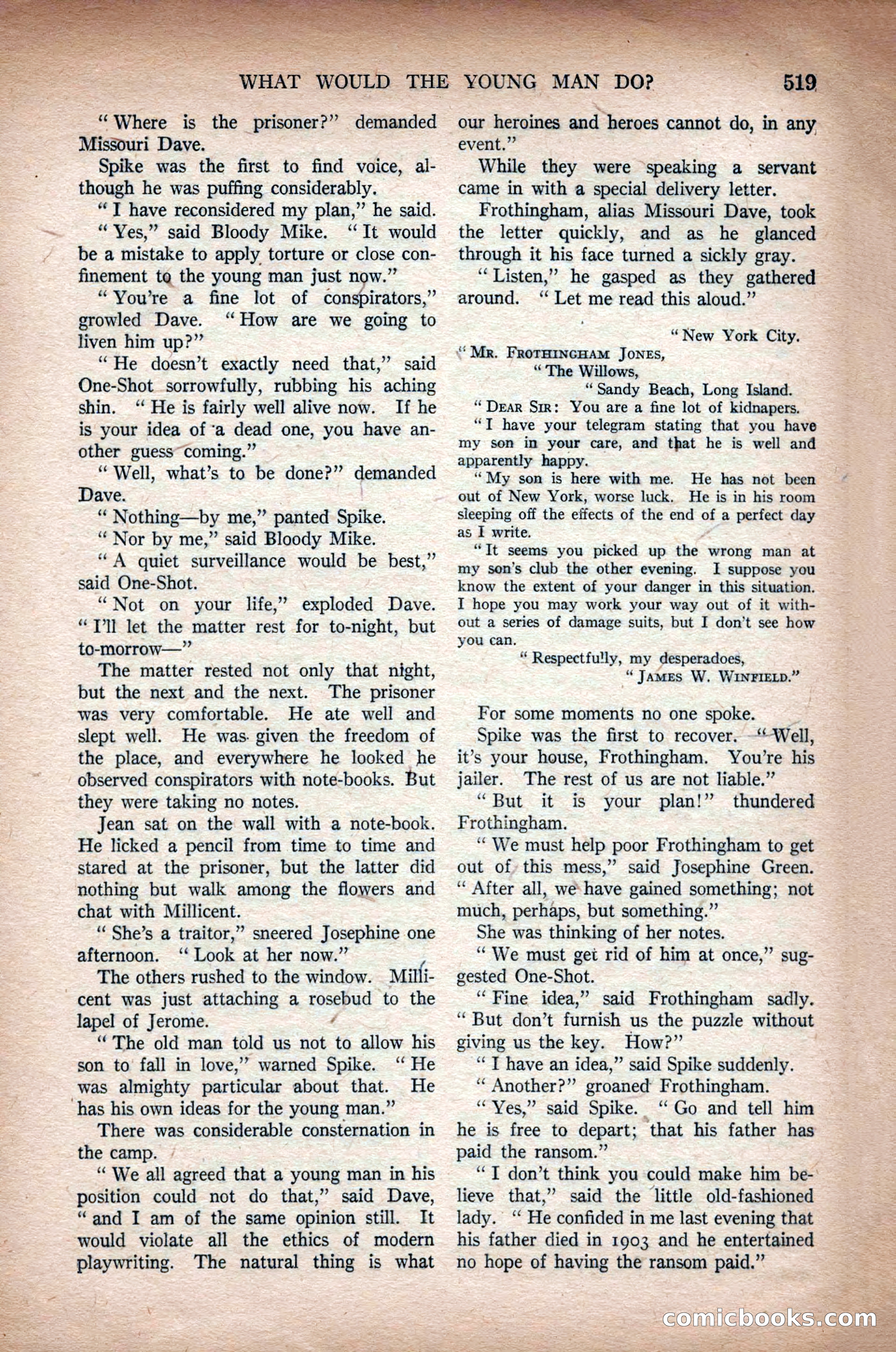
A restored page from Pulp Fiction, 1919. Page through the whole issue in the reader above.
📄 Transcribed text from this page (OCR, searchable)
Machine-transcribed from the original scan — historical spelling and the odd misread are preserved.
- WHAT WOULD THE YOUNG “MAN DO? “Where is the prisoner?” demanded Missouri Dave. Spike was the first to find voice, al- though he was puffing considerably. “I have reconsidered my plan,” he said. “ Yes,” said Bloody Mike. “It would be a mistake to apply torture or close con- finement to the young man just now.” “You're a fine lot of conspirators,” growled Dave. “How are we going to liven him up?” “He doesn’t exactly need that,” said One-Shot sorrowfully, rubbing his aching shin. ‘“ He is fairly well alive now. If he is your idea of ‘a dead one, you have an- other guess“ coming.” “Well, what’s to be done?” demanded Dave. “ Nothing—by me,” panted Spike. “Nor by me,” said Bloody Mike. “A quiet surveillance would be best,” said One-Shot. “Not on your life,” exploded Dave. “T'll let the matter rest for to-night, but to-morrow—”’ The matter rested not only that night, but the next and the next. The prisoner was very comfortable. He ate well and slept well. He was. given the freedom of the place, and everywhere he looked he observed conspirators with note-books. But they were taking no notes. Jean sat on the wall with a note-book. He licked a pencil from time to time and stared at the prisoner, but the latter did nothing but walk among the flowers and chat with Millicent. ‘‘ She’s a traitor,” sneered Josephine one afternoon. ‘“ Look at her now.” The others rushed to the window. Milli- cent was just attaching a rosebud to the lapel of Jerome. é “The old man told us not to allow his son to fall in love,’ warned Spike. ‘“ He was almighty particular about that. He has his own ideas for the young man.” There was considerable consternation in the camp. | “We all agreed that a young man in his position could not do that,” said Dave, “and I am of the same opinion still. It would violate all the ethics of modern playwriting. The natural thing is what our heroines and heroes cannot ae, in any event.” While they were Serking a servant — came in with a special delivery letter. Frothingham, alias Missouri Dave, took the letter quickly, and as he glanced through it his face turned a sickly gray. “Listen,” he gasped as they gathered — around. c Let me read this aloud.” “New York City. “Mr. FROTHINGHAM JONES, “The Willows, “Sandy Beach, Long Island. ‘“ DeAR SiR: You are a fine lot of kidnapers. “T have your telegram stating that you have my son in your care, and that he is well and apparently happy. ‘“My son is here with me. He has not been out of New York, worse luck. He is in his room sleeping off the effects of the end of a perfect day as I write. “It seems you picked up the wrong man at my son’s club the other evening. I suppose you know the extent of your danger in this situation. I hope you may work your way out of it with- out a series of damage suits, but I don’t see how you can. “ Respectfully, my desperadoes, “James W. WINFIELD.” For some moments no one spoke. Spike was the first to recover. ‘Well, it’s your house, Frothingham. You're his jailer. The rest of us are not liable.” “But it is your plan!” thundered Frothingham. ‘We must help poor Frothingham to get out of this mess,” said Josephine Green. ‘“ After all, we have gained something; not much, perhaps, but something.” She was thinking of her notes. “We must get rid of him at once,’’ sug- gested One-Shot. “Fine idea,” said Frothingham sadly. ‘But don’t furnish us the puzzle without giving us the key. How?” ‘“T have an idea,” said Spike suddenly. ‘* Another?” groaned Frothingham. “Yes,” said Spike. ‘‘ Go and tell him he is free to depart; that his father has paid the ransom.” ‘““T don’t think you could make him be-' lieve that,” said the little old-fashioned lady. “ He confided in me last evening that his father died in 1903 and he entertained no hope of having the ransom paid.” 1 ‘ : Se : < oe = a mew — < he = ~ . : > ~ = eel “— er =~ - ~ = . - iu : “. +« = . et Se ye a oS —— <1) — se — > a <a ms a — a - ~ . 2 — ~~ = ~~ “ o , SS. 2 > so “ater Ps — ——_ ——s x te = an in ee ——— ~" 254 ™. ~Oee, S - i