
Pulp Fiction, 1919 · page 172 of 192
All-Story Weekly, March 1, 1919 — page 172: what you’re looking at
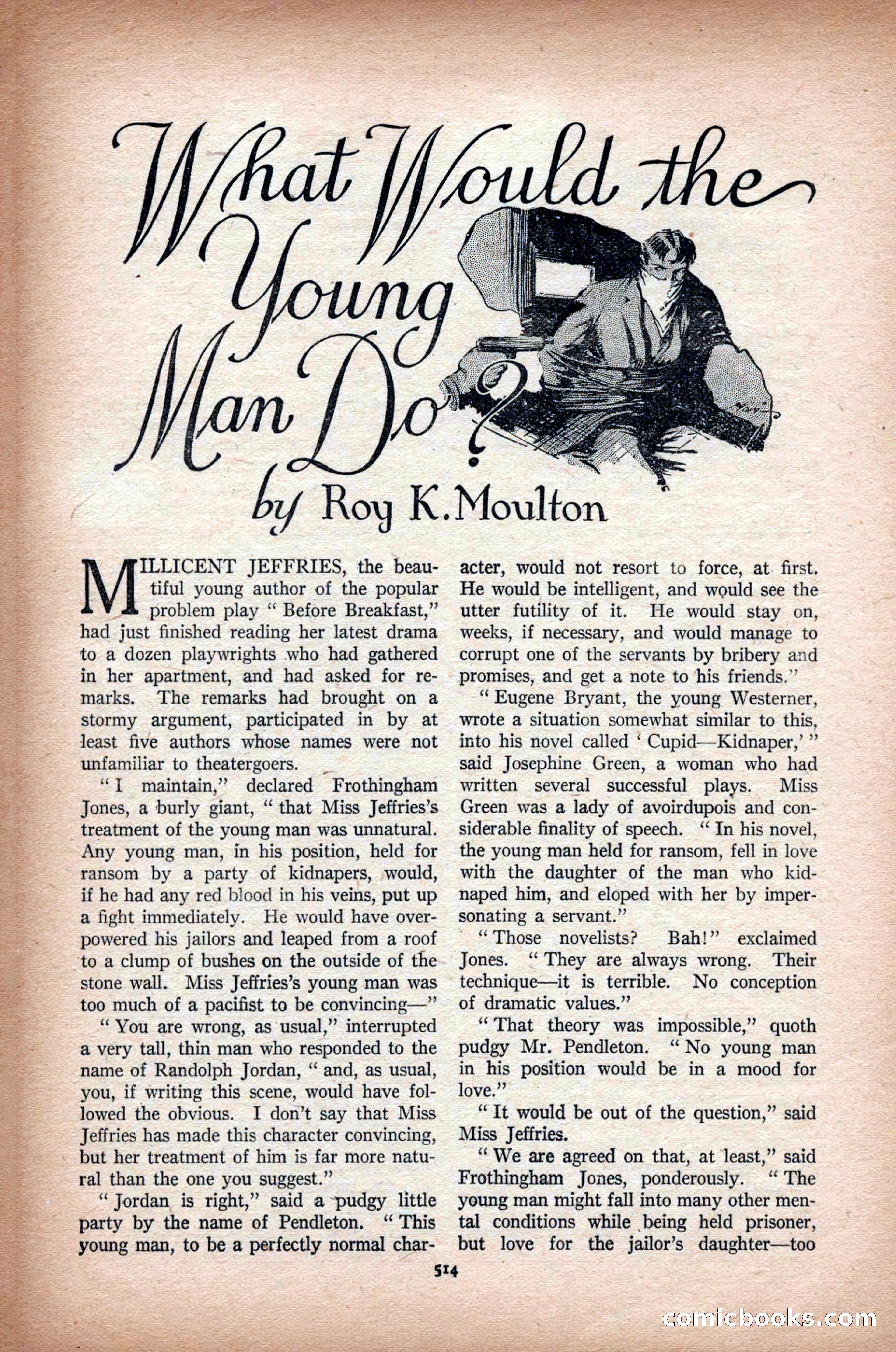
A restored page from Pulp Fiction, 1919. Page through the whole issue in the reader above.
📄 Transcribed text from this page (OCR, searchable)
Machine-transcribed from the original scan — historical spelling and the odd misread are preserved.
a : _ young man, to be a perfectly normal char- 514 ILLICENT JEFFRIES, the beau- tiful young author of the popular _& problem play “ Before Breakfast,” had just finished reading her latest drama to a dozen playwrights who had gathered in her apartment, and had asked for re- marks. The remarks had brought on a stormy argument, participated in by at least five authors whose names were not unfamiliar to theatergoers. _ “| maintain,” declared Frothingham Jones, a burly giant, “ that Miss Jeffries’s treatment of the young man was unnatural. Any young man, in his position, held for ransom by a party of kidnapers, would, if he had any red blood in his veins, put up a fight immediately. He would have over- powered his jailors and leaped from a roof to a clump of bushes on the outside of the stone wall. Miss Jeffries’s young man was too much of a pacifist to be convincing—” “You are wrong, as usual,” interrupted a very tall, thin man who responded to the name of Randolph Jordan, “ and, as usual, you, if writing this scene, would have fol- lowed the obvious. I don’t say that Miss Jeffries has made this character convincing, but her treatment of him is far more natu- ral than the one you suggest.” “Jordan is right,” said a ~pudgy little _ party by the name of Pendleton. ‘“ This aa ae ——= => = by Roy K.Moulton = - : : SS. =>: = == oe —= > acter, would not resort to force, at. first. He would be intelligent, and would see the utter futility of it. He would stay on, weeks, if necessary, and would manage to corrupt one of the servants by bribery and promises, and get a note to his friends.” “Eugene Bryant, the young Westerner, wrote a situation somewhat similar to this, into his novel called ‘ Cupid—Kidnaper,’ ” said Josephine Green, a woman who had written several successful plays. Miss Green was a lady of avoirdupois and con- siderable finality of speech. ‘‘ In his novel, the young man held for ransom, fell in love with the daughter of the man who kid- naped him, and eloped with her by imper- sonating a servant.” “Those novelists? Bah!” exclaimed Jones. ‘‘ They are always wrong. Their technique—it is terrible. No conception of dramatic values.” “That theory was impossible,” quoth pudgy Mr. Pendleton. “No young man in his position would be in a mood for love.” “It would be out of the question,” said Miss Jeffries. “We are agreed on that, at least,” said Frothingham Jones, ponderously. ‘“ The young man might fall into many other men- tal conditions while being held prisoner, but love for the jailor’s daughter—too S, 0) : = €0 ae .OOK AACE 6 — i = Ss SS -- aay . NN A See 5g te Se SS Se - —, - = = ae SEES ae