
Pulp Fiction, 1919 · page 152 of 192
All-Story Weekly, March 1, 1919 — page 152: what you’re looking at
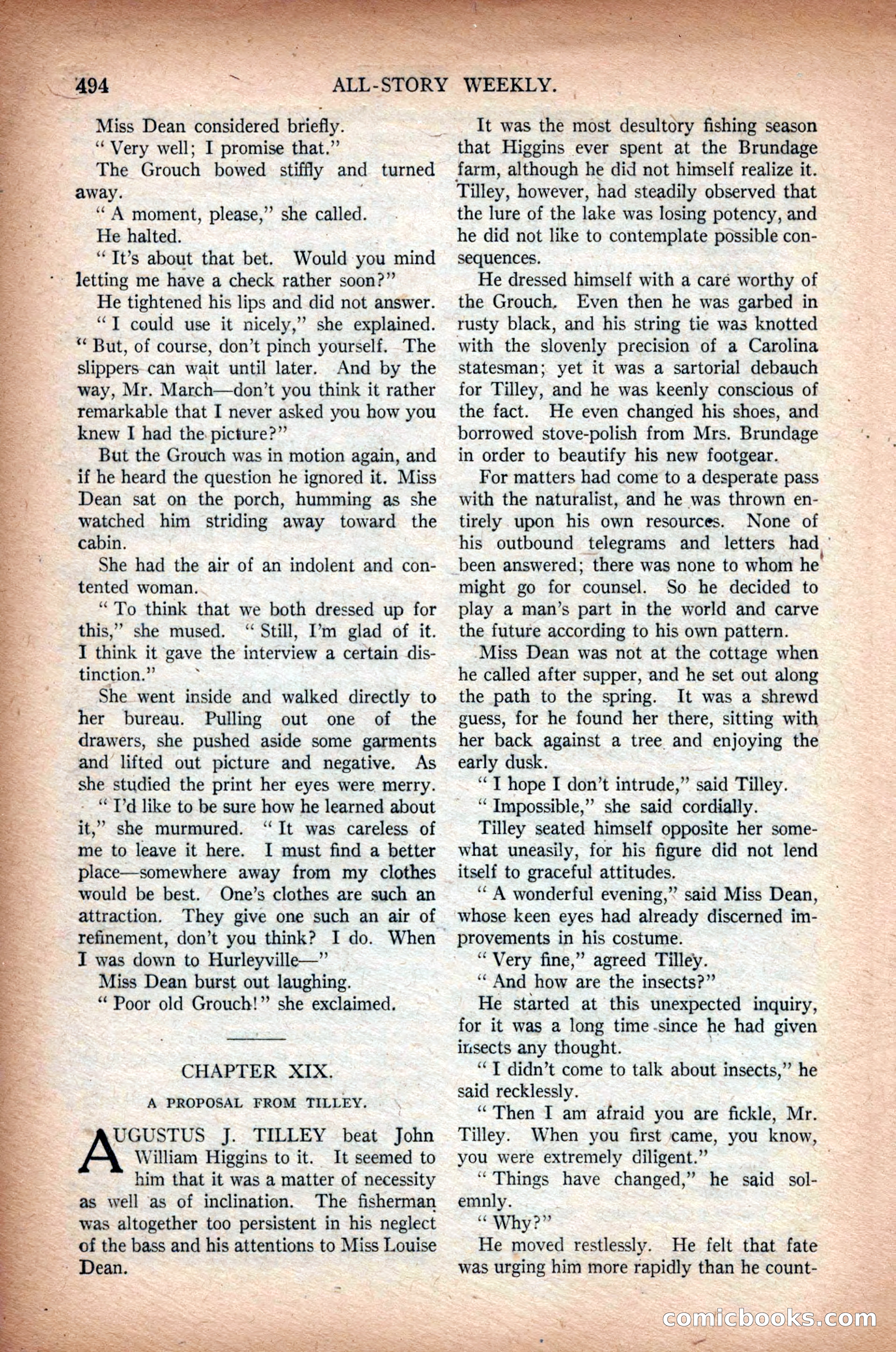
A restored page from Pulp Fiction, 1919. Page through the whole issue in the reader above.
📄 Transcribed text from this page (OCR, searchable)
Machine-transcribed from the original scan — historical spelling and the odd misread are preserved.
<s¥ ae 3 a i> —, + —. mee on = = 5) pers it are ee ae . : : Ps ~'S ‘ - == a eS . E ; * ; * = : ee a it ~ . we .* " . a =a d ‘ < i Per & Ce “0 < Soon - ‘ a ' me ee | =< _ Dean. Miss Dean considered briefly. “Very well; I promise that.” The Grouch bowed stiffly and turned away. ‘“A moment, please,” she called. He halted. “It’s about that bet. Would you mind ~ letting me have a check rather soon?” He tightened his lips and did not answer. “T could use it nicely,” she explained. « But, of course, don’t pinch yourself. The slippers-can wait until later. And by the way, Mr. March—don’t you think it rather remarkable that I never asked you how you knew I had the picture?” But the Grouch was in motion again, and . if he heard the question he ignored it. Miss - Dean sat on the porch, humming as she watched him striding away toward the cabin. She had the air of an indolent and con- tented woman. “To think that we both dressed up for this,” she mused. “ Still, I’m glad of it. I think it gave the interview a certain dis- tinction.” : She went inside and walked directly to her bureau. Pulling out one of the drawers, she pushed aside some garments and lifted out picture and negative. As she studied the print her eyes were merry. - “Td like to be sure how he learned about it,’ she murmured. ‘It was careless of me to leave it here. I must find a better place—somewhere away from my clothes would be best. One’s clothes are such an attraction. They give one such an air of refinement, don’t you think? I do. When I was down to Hurleyville—” Miss Dean burst out laughing. “Poor old Grouch!” she exclaimed. CHAPTER XIX. A PROPOSAL FROM TILLEY. “AUGUSTUS J. TILLEY beat John A William Higgins to it. It seemed to him that it was a matter of necessity as well as of inclination. The fisherman was altogether too persistent in his neglect _ of the bass and his attentions to Miss Louise It was the most desultory fishing season s that Higgins ever spent at the Brundage farm, although he did not himself realize it. Tilley, however, had steadily observed that the lure of the lake was losing potency, and he did not like to contemplate possible con- sequences. He dressed himself with a caré worthy of the Grouch. Even then he was garbed in rusty black, and his string tie was knotted with the slovenly precision of a Carolina statesman; yet it was a sartorial debauch for Tilley, and he was keenly conscious of the fact. He even changed his shoes, and borrowed stove-polish from Mrs. Brundage in order to beautify his new footgear. For matters had come to a desperate pass with the naturalist, and he was thrown en- tirely upon his own resources. None of his outbound telegrams and letters had’ been answered; there was none to whom he might go for counsel. So he decided to play a man’s part in the world and carve the future according to his own pattern. Miss Dean was not at the cottage when he called after supper, and he set out along the path to the spring. It was a shrewd guess, for he found her there, sitting with her back against a tree and enjoying the early dusk. ‘T hope I don’t intrude,” said Tilley. “Impossible,” she said cordially. Tilley seated himself opposite her some- what uneasily, for his figure did not lend itself to graceful attitudes. ‘“ A wonderful evening,” said Miss Dean, whose keen eyes had already discerned im- provements in his costume. “Very fine,” agreed Tilley. ‘“And how are the insects?” He started at this unexpected inquiry, for it was a long time-since he had given insects any thought. ‘““T didn’t come to talk about insects,” he Soo said recklessly. “Then I am afraid you are fickle, Mr. Tilley. When you first came, you know, you were extremely diligent.” “Things have changed,” he said sol- emnly. ce Why?” . He moved restlessly. He felt that fate was urging him more se than he count- . ae he SS & .