
Pulp Fiction, 1919 · page 140 of 192
All-Story Weekly, March 1, 1919 — page 140: what you’re looking at
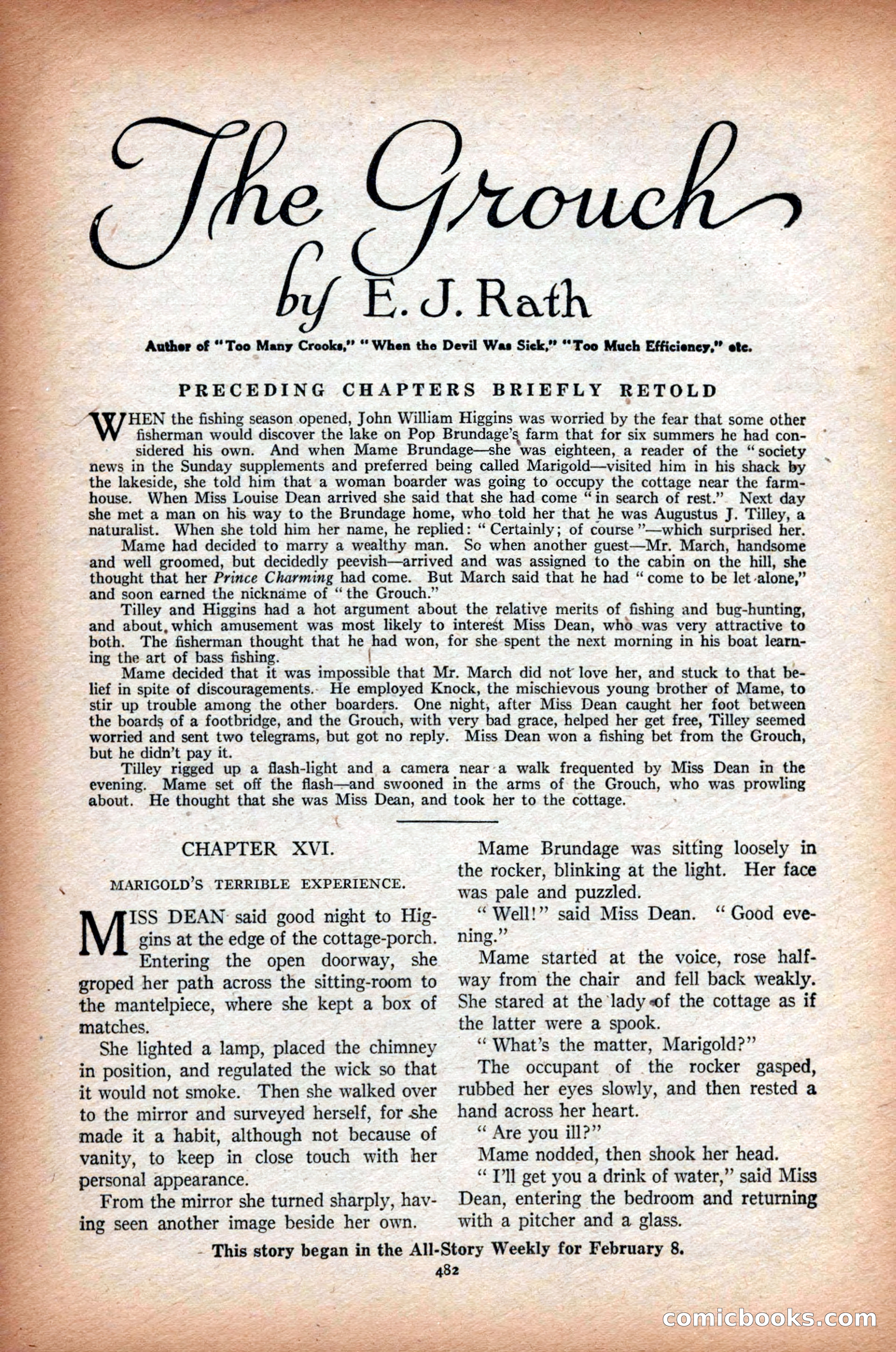
A restored page from Pulp Fiction, 1919. Page through the whole issue in the reader above.
📄 Transcribed text from this page (OCR, searchable)
Machine-transcribed from the original scan — historical spelling and the odd misread are preserved.
by E.J. Rath Auther of “Too Many Crooks,” “ When the Devil Was Sick,” “Too Much Efficiency,” ete. PRECEDING CHAPTERS BRIEFLY RETOLD HEN the fishing season opened, John William Higgins was worried by the fear that some other fisherman would discover the lake on Pop Brundage’s farm that for six summers he had con- sidered his own. And when Mame Brundage—she was eighteen, a reader of the “ society news in the Sunday supplements and preferred being called Marigold—visited him in his shack by the lakeside, she told him that a woman boarder was going to occupy the cottage near the farm- house. When Miss Louise Dean arrived she said that she had come “in search of rest.” Next day she met a man on his way to the Brundage home, who told her that he was Augustus J. Tilley, a naturalist. When she told him her name, he replied: “ Certainly; of course ”—which surprised her. Mame had decided to marry a wealthy man. So when another guest—Mr. March, handsome and well groomed, but decidedly peevish—arrived and was assigned to the cabin on the hill, she thought that her Prince Charming had come. But March said that he had “come to be let alone,” and soon earned the nickndme of “ the Grouch.” Tilley and Higgins had a hot argument about the relative merits of fishing and bug-hunting, and about, which amusement was most likely to interest Miss Dean, who was very attractive to both. The fisherman thought that he 5284 won, for she spent the next morning in his boat learn- ing the art of bass fishing. Mame decided that it was impossible that Mr. March did not love her, and stuck to that be- lief in spite of discouragements.. He employed Knock, the mischievous young brother of Mame, to stir up trouble among the other boarders. One night, after Miss Dean caught her foot between the boards of a footbridge, and the Grouch, with very bad grace, helped her get free, Tilley seemed wotried and sent two telegrams, but got no reply. but he didn’t pay it. Miss Dean won a fishing bet from the Grouch, Tilley rigged up a flash-light and a camera near-a walk frequented by Miss Dean in the evening. Mame set off the flash—and swooned in the arms of the Grouch, who was prowling about. He thought that she was Miss Dean, and took her to the cottage. . t ‘ CHAPTER XVI. MARIGOLD’S TERRIBLE EXPERIENCE. ISS DEAN said good night to Hig- gins at the edge of the cottage-porch. Entering the open doorway, she groped her path across the sitting-room to the mantelpiece, where she kept a box of matches. She lighted a lamp, placed the chimney in position, and regulated the wick so that it would not smoke. Then she walked over to the mirror and surveyed herself, for she made it a habit, although not because of vanity, to keep in close touch with her personal appearance. : From the mirror she turned sharply, hav- ing seen another image beside her own. Mame Brundage was sitting loosely in the rocker, blinking at the light. Her face was pale and puzzled. “Well!” said Miss Dean. ‘ Good eve- ning.” Mame started at the voice, rose half- way from the chair and fell back weakly. She stared at the lady of the cottage as if the latter were a spook. ‘ What’s the matter, Marigold?” The occupant of the rocker gasped, rubbed her eyes slowly, and then rested a hand across her heart. “ Are you ill?” Mame nodded, then shook her head. “Tl get you a drink of water,” said Miss Dean, entering the bedroom and returning with a pitcher and a glass. - This story began in the All-Story Weekly for February 8. 3 ce ay ib L ‘ CUPRA orata AiN y) "| a Ott Bat ’ 9 f ue rey x "\ —, wae | Wis ig