
Pulp Fiction, 1919 · page 138 of 192
All-Story Weekly, March 1, 1919 — page 138: what you’re looking at
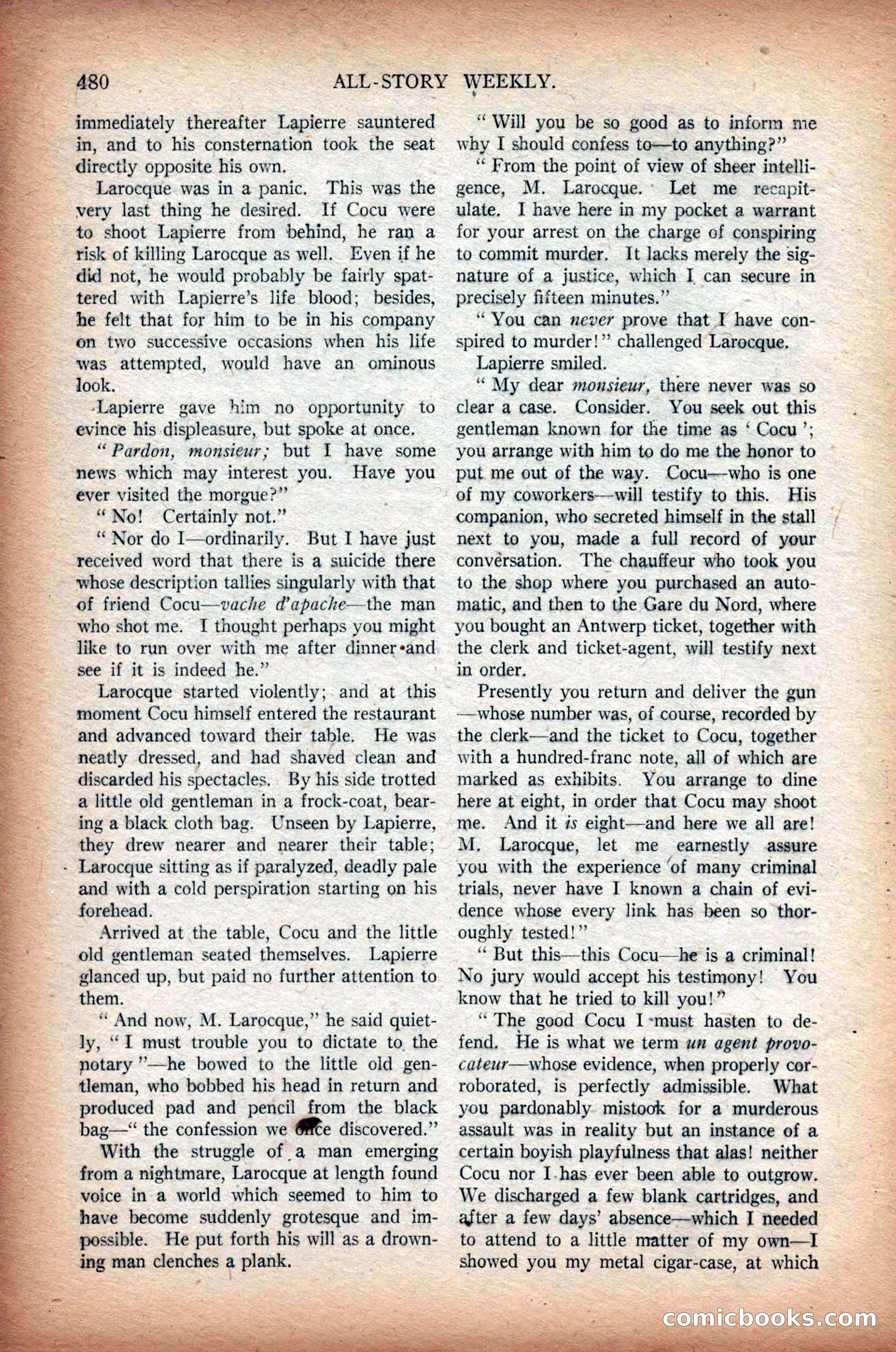
A restored page from Pulp Fiction, 1919. Page through the whole issue in the reader above.
📄 Transcribed text from this page (OCR, searchable)
Machine-transcribed from the original scan — historical spelling and the odd misread are preserved.
= immediately thereafter Lapierre sauntered 4 Ee in, and to his consternation took the seat ate j ; yttte ri Sas | . i 7 ‘ Ps \ : : } " £ e.¢ (fhe - i ‘ ’ wi) . ’ é ; / ey, - iZ oe OL edd lt : iS 4 ye : : ity : (dag Ve F swt Ad ately al : wiv t She Yes Pe » ON vs 4) 4 : * , . : my of Toate: pelty Leas a us i eit #7 a et rad. We rks , f NN ay Care) OF } Cs 2a) rae Bete Pri Minas ) wt i SP feta ! “ge is j S aNh by a Pro x * - why / Ga! RON ita Malas if ani . ? % Wie oot e ey : « eile _ directly opposite his own. news which may interest you. This was the If Cocu were Larocque was in a panic. very last thing he desired. to shoot Lapierre from behind, he ran a _ risk of killing Larocque as well. did not, he wont probably be fairly spat- Even if he tered with Lapierre’s life blood; besides, he felt that for him to be in his company on two successive occasions when his life was attempted, would have an ominous look. ‘Lapierre gave him no opportunity to evince his displeasure, but spoke at once. “ Pardon, but I have some Have you monsi€ur ; ever visited the morgue?”’ “No! Certainly not.” “Nor do I—ordinarily. But I have just ¢ received word that there is a suicide there _ whose description tallies singularly with that of friend Cocu—vache d’apache—the man who shot me. I thought perhaps you might like to run over with me after dinner sand see if it is indeed he.” Larocque started violently; and at this moment Cocu himself entered the restaurant and advanced toward their table. He was neatly dressed, and had shaved clean and discarded his spectacles. By his side trotted a little old gentleman in a frock-coat, bear- ing a black cloth bag. Unseen by Lapierre, they drew nearer and nearer their table; Larocque sitting as if paralyzed, deadly pale and with a cold perspiration starting on his forehead. Arrived at the table, Cocu and the little old gentleman seated themselves. Lapierre glanced up, but paid no further attention to - them. ‘And now, M. Larocque,” he said quiet- ly, ‘‘I must trouble you to dictate to the notary ’—he bowed to the little old gen- tleman, who bobbed his head in return and 3 produced pad and pencil from the black bag—‘ the confession we Offce discovered.” With the struggle of a man emerging from a nightmare, Larocque at length found = voice in a world which seemed to him to have become suddenly grotesque and im- a pee: He put forth his will as a drown- ALL- STORY WEEKLY. why I should confess to—to anything?” “From the point of view of sheer intelli- gence, M. Larocque.* Let me _ recapit- ulate. I have here in my pocket a warrant for your arrest on the charge of conspiring to commit murder, It lacks merely the sig- nature of a justice, which I can secure in precisely fifteen minutes.” “You can never prove that IT have con- spired to murder!” challenged Larocque, Lapierre smiled. _ “My dear monsieur, there never was so clear a case. Consider. You seek out this gentleman known for the time as ‘ Cocu’; you arrange with him to do me the honor to put me out of the way. Cocu—-who is one of my coworkers—will testify to this. His companion, who secreted himself in the stall next to you, made a full record of your conversation. The chauffeur who took you to the shop where you purchased an auto- matic, and then to the Gare du Nord, where you bought an Antwerp ticket, together with the clerk and ticket-agent, will testify next in order, Presently you return and deliver the gun ——whose number was, of course, recorded by the clerk—and the ticket to Cocu, together with a hundred-franc note, all of which are marked as exhibits. You arrange to dine here at eight, in order that Cocu may shoot me. And it is eight—and here we all are! M. Larocque, let me earnestly assure you with the experience ‘of many criminal trials, never have I known a chain of evi- dence whose every link has been so thor- oughly tested!” “ But this—this Cocu—he is a criminal! No jury would accept his testimony! You know that he tried to kill you!” “The good Cocu I-must hasten to de- fend, He is what we term un agent provo- cateur—whose evidence, when properly cor- roborated, is perfectly admissible. What you pardonably. mistook for a murderous assault was in reality but an instance of a certain boyish playfulness that alas! neither Cocu nor I.has ever been able to outgrow. We discharged a few blank cartridges, and after a few days’ absence—which I needed to attend to a little matter of my own—I “Will you be so good as to inform me RSS Chee , io we sate we Mp Oey 7 ed FT ee | sf ay a4 <a. . , we ene