
Pulp Fiction, 1919 · page 122 of 192
All-Story Weekly, March 1, 1919 — page 122: what you’re looking at
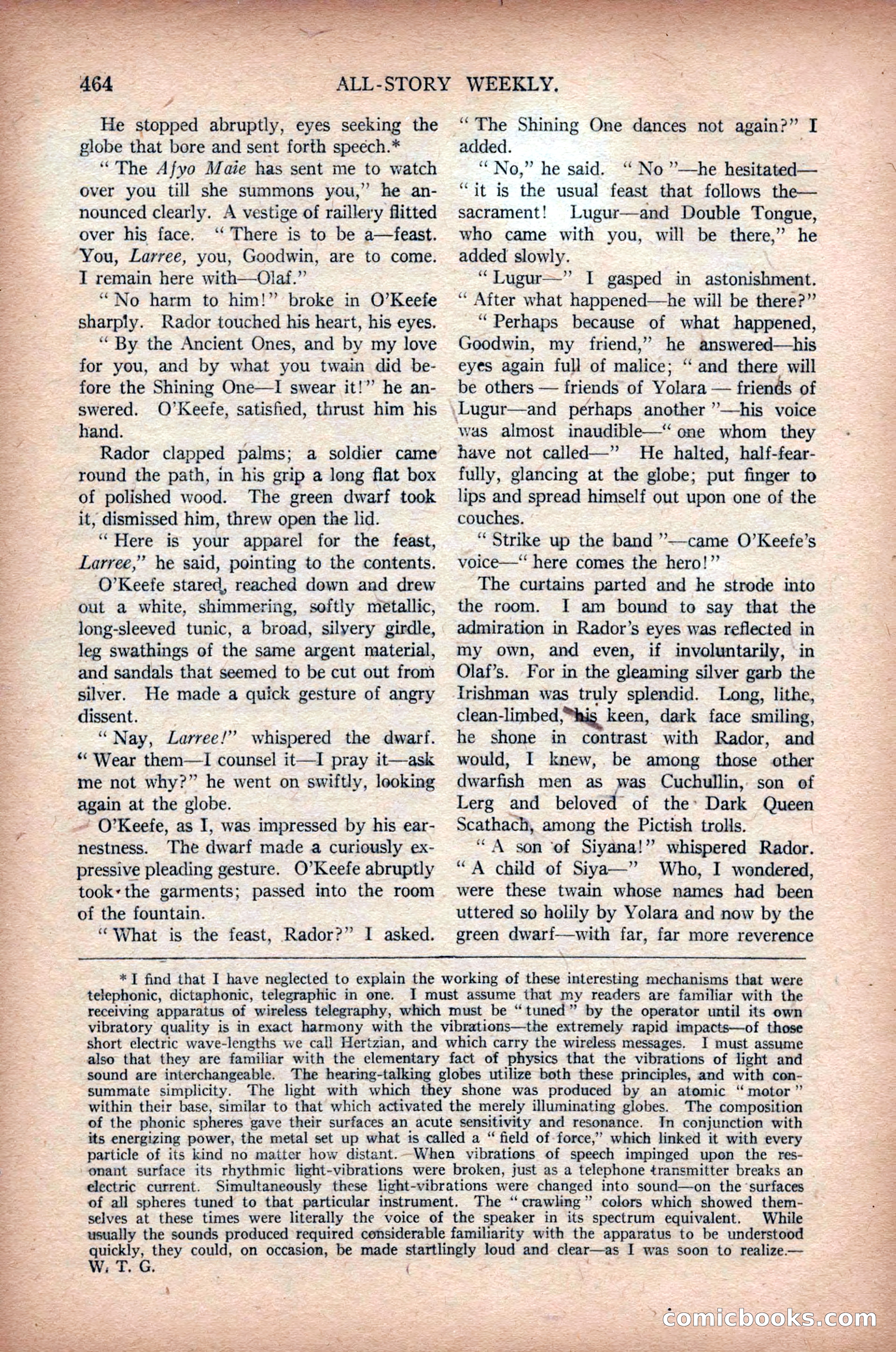
A restored page from Pulp Fiction, 1919. Page through the whole issue in the reader above.
📄 Transcribed text from this page (OCR, searchable)
Machine-transcribed from the original scan — historical spelling and the odd misread are preserved.
~\ AEETAAS YL) re Bs Te pt hay STS) Pines A ee Piswiis > 4h at Ee i a EA BTA Vy emer UN Cy PUY RANE MTS MONICA ft ge : . . + *< 7 Te yan aT SE pe ~ f : WAN TNS AG4 He stopped abruptly, eyes seeking the globe that bore and sent forth speéch.* “The Afyo Maie has sent me to watch over you till she summons you,” he an- nounced clearly. A vestige of raillery flitted over his face. ‘‘ There is to be a—feast. “You, Larree, you, Goodwin, are to come. I remain here with—Olaf.” “No harm to him!” broke in O’Keefe sharply. Rador touched his heart, his eyes. ‘By the Ancient Ones, and by my love for you, and by what you twain did be- fore the Shining One—I swear it!”’ he an- swered. O’Keefe, satisfied, thrust him his hand. Rador clapped palms; a soldier came round the path, in his grip a long flat box of polished wood. The green dwarf took it, dismissed him, threw open the lid. “Here is your apparel for the feast, Larree,” he said, pointing to the contents. O’Keefe stared, reached down and drew out a white, shimmering, softly metallic, long-sleeved tunic, a broad, silvery girdle, leg swathings of the same argent material, and sandals that seemed to be cut out from silver. He made a quick gesture of angry dissent. | “Nay, Larree!” whispered the dwarf. “Wear them—lI counsel it—I pray it—ask me not why?” he went on swiftly, looking again at the globe. ~ O’Keefe, as I, was impressed by his ear- nestness. The dwarf made a curiously ex- pressive pleading gesture. O’Keefe abruptly took«the garments; passed into the room of the fountain. ‘““What is the feast, Rador?” I asked. ALL-STORY WEEKLY. “ The Shining One dances not again?” I added. “No,” he said. “ No ”’—he hesitated— “it is the usual feast that follows the— sacrament! Lugur—and Double Tongue, who came with you, will be there,” he added slowly. ‘“Lugur—” I gasped in astonishment. “After what happened—he will be there?” ‘Perhaps because of what happened, Goodwin, my friend,” he answered—his eyes again full of malice; “ and there will be others — friends of Yolara — friends of Lugur—and perhaps another ”—his voice was almost inaudible—‘ one whom they have not called—” He halted, half-fear- fully, glancing at the globe; put finger to lips and spread himself out upon one of the couches. ‘Strike up the band ”—-came O’Keefe’s voice—‘‘ here comes the hero!”’ The curtains parted and he strode into the room. I am bound to say that the admiration in Rador’s eyes was reflected in my own, and even, if involuntarily, in Olaf’s. For in the gleaming silver garb the Irishman was truly splendid. Long, lithe, clean-limbed, keen, dark face smiling, he shone in contrast with Rador, and would, I knew, be among those other dwarfish men as was Cuchullin, son of Lerg and beloved of the’ Dark Queen Scathach, among the Pictish trolls. ‘A son ‘of Siyana!”’ whispered Rador. ‘A child of Siya—” Who, I wondered, were these twain whose names had been uttered so holily by Yolara and now by the green dwarf—with far, far more reverence * I find that I have neglected to explain the working of these interesting mechanisms that were telephonic, dictaphonic, telegraphic in one. I must assume that my readers are familiar with the receiving apparatus of wireless telegraphy, which must be “tuned” by the operator until its own vibratory quality is in exact harmony with the vibrations—the extremely rapid impacts—of those short electric wave-lengths we call Hertzian, and which carry the wireless messages. I must assume also that they are familiar with the elementary fact of physics that the vibrations of light and sound are interchangeable. The hearing-talking globes utilize both these principles, and with con- summate simplicity. The light with which they shone was produced by an atomic “motor” within their base, similar to that which activated the merely illuminating globes. The composition of the phonic spheres gave their surfaces an acute sensitivity and resonance. In conjunction with its energizing power, the metal set up what is called a “ field of-force,’’ which linked it with every particle of its kind no maiter how distant. When vibrations of speech impinged upon the res- -onant surface its rhythmic light-vibrations were broken, just as a telephone transmitter breaks an | electric current. Simultaneously these light-vibrations were changed into sound—on the ‘surfaces of all spheres tuned to that particular instrument. The “ crawling” selves at these times were literally the voice of the speaker in its spectrum equivalent. While usually the sounds produced required considerable familiarity with the apparatus to be understood quickly, they could, on occasion, be made startlingly aus and clear—as I was soon to realize. — ‘ , . { s colors which showed them- | Y tel Ke F Retired Ae FU | : , bet \ ' u mapee yi! Mi Wi ia xy’. AP AMS / AY eet) AL APA ee ea ie, ani ty tin. ol Mane BP te ROY Une Nid? ecomicbooks ate tS = = - —— . -_ mer 3 =e ——— SA ge S x - Zs 2 <2 ‘ ~~ © Sai —— > ps Me <> >" - ae > a ome = — = = = : = a = ¢ ee eee ee = eee - ——— ee SS eee bee a, Ee ee er ee eS ee ee a lee ee ee he