
Pulp Fiction, 1913 · page 87 of 268
All Story Magazine, December 1913 — page 87: what you’re looking at
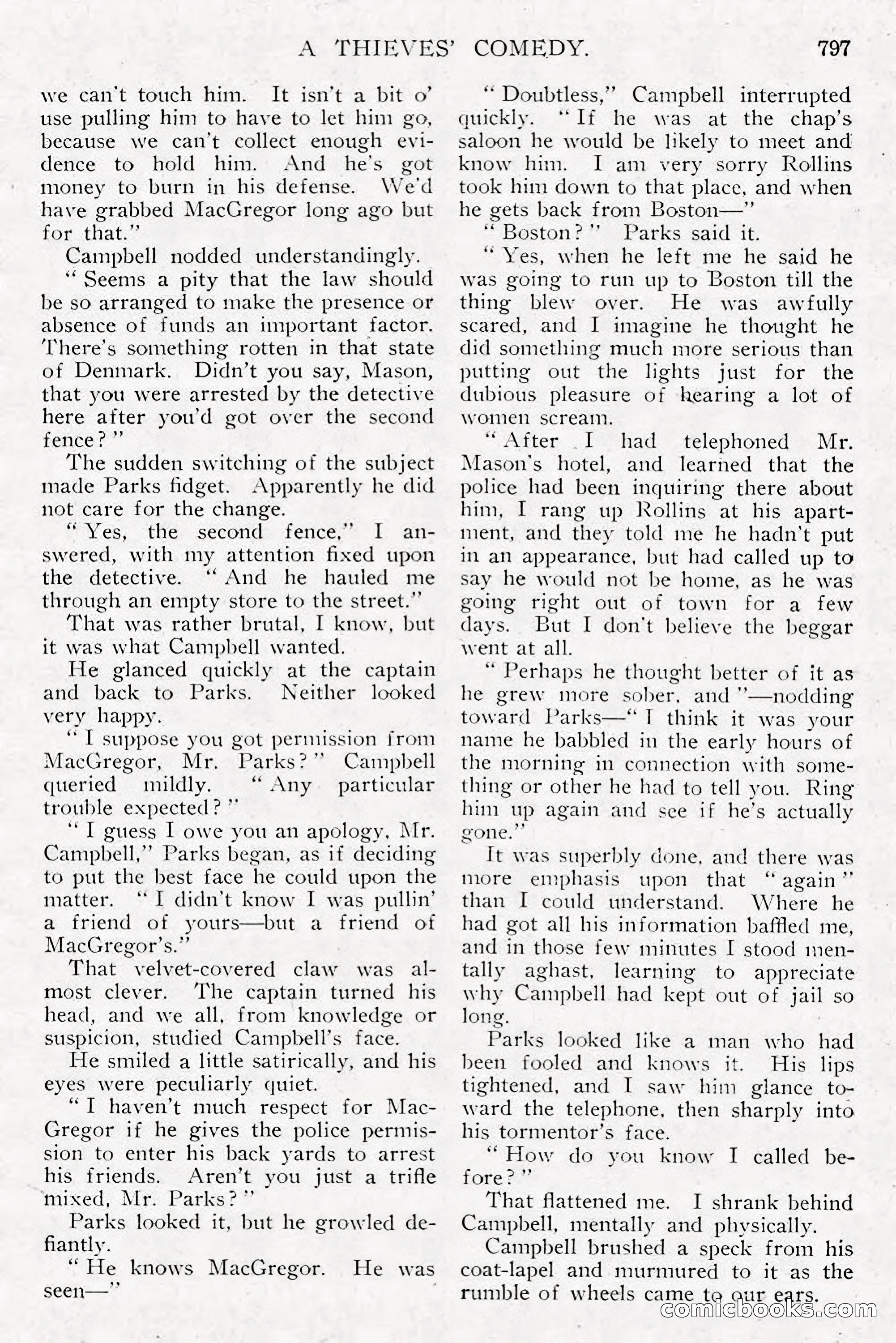
A restored page from Pulp Fiction, 1913. Page through the whole issue in the reader above.
📄 Transcribed text from this page (OCR, searchable)
Machine-transcribed from the original scan — historical spelling and the odd misread are preserved.
A THIEVES’ we can't touch him. It isn’t a bit o° use pulling him to have to let him go, because we can't collect enough evi- dence to hold him. And he’s got money to burn in his defense. We'd have grabbed MacGregor long ago but for that.” Campbell nodded understandingly. ‘Seems a pity that the law should be so arranged to make the presence or absence of funds an important factor. There's something rotten in that state of Denmark. Didn’t you say, Mason, that you were arrested by the detective here after you'd got over the second fence?” The sudden switching of the subject made Parks fidget. Apparently he did not care for the change. “Yes, the second fence,” I an- swered, with my attention fixed upon the detective. ‘And he hauled me through an empty store to the street.” That was rather brutal, I know, but it was what Campbell wanted. He glanced quickly at the captain and back to Parks. Neither looked very happy. * T suppose you got permission from MacGregor, Mr, Parks?’’ Campbell queried mildly. “Any particular trouble expected?” “I guess I owe you an apology, Mr. Campbell,” Parks began, as if deciding to put the best face he could upon the matter. ‘I didn’t know I was pullin’ a friend of yours—but a friend of MacGregor’s.”’ That velvet-covered claw was al- most clever. The captain turned his head, and we all, from knowledge or suspicion, studied Campbell’s face. He smiled a little satirically, and his eyes were peculiarly quiet. “T haven’t much respect for Mac- Gregor if he gives the police permis- sion to enter his back yards to arrest his friends. Aren’t you just a trifle mixed, Mr. Parks? ”’ Parks looked it, but he growled de- fiantly. “He knows MacGregor. He was seen—”’ COMEDY. 797 * Doubtless,” Campbell interrupted quickly. ‘‘If he was at the chap’s saloon he would be likely to meet and know him. I am very sorry Rollins took him down to that place, and when he gets back from Boston—’” “Boston? ’’ Parks said it. “Yes, when he left me he said he was going to run up to Boston till the thing blew over. He was awfully scared, and I imagine he thought he did something much more serious than putting out the lights just for the dubious pleasure of hearing a lot of women scream. “After I had telephoned Mr. Mason's hotel, and learned that the police had been inquiring there about him, I rang up Rollins at his apart- ment, and they told me he hadn't put in an appearance, but had called up to say he would not be home, as he was going right out of town for a few days. But I don’t believe the beggar went at all. “ Perhaps he thought better of it as he grew more sober, and "—nodding toward Parks—*T think it was your name he babbled in the early hours of the morning in connection with some- thing or other he had to tell you. Ring hini up again and see if he’s actually gone.” Tt was superbly done, and there was more emphasis upon that “ again” than I could understand. Where he had got all his information baffled me, and in those few minutes I stood men- tally aghast, learning to appreciate why Campbell had kept out of jail so long. : Parks looked like a man who had been fooled and knows it. His lips tightened, and I saw him glance to- ward the telephone, then sharply into his tormentor’s face. “How do you know I called be- fore?.”’ That flattened me. I shrank behind Campbell, mentally and physically. Campbell brushed a speck from his coat-lapel and murmured to it as the rumble of wheels came te aur ears. CONNIGLOOKS .COhn