
Pulp Fiction, 1913 · page 56 of 268
All Story Magazine, December 1913 — page 56: what you’re looking at
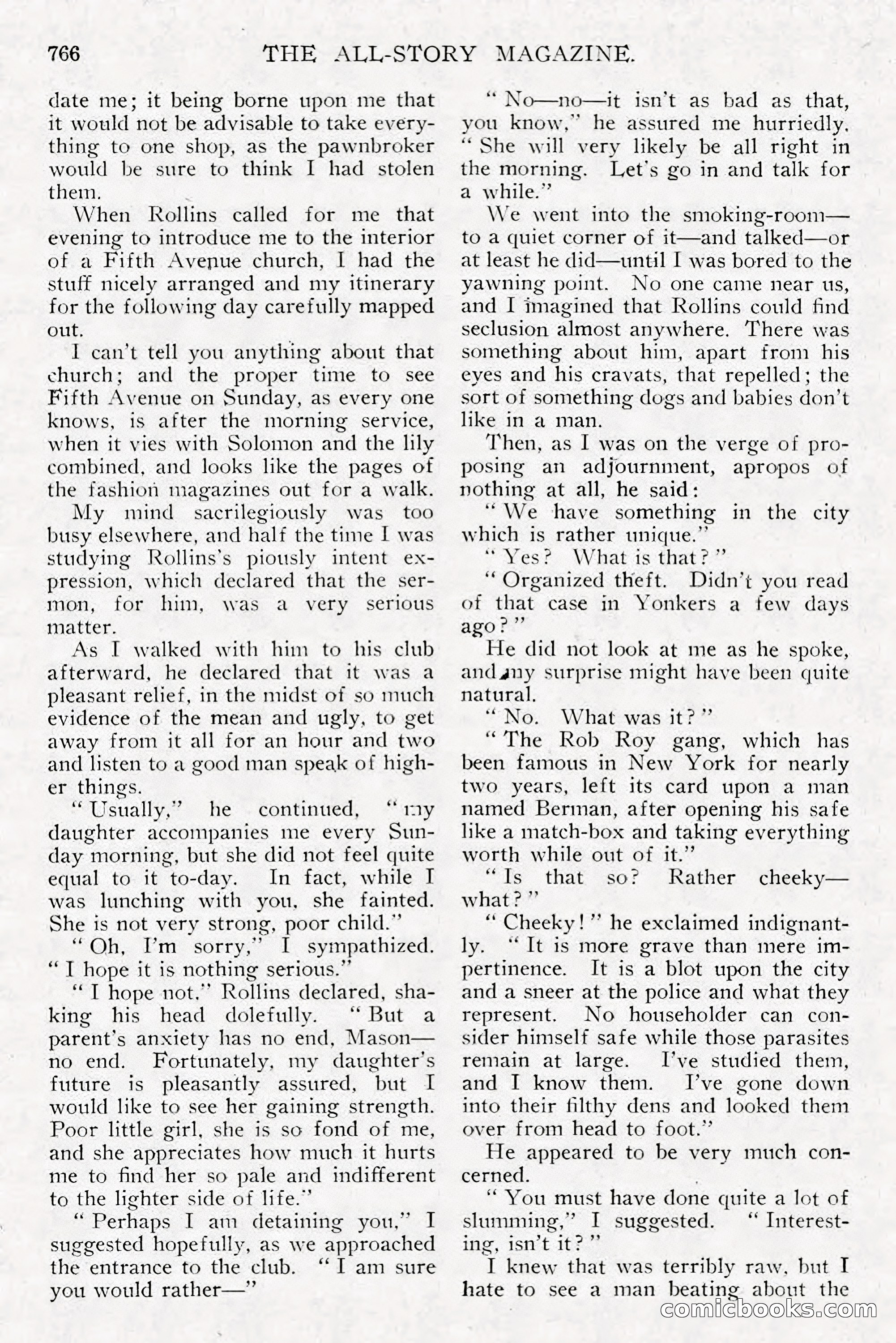
A restored page from Pulp Fiction, 1913. Page through the whole issue in the reader above.
📄 Transcribed text from this page (OCR, searchable)
Machine-transcribed from the original scan — historical spelling and the odd misread are preserved.
766 date me; it being borne upon me that it would not be advisable to take every- thing to one shop, as the pawnbroker would be sure to think I had stolen them. When Rollins called for me _ that evening to introduce me to the interior of a Fifth Avenue church, I had the stuff nicely arranged and my itinerary for the following day carefully mapped out. I can’t tell you anything about that church; and the proper time to see Fifth Avenue on Sunday, as every one knows, is after the morning service, when it vies with Solomon and the lily combined, and looks like the pages of the fashion magazines out for a walk. My mind sacrilegiously was _ too busy elsewhere, and half the time I was studying Rollins’s piously intent ex- pression, which declared that the ser- mon, for him, was a very serious matter. As I walked with him to his club afterward, he declared that it was a pleasant relief, in the midst of so much evidence of the mean and ugly, to get away from it all for an hour and two and listen to a good man speak of high- er things. “Usually,” he . continued, “ay daughter accompanies me every Sun- day morning, but she did not feel quite equal to it to-day. In fact, while I was lunching with you, she fainted. She is not very strong, poor child.” “Oh, I’m sorry,” I sympathized. “T hope it is nothing serious.” “T hope not.” Rollins declared, sha- king his head dolefully. “But a parent’s anxiety has no end, Mason— no end. Fortunately, my daughter's future is pleasantly assured, but I would like to see her gaining strength. Poor little girl, she is so fond of me, and she appreciates how much it hurts me to find her so pale and indifferent to the lighter side of life.” “Perhaps I am detaining you,” I suggested hopefully, as we approached the entrance to the club. “I am sure you would rather—” THE ALL-STORY MAGAZINE. “ No—no—it isn’t as bad as that, you know,” he assured me hurriedly, “She will very likely be all right in the morning. Let’s go in and talk for a while.” We went into the smoking-room— to a quiet corner of it—and talked—or at least he did—until I was bored to the yawning point. No one came near us, and I imagined that Rollins could find seclusion almost anywhere. There was something about him, apart from his eyes and his cravats, that repelled; the sort of something dogs and babies don’t like in a man. Then, as I was on the verge of pro- posing an adjournment, apropos of nothing at all, he said: “We have something in the city which is rather unique.” “Yes? What is that? ” “ Organized theft. Didn’t you read of that case in Yonkers a few days He did not look at me as he spoke, andany surprise might have been quite natural. “No. What was it?” “The Rob Roy gang, which has been famous in New York for nearly two years, left its card upon a man named Berman, after opening his safe like a match-box and taking everything worth while out of it.” “Ts that so? Rather what?” “ Cheeky!’ he exclaimed indignant- ly. “It is more grave than mere im- pertinence. It is a blot upon the city and a sneer at the police and what they represent. No householder can con- sider himself safe while those parasites remain at large. I've studied them, and I know them. I’ve gone down into their filthy dens and looked them over from head to foot.” He appeared to be very much con- cerned. : “You must have done quite a lot of slumming,’ I suggested. “ Interest- ing, isn’t it?” I knew that was terribly raw, but I hate to see a man beating about the connicbooks.conn cheeky—