
Pulp Fiction, 1913 · page 49 of 268
All Story Magazine, December 1913 — page 49: what you’re looking at
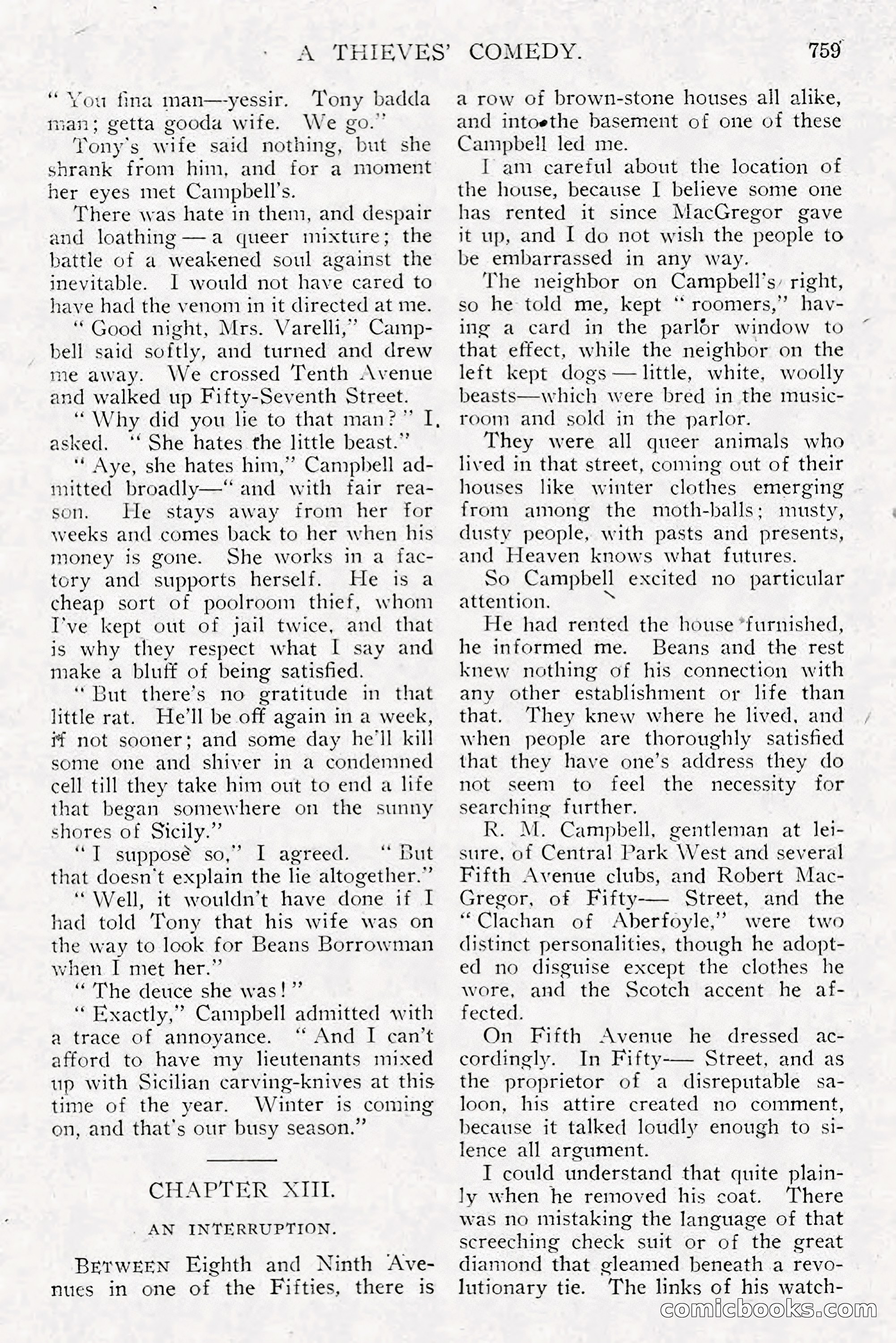
A restored page from Pulp Fiction, 1913. Page through the whole issue in the reader above.
📄 Transcribed text from this page (OCR, searchable)
Machine-transcribed from the original scan — historical spelling and the odd misread are preserved.
A THIEVES’ se You fina man—yessir. Tony badda man; getta gooda wife. We go.” Tony's wife said nothing, but she shrank from him, and for a moment her eyes met Campbell's. There was hate in them, and despair and loathing —a queer mixture; the battle of a weakened soul against the inevitable. I would not have cared to have had the venom in it directed at me. ‘Good night, Mrs. Varelli,’ Camp- bell said softly, and turned and drew me away. We crossed Tenth .\venue and walked up Fifty-Seventh Street. “Why did you lie to that man?” I, asked. ‘‘ She hates the little beast.” ‘* Aye, she hates him,” Campbell ad- mitted broadly—“ and with fair rea- son. He stays away from her for weeks and comes back to her when his money is gone. She works in a fac- tory and supports herself. He is a cheap sort of poolroom thief, whom I’ve kept out of jail twice, and that is why they respect what | say and make a bluff of being satisfied. “ But there’s no gratitude in that little rat. He’ll be off again in a week, if not sooner; and some day he'll kill some one and shiver in a condemned cell till they take him out to end a life that began somewhere on the sunny shores of Sicily.” “I suppose so,” I agreed. “ But that doesn’t explain the lie altogether.” ‘“Well, it wouldn't have done if I had told Tony that his wife was on the way to look for Beans Borrowman when I met her.” “The deuce she was!” “Exactly,” Campbell admitted with a trace of annoyance. “ And I can’t afford to have my lieutenants mixed up with Sicilian carving-knives at this time of the year. Winter is coming on, and that's our busy season.” CHAPTER XIII AN INTERRUPTION. BETWEEN Eighth and Ninth Ave- nues in one of the Fifties, there is COMEDY. 759 a row of brown-stone houses all alike, and intoethe basement of one of these Campbell led me. I am careful about the location of the house, because I believe some one has rented it since MacGregor gave it up, and I do not wish the people to be embarrassed in any way. The neighbor on Campbell's, right, so he told me, kept “ roomers,”’ hay- ing a card in the parlor window to that effect, while the neighbor on the left kept dogs — little, white, woolly beasts—which were bred in the music- room and sold in the parlor. They were all queer animals who lived in that street, coming out of their houses like winter clothes emerging from among the moth-balls; musty, dusty people, with pasts and presents, and Heaven knows what futures. So Campbell excited no particular attention. He had rented the house *furnished, he informed me. Beans and the rest knew nothing of his connection with any other establishment or life than that. They knew where he lived, and when people are thoroughly satisfied that they have one’s address they do not seem to feel the necessity for searching further. R. M. Campbell, gentleman at lei- sure, of Central Park West and several Fifth Avenue clubs, and Robert Mac- Gregor, of Fifty-— Street, and the ““Clachan of Aberfoyle,” were two distinct personalities, though he adopt- ed no disguise except the clothes he wore, and the Scotch accent he af- fected. On Fifth Avenue he dressed ac- cordingly. In Fifty-— Street, and as the proprietor of a disreputable sa- loon, his attire created no comment, because it talked loudly enough to si- lence all argument. I could understand that quite plain- ly when he removed his coat. There was no mistaking the language of that screeching check suit or of the great dianiond that gleamed beneath a revo- lutionary tie. The links of his watch- comicloooks.com