
Pulp Fiction, 1913 · page 44 of 268
All Story Magazine, December 1913 — page 44: what you’re looking at
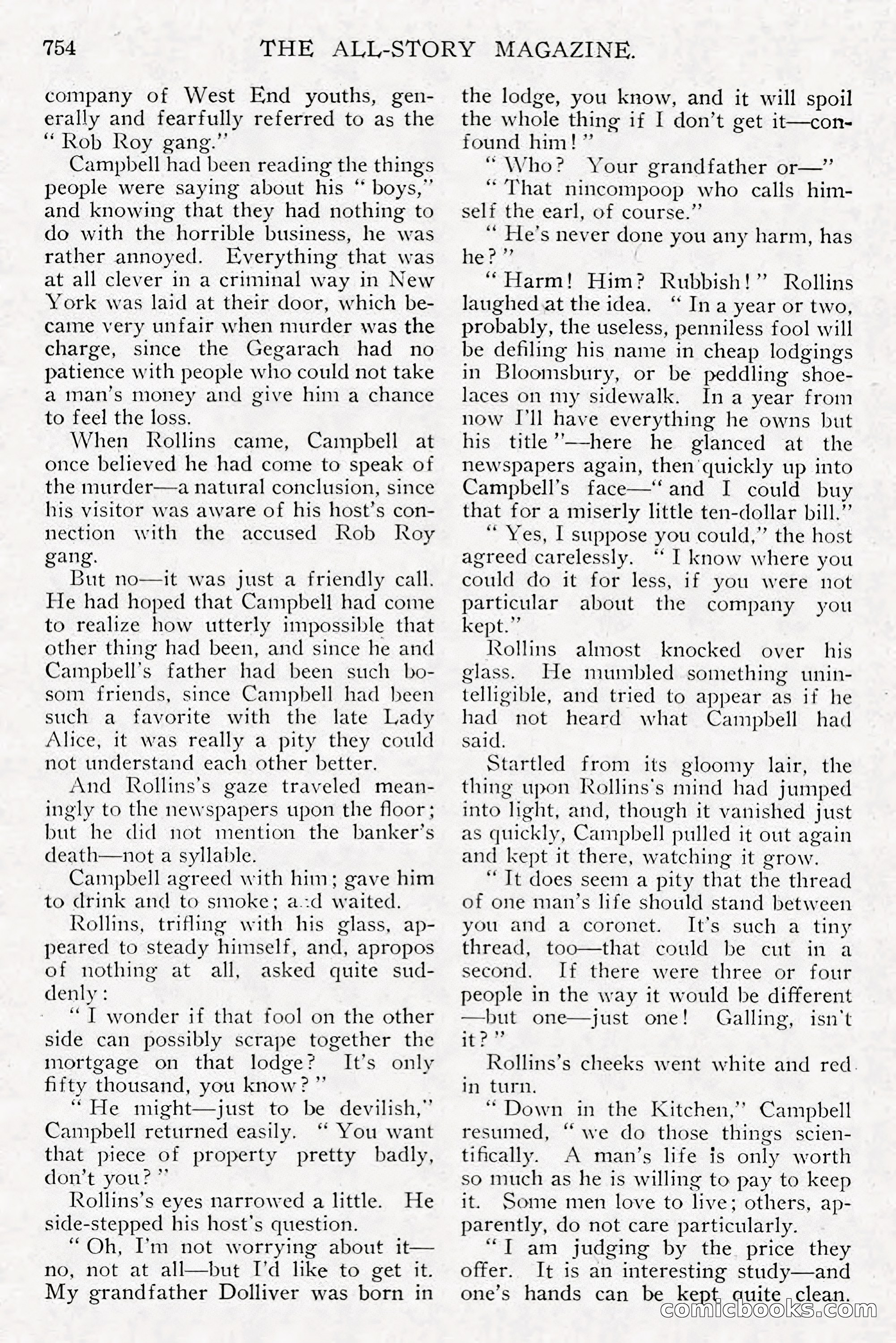
A restored page from Pulp Fiction, 1913. Page through the whole issue in the reader above.
📄 Transcribed text from this page (OCR, searchable)
Machine-transcribed from the original scan — historical spelling and the odd misread are preserved.
754 company of West End youths, gen- erally and fearfully referred to as the “Rob Roy gang.” Campbell had been reading the things people were saying about his * boys,” and knowing that they had nothing to do with the horrible business, he was rather annoyed. Lverything that was at all clever in a criminal way in New York was laid at their door, which be- came very unfair when murder was the charge, since the Gegarach had no patience with people who could not take a man’s money and give him a chance to feel the loss. When Rollins came, Campbell at once believed he had come to speak of the murder—a natural conclusion, since his visitor was aware of his host's con- nection with the accused Rob Roy gang. But no—it was just a friendly call. He had hoped that Campbell had come to realize how utterly impossible that other thing had been, and since he and Campbell's father had been such bo- som friends, since Campbell had been such a favorite with the late Lady Alice, it was really a pity they could not understand each other better. And Rollins’s gaze traveled mean- ingly to the newspapers upon the floor; but he did not mention the banker’s death—not a syllable. Campbell agreed with him; gave him to drink and to smoke; a.:d waited. Rollins, trifling with his glass, ap- peared to steady himself, and, apropos of nothing at all, asked quite sud- denly : “T wonder if that fool on the other side can possibly scrape together the mortgage on that lodge? It’s only fifty thousand, you know? ”’ “He might—just to be devilish,” Campbell returned easily. ‘ You want that piece of property pretty badly, don’t you?” Rollins’s eyes narrowed a little. side-stepped his host’s question. “Oh, ['m not worrying about it— no, not at all—but I'd like to get it. My grandfather Dolliver was born in He THE ALL-STORY MAGAZINE. the lodge, you know, and it will spoil the whole thing if I don’t get it—con- found him!” “Who? Your grandfather or—” “That nincompoop who calls him- self the earl, of course.” ‘ He’s never done you any harm, has her”? “Harm! Him? Rubbish!” Rollins laughed at the idea. ‘ Ina year or two, probably, the useless, penniless fool will be defiling his name in cheap lodgings in Bloomsbury, or be peddling shoe- laces on my sidewalk. Ina year from now I'll have everything he owns but his title’’-—here he glanced at the newspapers again, then'quickly up into Campbell’s face—‘‘and I could buy that for a miserly little ten-dollar bill.” “Yes, I suppose you could,” the host agreed carelessly. “ I know where you could do it for less, if you were not particular about the company you kept.”’ Rollins almost knocked over his glass. He mumbled something unin- telligible, and tried to appear as if he had not heard what Campbell had said. Startled from its gloomy lair, the thing upon Rollins’s mind had jumped into light, and, though it vanished just as quickly, Campbell pulled it out again and kept it there, watching it grow. “Tt does seem a pity that the thread of one man’s life should stand between you and a coronet. It’s such a tiny thread, too—that could be cut in a second. If there were three or four people in the way it would be different —but one—just one! Galling, isn't ite? Rollins’s cheeks went white and red. in turn. “Down in the Kitchen,”” Campbell resumed, “we do those things scien- tifically. A man’s life is only worth so much as he is willing to pay to keep it. Some men love to live; others, ap- parently, do not care particularly. “T am judging by the price they offer. It is an interesting study—and one’s hands can be kept. uite clean. CONNIG OoOkS.Cconn