
Pulp Fiction, 1913 · page 35 of 268
All Story Magazine, December 1913 — page 35: what you’re looking at
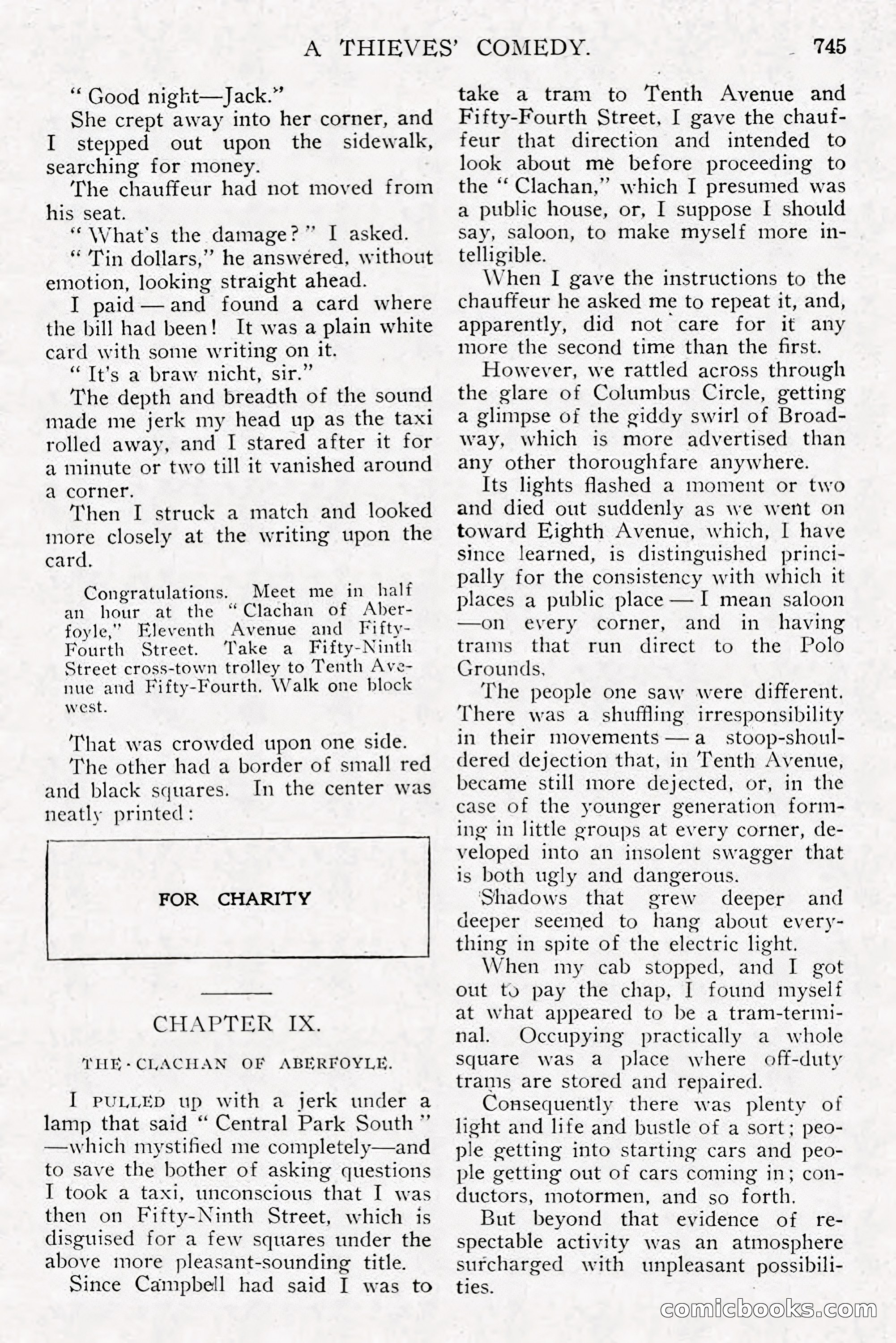
A restored page from Pulp Fiction, 1913. Page through the whole issue in the reader above.
📄 Transcribed text from this page (OCR, searchable)
Machine-transcribed from the original scan — historical spelling and the odd misread are preserved.
A THIEVES’ “Good night—Jack.” She crept away into her corner, and I stepped out upon the sidewalk, searching for money. The chauffeur had not moved from his seat. ‘What's the damage?” I asked. * Tin dollars,” he answered, without emotion, looking straight ahead. I paid—and found a card where the bill had been! It was a plain white card with some writing on it. “It's a braw nicht, sir.” The depth and breadth of the sound made me jerk my head up as the taxi rolled away, and I stared after it for a minute or two till it vanished around a corner. Then I struck a match and looked more closely at the writing upon the card. Congratulations. Meet me in half an hour at the “Clachan of Aber- foyle,” Eleventh Avenue and Fifty- Fourth Street. Take a Fifty-Ninth Street cross-town trolley to Tenth Ave- nue and Fifty-Fourth. Walk one block west. That was crowded upon one side. The other had a border of small red and black squares. In the center was neatly printed: FOR CHARITY GFLAPT ER LX. THE-CLACHAN OF ABERFOYLE. I PULLED up with a jerk under a lamp that said “ Central Park South” —which mystified me completely—and to save the bother of asking questions I took a taxi, unconscious that I was then on Fifty-Ninth Street, which is disguised for a few squares under the above more pleasant-sounding title. Since Campbell had said I was to COMEDY. 745 take a tram to Tenth Avenue and Fifty-Fourth Street, I gave the chauf- feur that direction and intended to look about me before proceeding to the “‘ Clachan,” which I presumed was a public house, or, I suppose I should say, saloon, to make myself more in- telligible. When [ gave the instructions to the chauffeur he asked me to repeat it, and, apparently, did not care for it any more the second time than the first. However, we rattled across through the glare of Columbus Circle, getting a glimpse of the giddy swirl of Broad- way, which is more advertised than any other thoroughfare anywhere. Its lights flashed a moment or two and died out suddenly as we went on toward Eighth Avenue, which, I have since learned, is distinguished princi- pally for the consistency with which it places a public place —I mean saloon —on every corner, and in having trams that run direct to the Polo Grounds, The people one saw were different. There was a shuffling irresponsibility in their movements —a_ stoop-shoul- dered dejection that, in ‘Tenth Avenue, became still more dejected, or, in the case of the younger generation form- ing in little groups at every corner, de- veloped into an insolent swagger that is both ugly and dangerous. Shadows that grew deeper and deeper seemed to hang about every- thing in spite of the electric light. When my cab stopped, and I got out to pay the chap, I found myself at what appeared to be a tram-termi- nal. Occupying practically a whole square was a place where off-duty trams are stored and repaired. Consequently there was plenty of light and life and bustle of a sort; peo- ple getting into starting cars and peo- ple getting out of cars coming in; con- ductors, motormen, and so forth. But beyond that evidence of re- spectable activity was an atmosphere surcharged with unpleasant possibili- ties. comicloooks.com