
Pulp Fiction, 1913 · page 19 of 268
All Story Magazine, December 1913 — page 19: what you’re looking at
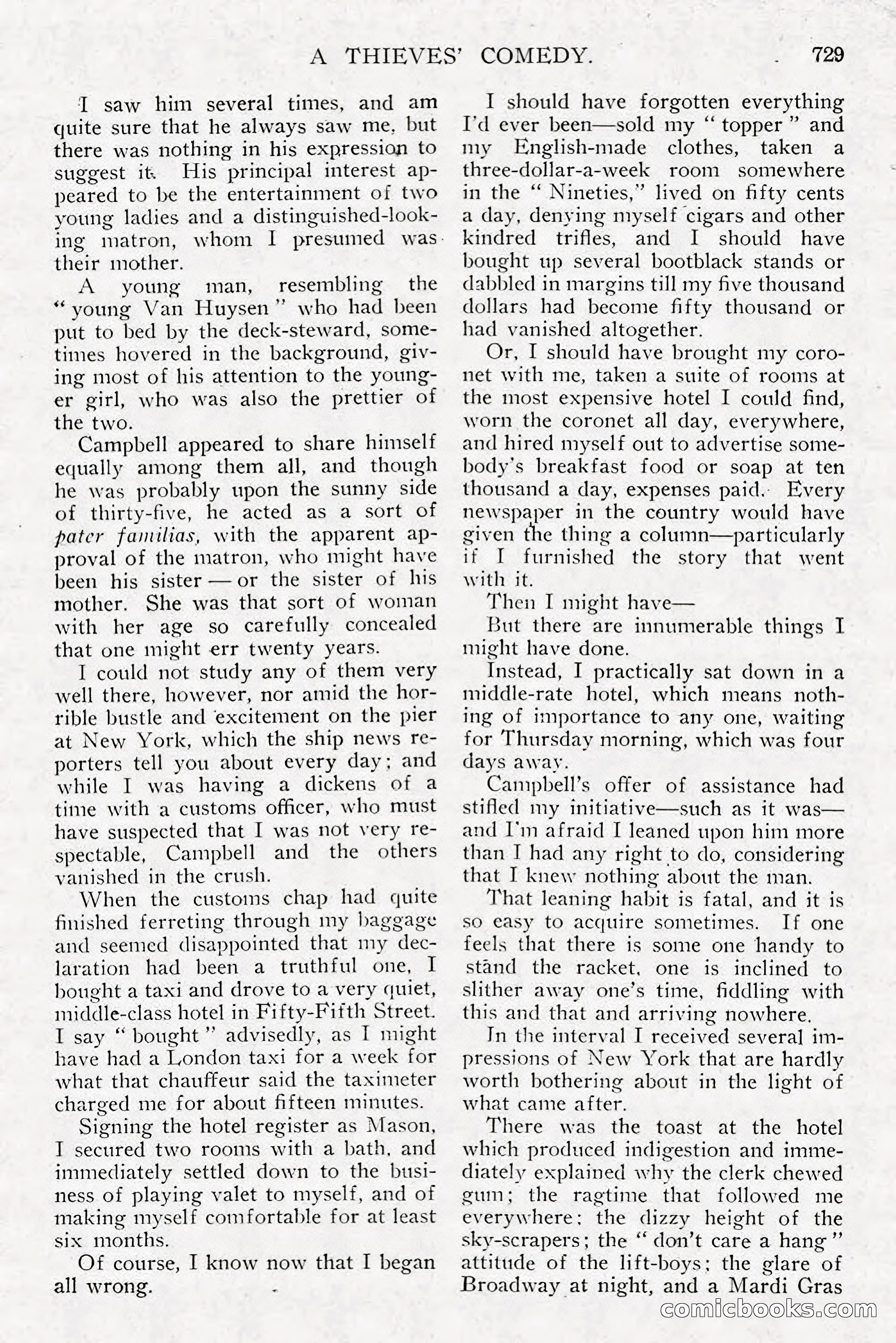
A restored page from Pulp Fiction, 1913. Page through the whole issue in the reader above.
📄 Transcribed text from this page (OCR, searchable)
Machine-transcribed from the original scan — historical spelling and the odd misread are preserved.
A THIEVES’ I saw him several times, and am quite sure that he always saw me, but there was nothing in his expression to suggest it His principal interest ap- peared to be the entertainment of two young ladies and a distinguished-look- ing matron, whom I presumed was. their mother. A young man, resembling — the “young Van Huysen”’ who had been put to bed by the deck-steward, some- times hovered in the background, giv- ing most of his attention to the young- er girl, who was also the prettier of the two. Campbell appeared to share himself equally among them all, and though he was probably upon the sunny side of thirty-five, he acted as a sort of pater familias, with the apparent ap- proval of the matron, who might have been his sister —or the sister of his mother. She was that sort of woman with her age so carefully concealed that one might err twenty years. I could not study any of them very well there, however, nor amid the hor- rible bustle and excitement on the pier at New York, which the ship news re- porters tell you about every day; and while I was having a dickens of a time with a customs officer, who must have suspected that I was not very re- spectable, Campbell and the others vanished in the crush. When the customs chap had quite finished ferreting through my baggage and seemed disappointed that my dec- laration had been a truthful one, I bought a taxi and drove to a very quiet, middle-class hotel in Fifty-Fifth Street. I say “ bought” advisedly, as I might have had a London taxi for a week for what that chauffeur said the taximeter charged me for about fifteen minutes. Signing the hotel register as Mason, T secured two rooms with a bath, and immediately settled down to the busi- ness of playing valet to myself, and of making myself comfortable for at least six months. Of course, I know now that I began all wrong. 2 COMEDY. 729 I should have forgotten everything I'd ever been—sold my “topper ” and my English-made clothes, taken a three-dollar-a-week room somewhere in the “ Nineties,” lived on fifty cents a day, denying myself cigars and other kindred trifles, and I should have bought up several bootblack stands or dabbled in margins till my five thousand dollars had become fifty thousand or had vanished altogether. Or, I should have brought my coro- net with me, taken a suite of rooms at the most expensive hotel I could find, worn the coronet all day, everywhere, and hired myself out to advertise some- body’s breakfast food or soap at ten thousand a day, expenses paid. Every newspaper in the country would have given the thing a column—particularly if I furnished the story that went with it. Then I might have— But there are innumerable things I might have done. Instead, I practically sat down in a middle-rate hotel, which means noth- ing of importance to any one, waiting for Thursday morning, which was four days away. Campbell’s offer of assistance had stifled my initiative—such as it was— and I’m afraid I leaned upon him more than I had any right to do, considering that I knew nothing about the man. That leaning habit is fatal, and it is so easy to acquire sometimes. If one feels that there is some one handy to stand the racket, one is inclined to slither away one’s time, fiddling with this and that and arriving nowhere, In the interval I received several im- pressions of New York that are hardly worth bothering about in the light of what came after. There was the toast at the hotel which produced indigestion and imme- diately explained why the clerk chewed gun; the ragtime that followed me everywhere: the dizzy height of the sky-scrapers; the “ don’t care a hang” attitude of the lift-boys: the glare of Broadway at night, and a Mardi Gras comiicloooks.com