
Pulp Fiction, 1913 · page 122 of 268
All Story Magazine, December 1913 — page 122: what you’re looking at
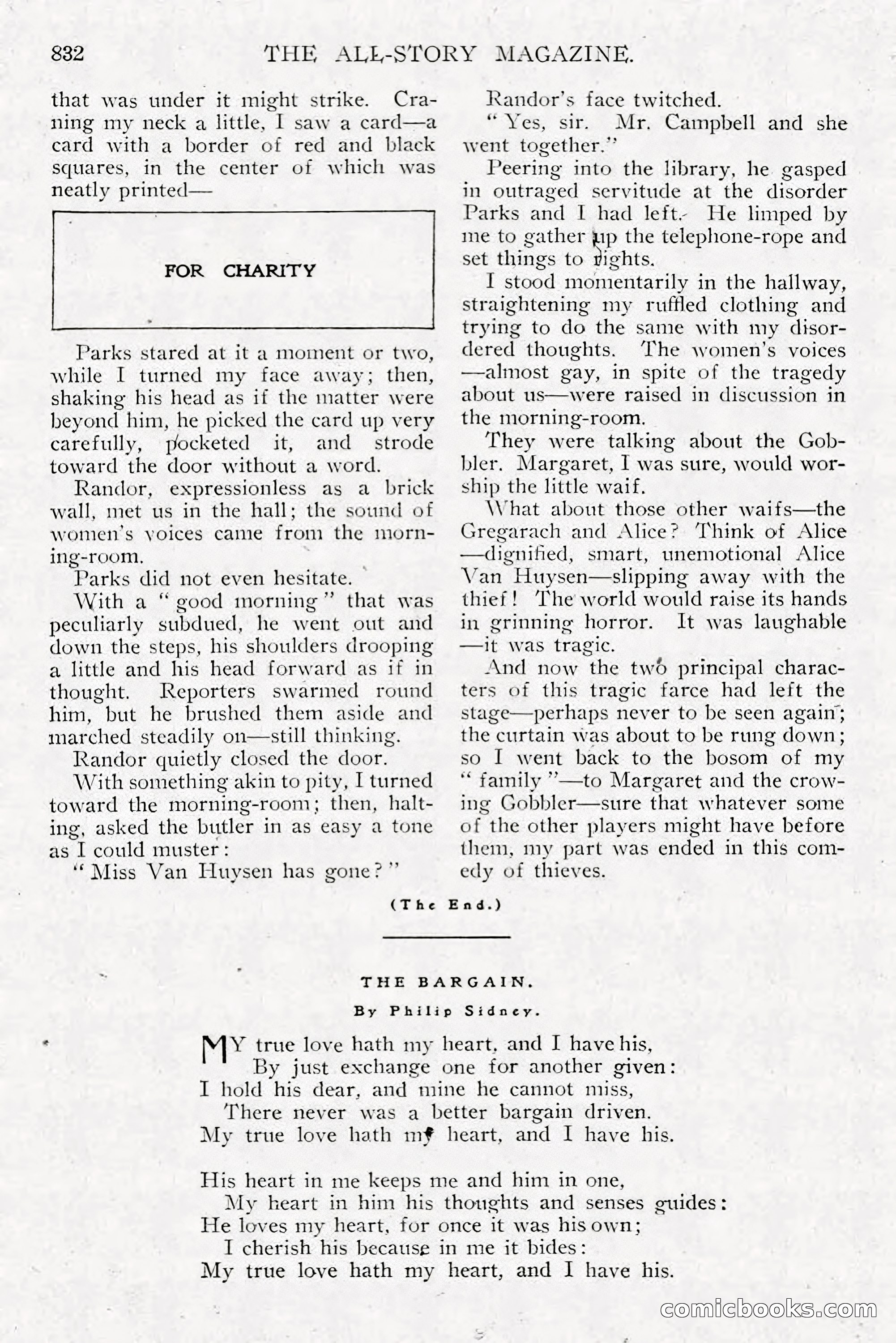
A restored page from Pulp Fiction, 1913. Page through the whole issue in the reader above.
📄 Transcribed text from this page (OCR, searchable)
Machine-transcribed from the original scan — historical spelling and the odd misread are preserved.
832 that was under it might strike. Cra- ning my neck a little, 1 saw a card—a card with a border of red and black squares, in the center of which was neatly printed— FOR CHARITY Parks stared at it a moment or two, while I turned my face away; then, shaking his head as if the matter were beyond him, he picked the card up very carefully, pocketed it, and strode toward the door without a word. Randor, expressionless as a_ brick wall, met us in the hall; the sound of women's yoices came from the morn- ing-room, Parks did not even hesitate. With a “ good morning” that was peculiarly subdued, he went out and down the steps, his shoulders drooping a little and his head forward as if in thought. Reporters swarmed round him, but he brushed them aside and marched steadily on—still thinking. Randor quietly closed the door. With something akin to pity, I turned toward the morning-room; then, halt- ing, asked the butler in as easy a tone as I could muster: ““ Miss Van Huysen has gone?” THE ALE-STORY MAGAZINE. Randor’s face twitched. “Yes, sir. Mr. Campbell and she went together.” Peering into the library, he gasped in outraged servitude at the disorder Parks and I had left- He limped by me to gather uP the telephone-rope and set things to rights. I stood momentarily in the hallway, straightening my ruffled clothing and trying to do the same with my disor- dered thoughts. The women’s voices —almost gay, in spite of the tragedy about us—were raised in discussion in the morning-room. They were talking about the Gob- bler. Margaret, I was sure, would wor- ship the little waif. What about those other waifs—the Gregarach and Alice? Think of Alice —dignified, smart, unemotional Alice Van Huysen—slipping away with the thief! The world would raise its hands in grinning horror. It was laughable —it was tragic. And now the tw6 principal charac- ters of this tragic farce had left the stage—perhaps never to be seen again; the curtain was about to be rung down; so I went back to the bosom of my “family ”"—to Margaret and the crow- ing Gobbler—sure that whatever some of the other players might have before them, my part was ended in this com- edy of thieves. (The End.) THE BARGAIN. By Philip Sidney. MY true love hath my heart, and I have his, By just exchange one for another given: I hold his dear, and mine he cannot miss, ‘There never was a better bargain driven. My true love hath mf heart, and I have his. His heart in me keeps me and him in one, My heart in him his thoughts and senses guides: He loves my heart, for once it was his own; I cherish his because in me it bides: My true love hath my heart, and I have his. comicloooks.com