
Pulp Fiction, 1956 · page 20 of 148
Alfred Hitchcock's Mystery Magazine, December 1956 — page 20: what you’re looking at
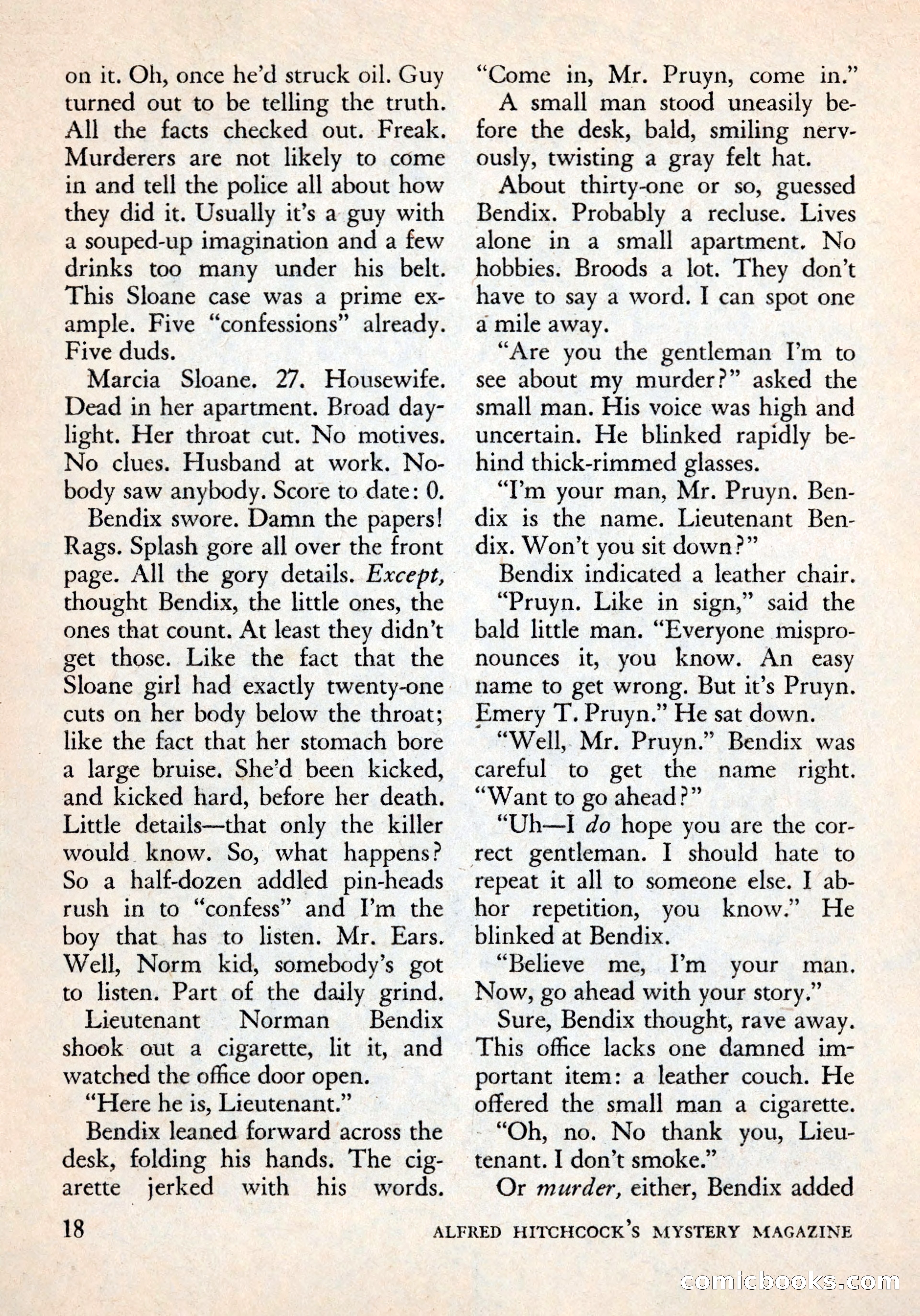
A restored page from Pulp Fiction, 1956. Page through the whole issue in the reader above.
📄 Transcribed text from this page (OCR, searchable)
Machine-transcribed from the original scan — historical spelling and the odd misread are preserved.
on it. Oh, once he’d struck oil. Guy turned out to be telling the truth. All the facts checked out. Freak. Murderers are not likely to come in and tell the police all about how they did it. Usually it’s a guy with a souped-up imagination and a few drinks too many under his belt. This Sloane case was a prime ex- ample. Five “confessions” already. Five duds. Marcia Sloane. 27. Housewife. Dead in her apartment. Broad day- light. Her throat cut. No motives. No clues. Husband at work. No- body saw anybody. Score to date: 0. Bendix swore. Damn the papers! Rags. Splash gore all over the front page. All the gory details. Except, thought Bendix, the little ones, the ones that count. At least they didn’t get those. Like the fact that the Sloane girl had exactly twenty-one cuts on her body below the throat; like the fact that her stomach bore a large bruise. She’d been kicked, and kicked hard, before her death. Little details—that only the killer would know. So, what happens? So a half-dozen addled pin-heads rush in to “confess” and I’m the boy that has to listen. Mr. Ears. Well, Norm kid, somebody’s got to listen. Part of the daily grind. Lieutenant Norman Bendix shook out a cigarette, lit it, and watched the office door open. “Here he is, Lieutenant.” Bendix leaned forward across the desk, folding his hands. The cig- arette jerked with his words. ? “Come in, Mr. Pruyn, come in, A small man stood uneasily be- fore the desk, bald, smiling nerv- ously, twisting a gray felt hat. About thirty-one or so, guessed Bendix. Probably a recluse. Lives alone in a small apartment. No hobbies. Broods a lot. They don’t have to say a word. I can spot one a mile away. “Are you the gentleman I’m to see about my murder?” asked the small man. His voice was high and uncertain. He blinked rapidly be- hind thick-rimmed glasses. “Tm your man, Mr. Pruyn. Ben- dix is the name. Lieutenant Ben- dix. Won’t you sit down?” Bendix indicated a leather chair. “Pruyn. Like in sign,” said the bald little man. “Everyone mispro- nounces it, you know. An easy name to get wrong. But it’s Pruyn. Emery T. Pruyn.” He sat down. “Well, Mr. Pruyn.” Bendix was careful to get the name right. “Want to go ahead?” “Uh—I do hope you are the cor- rect gentleman. I should hate to repeat it all to someone else. J ab- hor repetition, you know.’ He blinked at Bendix. “Believe me, I’m your man, Now, go ahead with your story.” Sure, Bendix thought, rave away. This office lacks one damned im- portant item: a leather couch. He offered the small man a cigarette. - “Oh, no. No thank you, Lieu- ‘tenant. I don’t smoke.” Or murder, either, Bendix added 18 ALFRED HITCHCOCK'S MYSTERY MAGAZINE ECOMMICLOOOCKKSs EO