
Pulp Fiction, 1938 · page 98 of 100
Air Stories — page 98: what you’re looking at
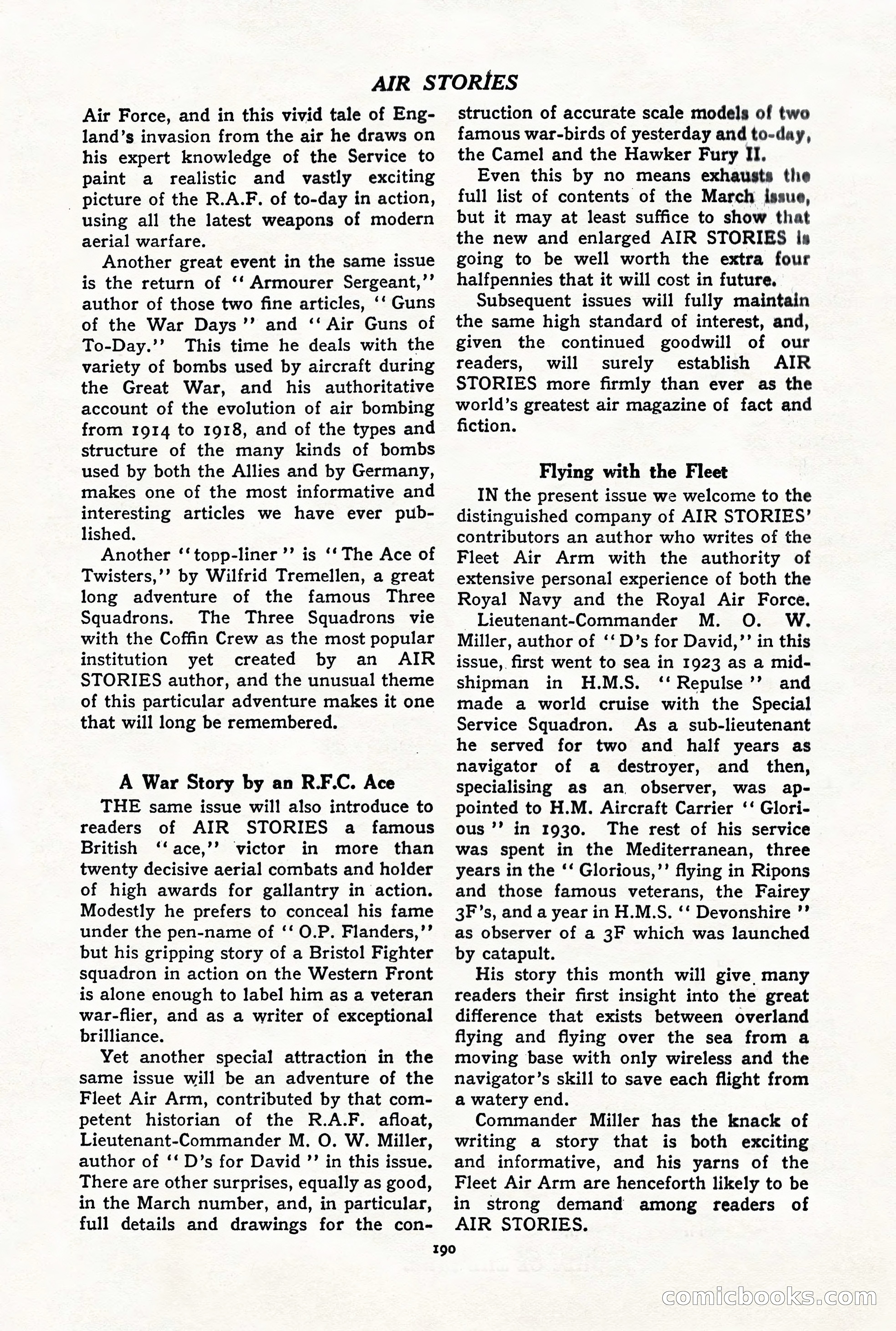
A restored page from Pulp Fiction, 1938. Page through the whole issue in the reader above.
📄 Transcribed text from this page (OCR, searchable)
Machine-transcribed from the original scan — historical spelling and the odd misread are preserved.
AIR STORIES Air Force, and in this vivid tale of Eng- land’s invasion from the air he draws on his expert knowledge of the Service to paint a realistic and vastly exciting _ picture of the R.A.F. of to-day in action, using all the latest weapons of modern aerial warfare. Another great event in the same issue is the return of ‘‘ Armourer Sergeant,”’ author of those two fine articles, ‘‘ Guns of the War Days’’ and ‘‘ Air Guns of To-Day.’’ This time he deals with the variety of bombs used by aircraft during the Great War, and his authoritative account of the evolution of air bombing from 1914 to 1918, and of the types and structure of the many kinds of bombs used by both the Allies and by Germany, makes one of the most informative and interesting articles we have ever pub- lished. Another ‘‘topp-liner ’’ is ‘‘ The Ace of Twisters,’’ by Wilfrid Tremellen, a great long adventure of the famous Three Squadrons. The Three Squadrons vie with the Coffin Crew as the most popular institution yet created by an AIR STORIES author, and the unusual theme of this particular adventure makes it one that will long be remembered. A War Story by an R.F.C. Ace THE same issue will also introduce to readers of AIR STORIES a famous British ‘‘ace,’’ victor in more than twenty decisive aerial combats and holder of high awards for gallantry in action. Modestly he prefers to conceal his fame under the pen-name of ‘‘ O.P. Flanders,’’ but his gripping story of a Bristol Fighter squadron in action on the Western Front is alone enough to label him as a veteran war-flier, and as a writer of exceptional brilliance. Yet another special attraction in the same issue will be an adventure of the Fleet Air Arm, contributed by that com- petent historian of the R.A.F. afloat, Lieutenant-Commander M. O. W. Miller, author of ‘‘ D’s for David ’’ in this issue. There are other surprises, equally as good, in the March number, and, in particular, full details and drawings for the con- struction of accurate scale models of two famous war-birds of yesterday and to-day, the Camel and the Hawker Fury II. Even this by no means exhausts thie full list of contents of the March issue, but it may at least suffice to show that the new and enlarged AIR STORIES is going to be well worth the extra four halfpennies that it will cost in future, Subsequent issues will fully maintain the same high standard of interest, and, given the continued goodwill of our readers, will surely establish AIR STORIES more firmly than ever as the world’s greatest air magazine of fact and fiction. Flying with the Fleet IN the present issue we welcome to the distinguished company of AIR STORIES’ contributors an author who writes of the Fleet Air Arm with the authority of extensive personal experience of both the Royal Navy and the Royal Air Force, _Lieutenant-Commander M. O. W., Miller, author of ‘‘ D’s for David,’’ in this issue, first went to sea in 1923 as a mid- shipman in H.M.S. ‘‘ Repulse’’ and made a world cruise with the Special Service Squadron. As a sub-lieutenant he served for two and half years as navigator of a destroyer, and _ then, specialising as an. observer, was ap- pointed to H.M. Aircraft Carrier ‘‘ Glori- ous ’’ in 1930. The rest of his service was spent in the Mediterranean, three years in the ‘‘ Glorious,’’ flying in Ripons and those famous veterans, the Fairey 3F’s, and a year in H.M.S. ‘‘ Devonshire ’’ as observer of a 3F which was launched by catapult. His story this month will give many readers their first insight into the great difference that exists between overland flying and flying over the sea from a moving base with only wireless and the navigator’s skill to save each flight from a watery end. Commander Miller has the knack of writing a story that is both exciting and informative, and his yarns of the Fleet Air Arm are henceforth likely to be in strong demand among readers of AIR STORIES. 190 COmiclbook (©