
Pulp Fiction, 1938 · page 95 of 100
Air Stories — page 95: what you’re looking at
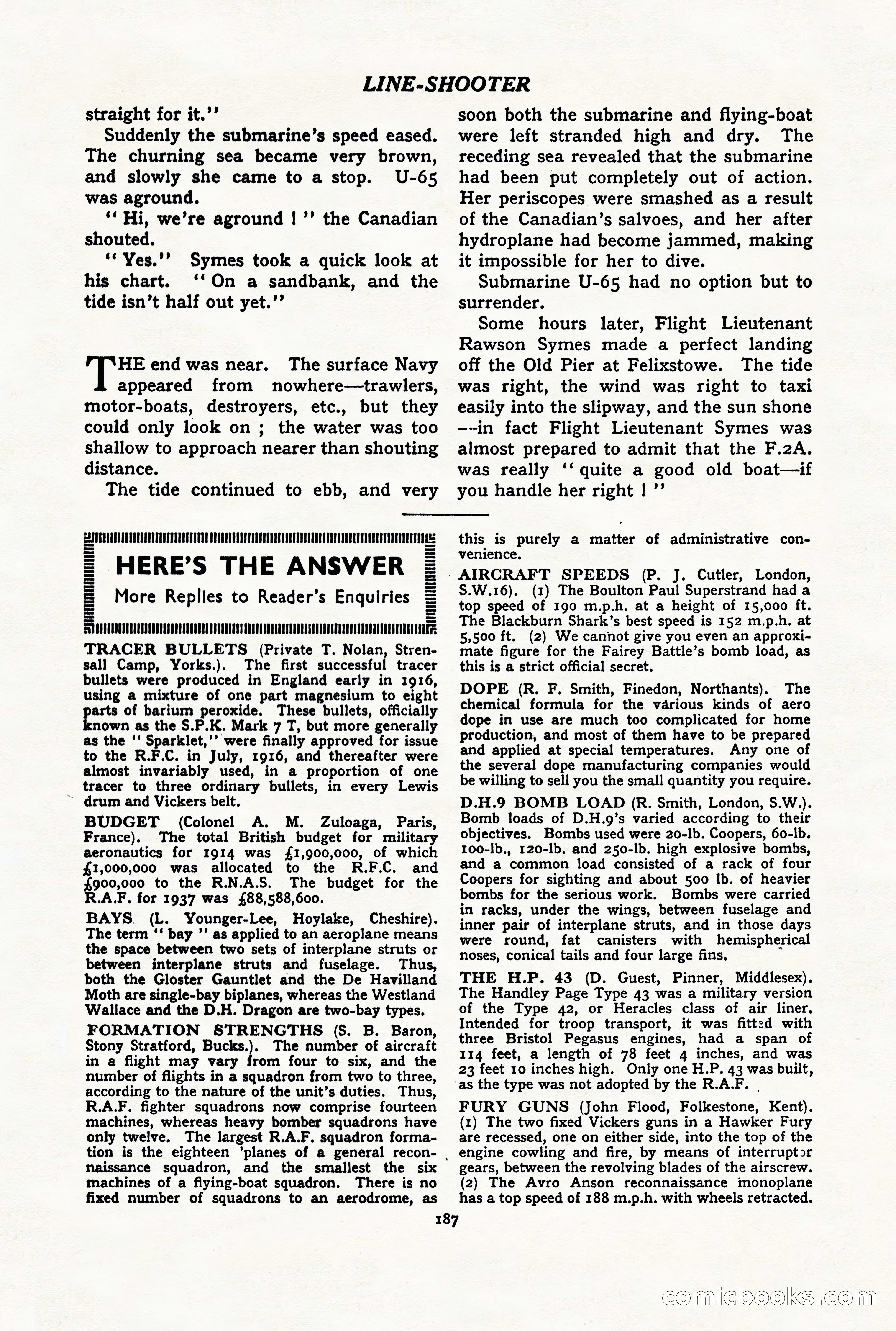
A restored page from Pulp Fiction, 1938. Page through the whole issue in the reader above.
📄 Transcribed text from this page (OCR, searchable)
Machine-transcribed from the original scan — historical spelling and the odd misread are preserved.
LINE-SHOOTER straight for it.’’ Suddenly the submarine’s speed eased. The churning sea became very brown, and slowly she came to a stop. U-65 was aground. ‘‘ Hi, we’re aground !’’ the Canadian shouted. ‘* Yes.’? Symes took a quick look at his chart. ‘‘On a sandbank, and the tide isn’t half out yet.’’ HE end was near. The surface Navy appeared from nowhere—trawlers, motor-boats, destroyers, etc., but they could only look on ; the water was too shallow to approach nearer than shouting distance. The tide continued to ebb, and very soon both the submarine and flying-boat were left stranded high and dry. The receding sea revealed that the submarine had been put completely out of action. Her periscopes were smashed as a result of the Canadian’s salvoes, and her after hydroplane had become jammed, making it impossible for her to dive. Submarine U-65 had no option but to surrender. Some hours later, Flight Lieutenant Rawson Symes made a perfect landing off the Old Pier at Felixstowe. The tide was right, the wind was right to taxi easily into the slipway, and the sun shone —~-in fact Flight Lieutenant Symes was almost prepared to admit that the F.2A. was really ‘‘ quite a good old boat—if you handle her right ! ’’ PEUUAUNOUEUECRNGAONCVOGEGUON OOUNOROSOUGEOORQONSENDOSAVONCSONSQOQUENOGEONOOOOONENSE LE HERE’S THE ANSWER More Replies to Reader’s Enquiries al = = UODNEUAENEAEUUUE UBT SM TRACER BULLETS (Private T. Nolan, Stren- sall Camp, Yorks.). The first successful tracer bullets were produced in England early in 1916, using a mixture of one part magnesium to eight parts of barium peroxide. These bullets, officially known as the S.P.K. Mark 7 T, but more generally as the ‘‘ Sparklet,’’ were finally approved for issue to the R.F.C. in July, 1916, and thereafter were almost invariably used, in a proportion of one tracer to three ordinary bullets, in every Lewis ~ drum and Vickers belt. BUDGET (Colonel A. M. Zuloaga, Paris, France). The total British budget for military aeronautics for 1914 was 1,900,000, of which £1,000,000 was allocated to the R.F.C. and £900,000 to the R.N.A.S. The budget for the R.A.F. for 1937 was {£88,588,600. BAYS. (L. Younger-Lee, Hoylake, Cheshire). The term ‘‘ bay ’’ as applied to an aeroplane means the space between two sets of interplane struts or between interplane struts and fuselage. Thus, both the Gloster Gauntlet and the De Havilland Moth are single-bay biplanes, whereas the Westland Wallace and the D.H. Dragon are two-bay types. FORMATION STRENGTHS (S. B. Baron, Stony Stratford, Bucks.), The number of aircraft in a flight may vary from four to six, and the number of flights in a squadron from two to three, according to the nature of the unit’s duties. Thus, R.A.F. fighter squadrons now comprise fourteen machines, whereas heavy bomber squadrons have only twelve. The largest R.A.F. squadron forma- tion is the eighteen ’planes of a general recon- | naissance squadron, and the smallest the six machines of a flying-boat squadron. There is no fixed number of squadrons to an aerodrome, as - AIRCRAFT SPEEDS (P. J. this is purely a matter of administrative con- venience. Cutler, London, S.W.16). (1) The Boulton Paul Superstrand had a top speed of 190 m.p.h. at a height of 15,000 ft. The Blackburn Shark’s best speed is 152 m.p.h. at 5,500 ft. (2) We cannot give you even an approxi- mate figure for the Fairey Battle’s bomb load, as this is a strict official secret. DOPE (R. F. Smith, Finedon, Northants). The chemical formula for the various kinds of aero dope in use are much too complicated for home production, and most of them have to be prepared and applied at special temperatures. Any one of the several dope manufacturing companies would be willing to sell you the small quantity you require. D.H.9 BOMB LOAD (R. Smith, London, $.W.). Bomb loads of D.H.g’s varied according to their objectives. Bombs used were 20-lb. Coopers, 60-Ib. 100-lb., 120-lb. and 250-lb. high explosive bombs, and a common load consisted of a rack of four Coopers for sighting and about 500 Ib. of heavier bombs for the serious work. Bombs were carried in racks, under the wings, between fuselage and inner pair of interplane struts, and in those days were round, fat canisters with hemispherical noses, conical tails and four large fins. THE H.P. 43 (D. Guest, Pinner, Middlesex). The Handley Page Type 43 was a military version of the Type 42, or Heracles class of air liner. Intended for troop transport, it was fitted with three Bristol Pegasus engines, had a span of 114 feet, a length of 78 feet 4 inches, and was 23 feet 10 inches high. Only one H.P. 43 was built, ‘as the type was not adopted by the R.A.F. | FURY GUNS (John Flood, Folkestone, Kent). (1) The two fixed Vickers guns in a Hawker Fury are recessed, one on either side, into the top of the engine cowling and fire, by means of interruptor gears, between the revolving blades of the airscrew. (2) The Avro Anson reconnaissance monoplane has a top speed of 188 m.p.h. with wheels retracted. 187 EO OO (Cc (©