
Pulp Fiction, 1938 · page 81 of 100
Air Stories — page 81: what you’re looking at
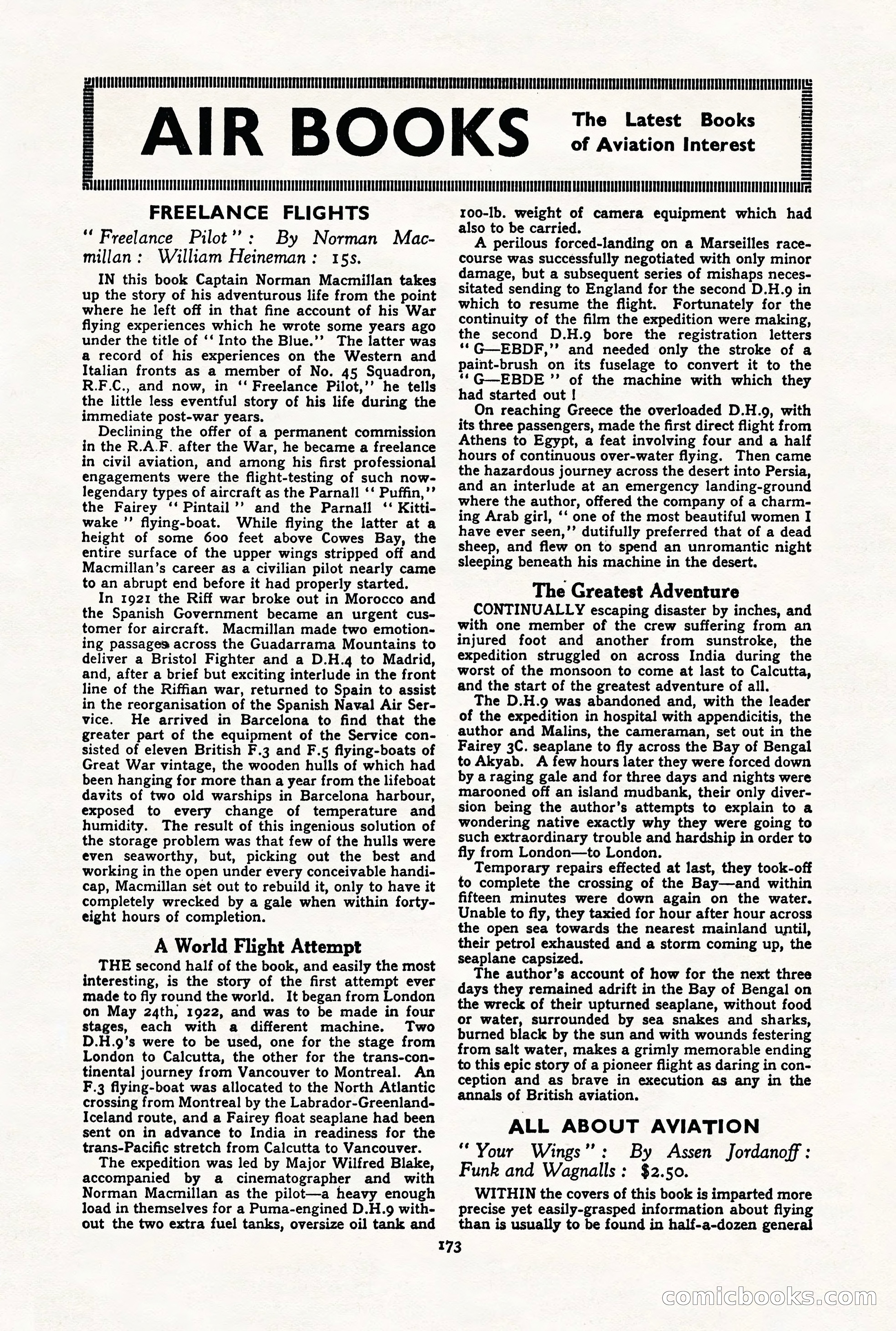
A restored page from Pulp Fiction, 1938. Page through the whole issue in the reader above.
📄 Transcribed text from this page (OCR, searchable)
Machine-transcribed from the original scan — historical spelling and the odd misread are preserved.
FREELANCE FLIGHTS “Freelance Pilot’’: By Norman Mac- millan: William Heineman: 153s. IN this book Captain Norman Macmillan takes up the story of his adventurous life from the point where he left off in that fine account of his War flying experiences which he wrote some years ago under the title of ‘‘ Into the Blue.’’ The latter was a record of his experiences on the Western and Italian fronts as a member of No. 45 Squadron, R.F.C., and now, in ‘‘ Freelance Pilot,’’ he tells the little less eventful story of his life during the immediate post-war years. Declining the offer of a permanent commission in the R.A.F. after the War, he became a freelance in civil aviation, and among his first professional engagements were the flight-testing of such now- legendary types of aircraft as the Parnall ‘‘ Puffin,’’ the Fairey ‘‘ Pintail’’ and the Parnall ‘‘ Kitti- wake ’’ flying-boat. While flying the latter at a height of some 600 feet above Cowes Bay, the entire surface of the upper wings stripped off and Macmillan’s career as a civilian pilot nearly came to an abrupt end before it had properly started. In 1921 the Riff war broke out in Morocco and the Spanish Government became an urgent cus- tomer for aircraft. Macmillan made two emotion- ing passages across the Guadarrama Mountains to deliver a Bristol Fighter and a D.H.q4 to Madrid, and, after a brief but exciting interlude in the front line of the Riffian war, returned to Spain to assist in the reorganisation of the Spanish Naval Air Ser- vice. He arrived in Barcelona to find that the greater part of the equipment of the Service con- sisted of eleven British F.3 and F.5 flying-boats of Great War vintage, the wooden hulls of which had been hanging for more than a year from the lifeboat davits of two old warships in Barcelona harbour, exposed to every change of temperature and humidity. The result of this ingenious solution of the storage problem was that few of the hulls were even seaworthy, but, picking out the best and working in the open under every conceivable handi- cap, Macmillan set out to rebuild it, only to have it completely wrecked by a gale when within forty- eight hours of completion. A World Flight Attempt THE second half of the book, and easily the most interesting, is the story of the first attempt ever made to fly round the world. It began from London on May 24th, 1922, and was to be made in four stages, each with a different machine. Two D.H.g’s were to be used, one for the stage from London to Calcutta, the other for the trans-con- tinental journey from Vancouver to Montreal. An F.3 flying-boat was allocated to the North Atlantic crossing from Montreal by the Labrador-Greenland- Iceland route, and a Fairey float seaplane had been sent on in advance to India in readiness for the trans-Pacific stretch from Calcutta to Vancouver. The expedition was led by Major Wilfred Blake, accompanied by a cinematographer and with Norman Macmillan as the pilot—a heavy enough load in themselves for a Puma-engined D.H.9 with- out the two extra fuel tanks, oversize oil tank and SEUUAGUAEANUOUEOOGORENNOUOUANSANOUGSNOCONOOOANENOGUONEOUEQEOUOVONCUNACONONOVAREOTONNOUONUREOREDCQUQONONOQCGNERNORSOOTAQEQNOUENNONOOEOUOONONOQUQUSONOQUSOURUONOUEOUONONOQNONESUONNQUONONOQTUNLES AIR BOOKS QUUDEODUNNNGQLONNUONTONEQDOOUSRUOGUOONAOUOOUUNOUNQUNONCONOQQUNQUNONOOUOUEQONNUOQUGQUEQNEQUCQUGQUNOQU0GBUOQUOGUEQNSSNOQUSOUNQNDOQUQQUOQUOQUQQUUSUOQUQUUOUSCQUEDUONNONUQQUSQUEQUOQUUOUOQULOT2 The Latest Books of Aviation Interest JORENUOERANUSELNRULIT 100-lb. weight of camera equipment which had also to be carried. A perilous forced-landing on a Marseilles race- course was successfully negotiated with only minor damage, but a subsequent series of mishaps neces- sitated sending to England for the second D.H.9 in which to resume the flight. Fortunately for the continuity of the film the expedition were making, the second D.H.9 bore the registration letters ‘* G—EBDF,’’ and needed only the stroke of a paint-brush on its fuselage to convert it to the ‘* G—EBDE ’’ of the machine with which they had started out ! On reaching Greece the overloaded D.H.9, with its three passengers, made the first direct flight from Athens to Egypt, a feat involving four and a half hours of continuous over-water flying. Then came the hazardous journey across the desert into Persia, and an interlude at an emergency landing-ground where the author, offered the company of a charm- ing Arab girl, ‘‘ one of the most beautiful women I have ever seen,’’ dutifully preferred that of a dead sheep, and flew on to spend an unromantic night sleeping beneath his machine in the desert. The Greatest Adventure CONTINUALLY escaping disaster by inches, and with one member of the crew suffering from an injured foot and another from sunstroke, the expedition struggled on across India during the worst of the monsoon to come at last to Calcutta, and the start of the greatest adventure of all. The D.H.9 was abandoned and, with the leader of the expedition in hospital with appendicitis, the author and Malins, the cameraman, set out in the Fairey 3C. seaplane to fly across the Bay of Bengal to Akyab. A few hours later they were forced down by a raging gale and for three days and nights were marooned off an island mudbank, their only diver- sion being the author’s attempts to explain to a wondering native exactly why they were going to such extraordinary trouble and hardship in order to fly from London—to London. Temporary repairs effected at last, they took-off to complete the crossing of the Bay—and within fifteen minutes were down again on the water. Unable to fly, they taxied for hour after hour across the open sea towards the nearest mainland until, their petrol exhausted and a storm coming up, the seaplane capsized. The author’s account of how for the next three days they remained adrift in the Bay of Bengal on the wreck of their upturned seaplane, without food or water, surrounded by sea snakes and sharks, burned black by the sun and with wounds festering from salt water, makes a grimly memorable ending to this epic story of a pioneer flight as daring in con- ception and as brave in execution as any in the annals of British aviation. ALL ABOUT AVIATION “Your Wings”: By Assen Jordanoff : Funk and Wagnalls: $2.50. WITHIN the covers of this book is imparted more precise yet easily-grasped information about flying than is usually to be found in half-a-dozen general 173 EO OO) (C (©