
Pulp Fiction, 1938 · page 43 of 100
Air Stories — page 43: what you’re looking at
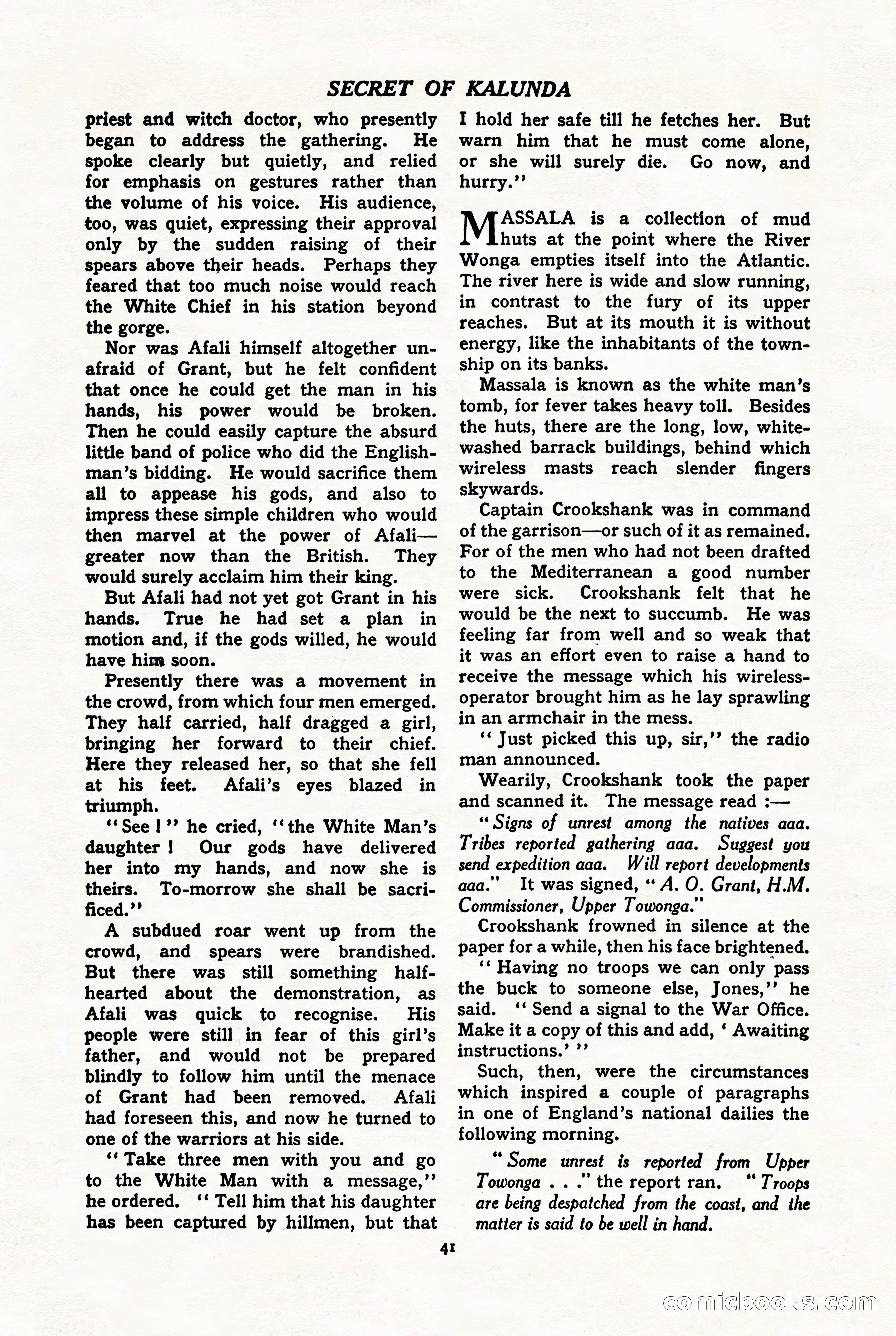
A restored page from Pulp Fiction, 1938. Page through the whole issue in the reader above.
📄 Transcribed text from this page (OCR, searchable)
Machine-transcribed from the original scan — historical spelling and the odd misread are preserved.
SECRET OF KALUNDA priest and witch doctor, who presently began to address the gathering. He spoke clearly but quietly, and relied for emphasis on gestures rather than the volume of his voice. His audience, too, was quiet, expressing their approval only by the sudden raising of their spears above their heads. Perhaps they feared that too much noise would reach the White Chief in his station beyond the gorge. Nor was Afali himself altogether un- afraid of Grant, but he felt confident that once he could get the man in his hands, his power would be broken. Then he could easily capture the absurd little band of police who did the English- man’s bidding. He would sacrifice them all to appease his gods, and also to impress these simple children who would then marvel at the power of Afali— greater now than the British. They would surely acclaim him their king. But Afali had not yet got Grant in his hands. True he had set a plan in motion and, if the gods willed, he would have him soon. Presently there was a movement in the crowd, from which four men emerged. They half carried, half dragged a girl, bringing her forward to their chief. Here they released her, so that she fell at his feet. Afali’s eyes blazed in triumph. : ‘*See !’? he cried, ‘‘the White Man’s daughter! Our gods have delivered her into my hands, and now she is theirs. To-morrow she shall be sacri- ficed.’’ A subdued roar went up from the crowd, and spears were brandished. But there was still something half- hearted about the demonstration, as Afali was quick to recognise. His people were still in fear of this girl’s father, and would not be _ prepared blindly to follow him until the menace of Grant had been removed. Afali had foreseen this, and now he turned to one of the warriors at his side. ‘‘ Take three men with you and go to the White Man with a message,”’’ he ordered. ‘‘ Tell him that his daughter has been captured by hillmen, but that 4! I hold her safe till he fetches her. But warn him that he must come alone, or she will surely die. Go now, and hurry.’’ ASSALA is a collection of mud ‘Ehuts at the point where the River Wonga empties itself into the Atlantic. The river here is wide and slow running, in contrast to the fury of its upper reaches. But at its mouth it is without energy, like the inhabitants of the town- ship on its banks. Massala is known as the white man’s tomb, for fever takes heavy toll. Besides the huts, there are the long, low, white- washed barrack buildings, behind which wireless masts reach slender fingers skywards. Captain Crookshank was in command of the garrison—or such of it as remained. For of the men who had not been drafted to the Mediterranean a good number were sick. Crookshank felt that he would be the next to succumb. He was feeling far from well and so weak that it was an effort even to raise a hand to receive the message which his wireless- operator brought him as he lay sprawling in an armchair in the mess. ‘< Just picked this up, sir,’’ the radio man announced. Wearily, Crookshank took the paper and scanned it. The message read :— *¢ Signs of unrest among the natives aaa. Tribes reported gathering aaa. Suggest you send expedition aaa. Will report developments aaa. It was signed, “A. O. Grant, H.M. Commissioner, Upper Towonga.” Crookshank frowned in silence at the paper for a while, then his face brightened. ‘* Having no troops we can only pass the buck to someone else, Jones,’’ he said. ‘‘ Send a signal to the War Office. Make it a copy of this and add, ‘ Awaiting instructions.’ ’’ Such, then, were the circumstances which inspired a couple of paragraphs in one of England’s national dailies the following morning. “Some unrest is reported from Upper Towonga ... the report ran. ‘“* Troops are being despatched from the coast, and the matter is said to be well in hand. CO DOO)