
Pulp Fiction, 1938 · page 40 of 100
Air Stories — page 40: what you’re looking at
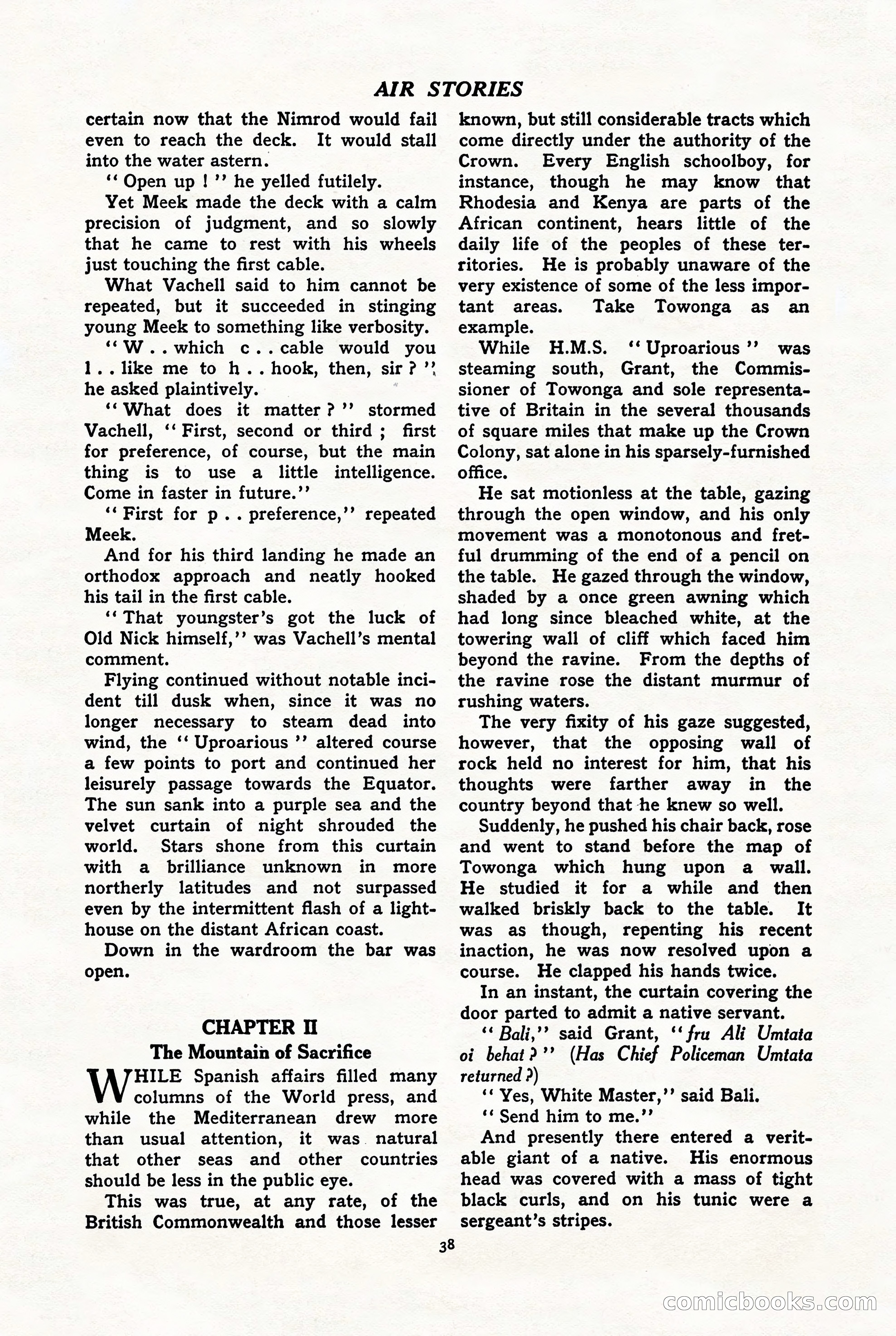
A restored page from Pulp Fiction, 1938. Page through the whole issue in the reader above.
📄 Transcribed text from this page (OCR, searchable)
Machine-transcribed from the original scan — historical spelling and the odd misread are preserved.
AIR STORIES certain now that the Nimrod would fail even to reach the deck. It would stall into the water astern. ‘‘Open up ! ’’ he yelled futilely. Yet Meek made the deck with a calm precision of judgment, and so slowly that he came to rest with his wheels just touching the first cable. What Vachell said to him cannot be repeated, but it succeeded in stinging young Meek to something like verbosity. ‘“W..which c..cable would you 1..like me to h.. hook, then, sir? ’? he asked plaintively. ‘“What does it matter? ’’ stormed Vachell, ‘‘ First, second or third ; first for preference, of course, but the main thing is to use a little intelligence. Come in faster in future.”’ ‘‘ First for p.. preference,’’ repeated Meek. And for his third landing he made an orthodox approach and neatly hooked his tail in the first cable. ‘‘That youngster’s got the luck of Old Nick himself,’’ was Vachell’s mental comment. Flying continued without notable inci- dent till dusk when, since it was no longer necessary to steam dead into wind, the ‘‘ Uproarious ’’ altered course a few points to port and continued her leisurely passage towards the Equator. The sun sank into a purple sea and the velvet curtain of night shrouded the world. Stars shone from this curtain with a brilliance unknown in more northerly latitudes and not surpassed even by the intermittent flash of a light- house on the distant African coast. Down in the wardroom the bar was open. CHAPTER Il The Mountain of Sacrifice HILE Spanish affairs filled many columns of the World press, and while the Mediterranean drew more than usual attention, it was. natural that other seas and other countries should be less in the public eye. This was true, at any rate, of the British Commonwealth and those lesser 38 known, but still considerable tracts which come directly under the authority of the Crown. Every English schoolboy, for instance, though he may know that Rhodesia and Kenya are parts of the African continent, hears little of the daily life of the peoples of these ter- ritories. He is probably unaware of the very existence of some of the less impor- tant areas. Take Towonga as an example. While H.M.S. ‘‘ Uproarious’’ was steaming south, Grant, the Commis- sioner of Towonga and sole representa- tive of Britain in the several thousands of square miles that make up the Crown Colony, sat alone in his sparsely-furnished office. He sat motionless at the table, gazing through the open window, and his only movement was a monotonous and fret- ful drumming of the end of a pencil on the table. He gazed through the window, shaded by a once green awning which had long since bleached white, at the towering wall of cliff which faced him beyond the ravine. From the depths of the ravine rose the distant murmur of rushing waters. The very fixity of his gaze suggested, however, that the opposing wall of rock held no interest for him, that his thoughts were farther away in the country beyond that -he knew so well. Suddenly, he pushed his chair back, rose and went to stand before the map of Towonga which hung upon a wall. He studied it for a while and then walked briskly back to the table. It was as though, repenting his recent inaction, he was now resolved upon a course. He clapped his hands twice. In an instant, the curtain covering the door parted to admit a native servant. ‘¢ Bali,’? said Grant, ‘‘ fru Ali Umtata oi behat?’’ (Has Chief Policeman Umtata returned ?) ‘‘ Yes, White Master,’’ said Bali. ‘* Send him to me.’’ And presently there entered a verit- able giant of a native. His enormous head was covered with a mass of tight black curls, and on his tunic were a sergeant’s stripes. Co LDOO