
Pulp Fiction, 1938 · page 35 of 100
Air Stories — page 35: what you’re looking at
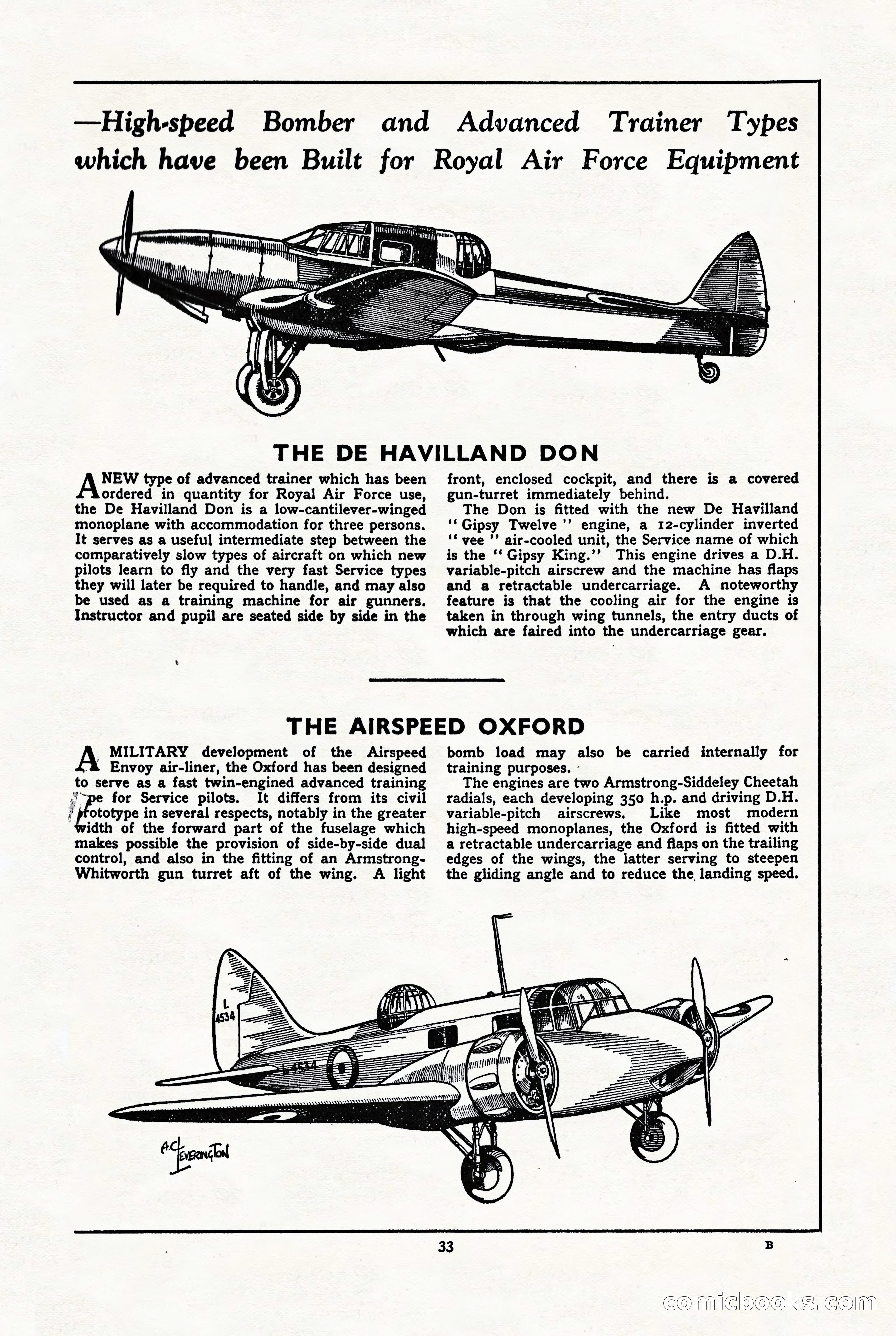
A restored page from Pulp Fiction, 1938. Page through the whole issue in the reader above.
📄 Transcribed text from this page (OCR, searchable)
Machine-transcribed from the original scan — historical spelling and the odd misread are preserved.
—High-speed Bomber and Advanced Trainer ‘Types which have been Built for Royal Air Force Equipment THE DE HAVILLAND DON AY type of advanced trainer which has been ordered in quantity for Royal Air Force use, the De Havilland Don is a low-cantilever-winged monoplane with accommodation for three persons. It serves as a useful intermediate step between the comparatively slow types of aircraft on which new pilots learn to fly and the very fast Service types they will later be required to handle, and may also be used as a training machine for air gunners. Instructor and pupil are seated side by side in the front, enclosed cockpit, and there is a covered gun-turret immediately behind. The Don is fitted with the new De Havilland ‘* Gipsy Twelve ’’ engine, a 12-cylinder inverted ‘* vee ’’ air-cooled unit, the Service name of which is the ‘‘ Gipsy King.’’ This engine drives a D.H. variable-pitch airscrew and the machine has flaps and a retractable undercarriage. A noteworthy feature is that the cooling air for the engine is taken in through wing tunnels, the entry ducts of which are faired into the undercarriage gear. THE AIRSPEED OXFORD , MILITARY development of the Airspeed a Envoy air-liner, the Oxford has been designed to serve as a fast twin-engined advanced training ~pe for Service pilots. It differs from its civil ? jfototype in several respects, notably in the greater idth of the forward part of the fuselage which makes possible the provision of side-by-side dual control, and also in the fitting of an Armstrong- Whitworth gun turret aft of the wing. A light bomb load may also be carried internally for training purposes. » The engines are two Armstrong-Siddeley Cheetah radials, each developing 350 h.p. and driving D.H. variable-pitch airscrews. Like most modern high-speed monoplanes, the Oxford is fitted with a retractable undercarriage and flaps on the trailing edges of the wings, the latter serving to steepen the gliding angle and to reduce the landing speed. COMIC OO® (©