
Pulp Fiction, 1938 · page 29 of 100
Air Stories — page 29: what you’re looking at
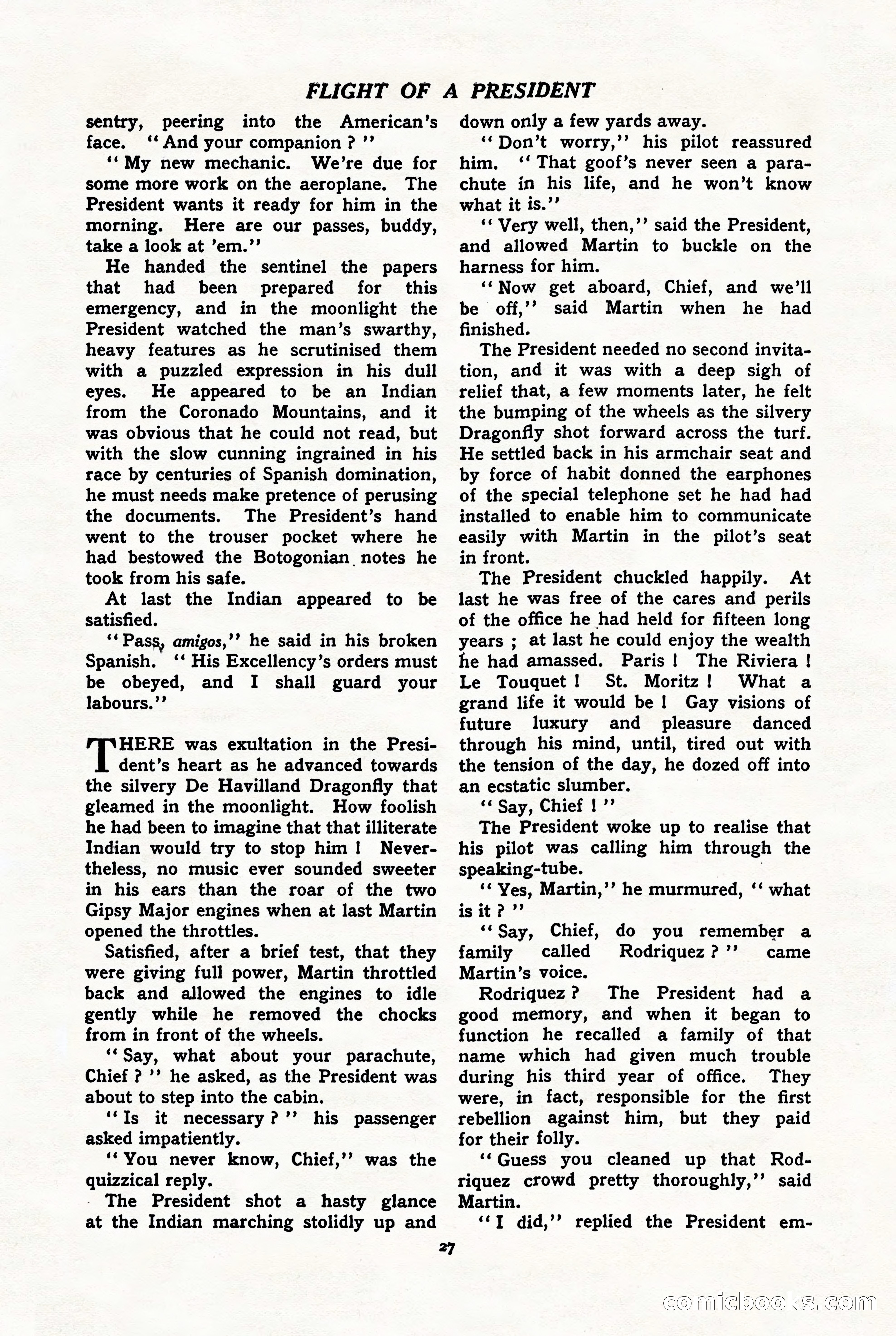
A restored page from Pulp Fiction, 1938. Page through the whole issue in the reader above.
📄 Transcribed text from this page (OCR, searchable)
Machine-transcribed from the original scan — historical spelling and the odd misread are preserved.
FLIGHT OF A PRESIDENT sentry, peering into the American’s face. ‘‘ And your companion ? ’”’ ‘‘My new mechanic. We’re due for some more work on the aeroplane. The President wants it ready for him in the morning. Here are our passes, buddy, take a look at ’em.”’ He handed the sentinel the papers that had been prepared ffor_ this emergency, and in the moonlight the President watched the man’s swarthy, heavy features as he scrutinised them with a puzzled expression in his dull eyes. He appeared to be an Indian from the Coronado Mountains, and it was obvious that he could not read, but with the slow cunning ingrained in his race by centuries of Spanish domination, he must needs make pretence of perusing the documents. The President’s hand went to the trouser pocket where he had bestowed the Botogonian notes he took from his safe. At last the Indian appeared to be satisfied. ‘* Pass, amigos,’’ he said in his broken Spanish. ‘‘ His Excellency’s orders must be obeyed, and I shall guard your labours.”’ HERE was exultation in the Presi- dent’s heart as he advanced towards the silvery De Havilland Dragonfly that gleamed in the moonlight. How foolish he had been to imagine that that illiterate Indian would try to stop him! Never- theless, no music ever sounded sweeter in his ears than the roar of the two Gipsy Major engines when at last Martin opened the throttles. Satisfied, after a brief test, that they were giving full power, Martin throttled back and allowed the engines to idle gently while he removed the chocks from in front of the wheels. ‘‘Say, what about your parachute, Chief ? ’’ he asked, as the President was about to step into the cabin. ‘‘Is it mecessary?’’ his passenger asked impatiently. ‘*'You never know, Chief,’’ was the quizzical reply. - The President shot a hasty glance at the Indian marching stolidly up and 27 down only a few yards away. ‘(Don’t worry,’’ his pilot reassured him. ‘‘ That goof’s never seen a para- chute in his life, and he won’t know what it is.”’ ‘“ Very well, then,’’ said the President, and allowed Martin to buckle on the harness for him. ‘“Now get aboard, Chief, and we’ll be off,’? said Martin when he had finished. The President needed no second invita- tion, and it was with a deep sigh of relief that, a few moments later, he felt the bumping of the wheels as the silvery Dragonfly shot forward across the turf. He settled back in his armchair seat and by force of habit donned the earphones of the special telephone set he had had installed to enable him to communicate easily with Martin in the pilot’s seat in front. The President chuckled happily. At last he was free of the cares and perils of the office he had held for fifteen long years ; at last he could enjoy the wealth he had amassed. Paris! The Riviera ! Le Touquet! St. Moritz! What a grand life it would be! Gay visions of future luxury and pleasure danced through his mind, until, tired out with the tension of the day, he dozed off into an ecstatic slumber. ‘« Say, Chief ! ’’ The President woke up to realise that his pilot was calling him through the speaking-tube. ‘‘ Yes, Martin,’’ he murmured, ‘‘ what is it? ”’ ‘‘Say, Chief, do you remember a family called Rodriquez?’’ came Martin’s voice. Rodriquez? The President had a good memory, and when it began to function he recalled a family of that name which had given much trouble during his third year of office. They were, in fact, responsible for the first rebellion against him, but they paid for their folly. ‘‘Guess you cleaned up that Rod- riquez crowd pretty thoroughly,’’ said Martin. ‘¢T did,’’ replied the President em- CO LDOO