
Pulp Fiction, 1938 · page 27 of 100
Air Stories — page 27: what you’re looking at
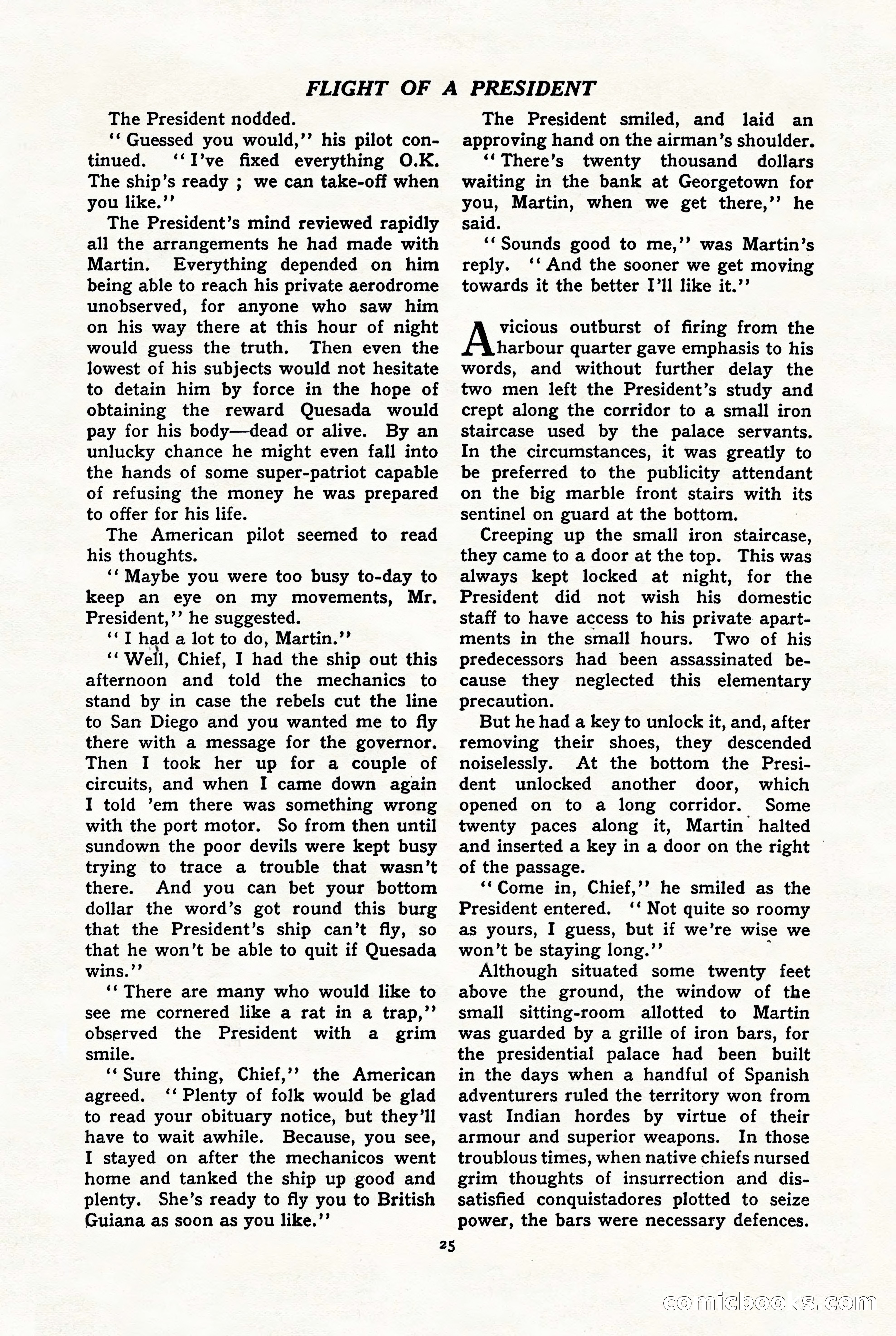
A restored page from Pulp Fiction, 1938. Page through the whole issue in the reader above.
📄 Transcribed text from this page (OCR, searchable)
Machine-transcribed from the original scan — historical spelling and the odd misread are preserved.
FLIGHT OF A PRESIDENT The President nodded. ‘“Guessed you would,’’ his pilot con- tinued. ‘‘I’ve fixed everything O.K. The ship’s ready ; we can take-off when you like.’’ The President’s mind reviewed rapidly all the arrangements he had made with Martin. Everything depended on him being able to reach his private aerodrome unobserved, for anyone who saw him on his way there at this hour of night would guess the truth. Then even the lowest of his subjects would not hesitate to detain him by force in the hope of obtaining the reward Quesada would pay for his body—dead or alive. By an unlucky chance he might even fall into the hands of some super-patriot capable of refusing the money he was prepared to offer for his life. The American pilot seemed to read his thoughts. ‘‘ Maybe you were too busy to-day to keep an eye on my movements, Mr. President,’’ he suggested. ‘“‘T had a lot to do, Martin.” ‘“ Well, Chief, I had the ship out this afternoon and told the mechanics to stand by in case the rebels cut the line to San Diego and you wanted me to fly there with a message for the governor. Then I took her up for a couple of circuits, and when I came down again I told ’em there was something wrong with the port motor. So from then until sundown the poor devils were kept busy trying to trace a trouble that wasn’t there. And you can bet your bottom dollar the word’s got round this burg that the President’s ship can’t fly, so that he won’t be able to quit if Quesada wins.’’ ‘‘ There are many who would like to see me cornered like a rat in a trap,’’ observed the President with a grim smile. ‘‘Sure thing, Chief,’’ the American agreed. ‘‘ Plenty of folk would be glad to read your obituary notice, but they’ll have to wait awhile. Because, you see, I stayed on after the mechanicos went home and tanked the ship up good and plenty. She’s ready to fly you to British Guiana as soon as you like.”’ 25 The President smiled, and laid an approving hand on the airman’s shoulder. ‘‘There’s twenty thousand dollars waiting in the bank at Georgetown for you, Martin, when we get there,’’ he said. ‘“Sounds good to me,’’ was Martin’s reply. ‘‘ And the sooner we get moving towards it the better I’ll like it.’’ vicious outburst of firing from the harbour quarter gave emphasis to his words, and without further delay the two men left the President’s study and crept along the corridor to a small iron staircase used by the palace servants. In the circumstances, it was greatly to be preferred to the publicity attendant on the big marble front stairs with its sentinel on guard at the bottom. Creeping up the small iron staircase, they came to a door at the top. This was always kept locked at night, for the President did not wish his domestic staff to have access to his private apart- ments in the small hours. Two of his predecessors had been assassinated be- cause they neglected this elementary precaution. But he had a key to unlock it, and, after removing their shoes, they descended noiselessly. At the bottom the Presi- dent unlocked another door, which opened on to a long corridor. Some twenty paces along it, Martin halted and inserted a key in a door on the right © of the passage. ‘*Come in, Chief,’’ he smiled as the President entered. ‘‘ Not quite so roomy as yours, I guess, but if we’re wise we won’t be staying long.’’ : Although situated some twenty feet above the ground, the window of the small sitting-room allotted to Martin was guarded by a grille of iron bars, for the presidential palace had been built in the days when a handful of Spanish adventurers ruled the territory won from vast Indian hordes by virtue of their armour and superior weapons. In those troublous times, when native chiefs nursed grim thoughts of insurrection and dis- satisfied conquistadores plotted to seize power, the bars were necessary defences. Co DOO) (©