
Pulp Fiction, 1938 · page 24 of 100
Air Stories — page 24: what you’re looking at
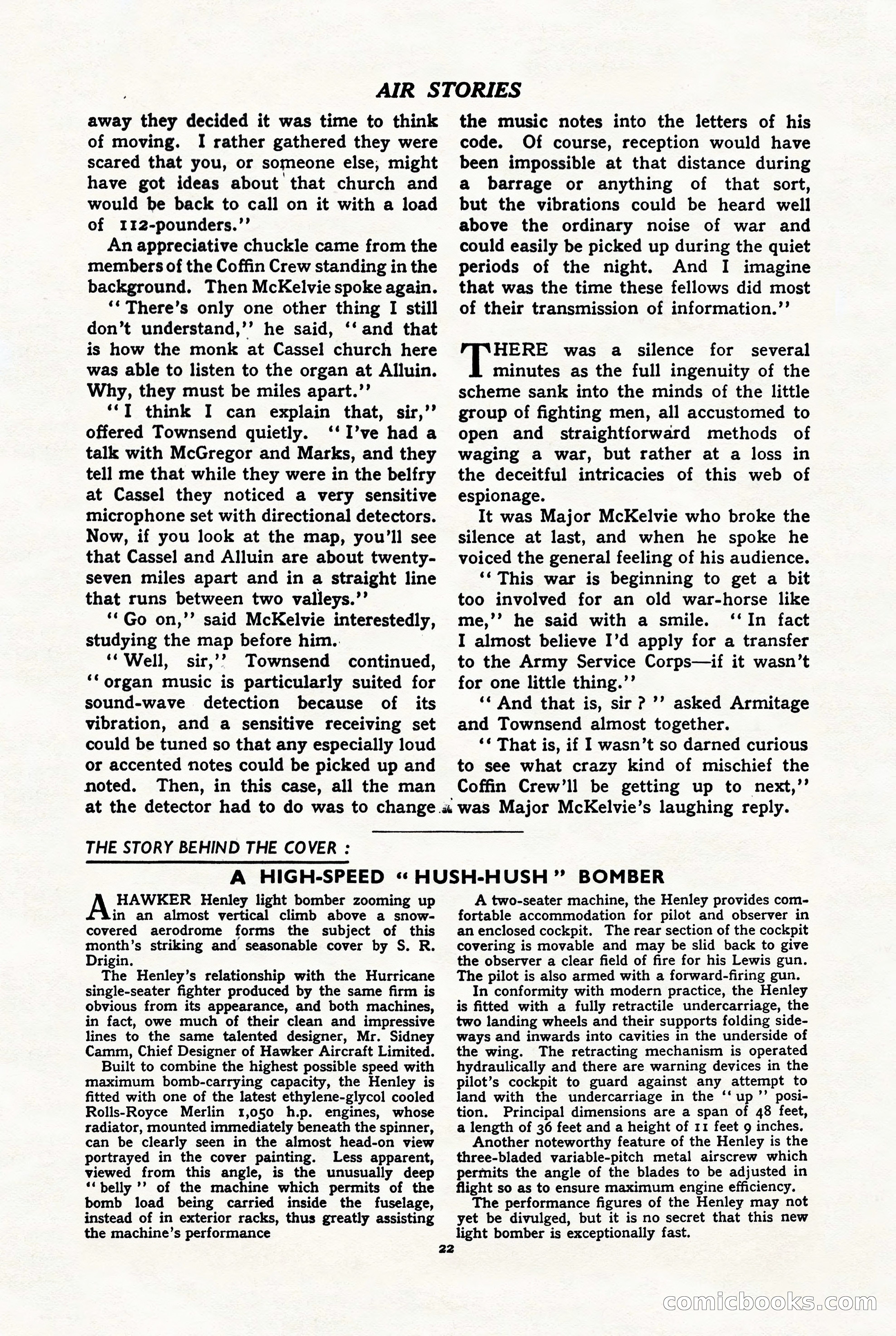
A restored page from Pulp Fiction, 1938. Page through the whole issue in the reader above.
📄 Transcribed text from this page (OCR, searchable)
Machine-transcribed from the original scan — historical spelling and the odd misread are preserved.
AIR STORIES away they decided it was time to think of moving. I rather gathered they were scared that you, or someone else, might have got ideas about that church and would be back to call on it with a load of 112-pounders.”’ An appreciative chuckle came from the members of the Coffin Crew standing in the background. Then McKelvie spoke again. ‘‘ There’s only one other thing I still don’t understand,’’ he said, ‘‘ and that is how the monk at Cassel church here was able to listen to the organ at Alluin. Why, they must be miles apart.’’ ‘‘I think I can explain that, sir,’’ offered Townsend quietly. ‘‘ I’ve had a talk with McGregor and Marks, and they tell me that while they were in the belfry at Cassel they noticed a very sensitive microphone set with directional detectors. Now, if you look at the map, you’ll see that Cassel and Alluin are about twenty- seven miles apart and in a straight line that runs between two valleys.’ ‘*Go on,’’ said McKelvie interestedly, studying the map before him.. ‘* Well, sir,’? Townsend continued, ‘‘organ music is particularly suited for sound-wave detection because of its vibration, and a sensitive receiving set could be tuned so that any especially loud or accented notes could be picked up and noted. Then, in this case, all the man the music notes into the letters of his code. Of course, reception would have been impossible at that distance during a barrage or anything of that sort, but the vibrations could be heard well above the ordinary noise of war and could easily be picked up during the quiet periods of the night. And I imagine that was the time these fellows did most of their transmission of information.”’ HERE was a silence for several minutes as the full ingenuity of the scheme sank into the minds of the little group of fighting men, all accustomed to open and straightforward methods of waging a war, but rather at a loss in the deceitful intricacies of this web of espionage. It was Major McKelvie who broke the silence at last, and when he spoke he voiced the general feeling of his audience. ‘‘ This war is beginning to get a bit too involved for an old war-horse like me,’’ he said with a smile. ‘‘In fact I almost believe I’d apply for a transfer to the Army Service Corps—if it wasn’t for one little thing.’’ ‘‘ And that is, sir? ’’ asked Armitage and Townsend almost together. ‘* That is, if I wasn’t so darned curious to see what crazy kind of mischief the Coffin Crew’ll be getting up to next,’’ at the detector had to do was to change .« was Major McKelvie’s laughing reply. THE STORY BEHIND THE COVER : A HIGH-SPEED « HUSH-HUSH ” BOMBER HAWKER Henley light bomber zooming up in an almost vertical climb above a snow- covered aerodrome forms the subject of this month’s striking and seasonable cover by S. R. Drigin. The Henley’s relationship with the Hurricane single-seater fighter produced by the same firm is obvious from its appearance, and both machines, in fact, owe much of their clean and impressive lines to the same talented designer, Mr. Sidney Camm, Chief Designer of Hawker Aircraft Limited. Built to combine the highest possible speed with maximum bomb-carrying capacity, the Henley is fitted with one of the latest ethylene-glycol cooled Rolls-Royce Merlin 1,050 h.p. engines, whose radiator, mounted immediately beneath the spinner, can be clearly seen in the almost head-on view portrayed in the cover painting. Less apparent, viewed from this angle, is the unusually deep ‘‘ belly ’’ of the machine which permits of the bomb load being carried inside the fuselage, instead of in exterior racks, thus greatly assisting the machine’s performance 22 A two-seater machine, the Henley provides com- fortable accommodation for pilot and observer in an enclosed cockpit. The rear section of the cockpit covering is movable and may be slid back to give the observer a clear field of fire for his Lewis gun. The pilot is also armed with a forward-firing gun. In conformity with modern practice, the Henley is fitted with a fully retractile undercarriage, the two landing wheels and their supports folding side- ways and inwards into cavities in the underside of the wing. The retracting mechanism is operated hydraulically and there are warning devices in the pilot’s cockpit to guard against any attempt to land with the undercarriage in the ‘‘ up ’’ posi- tion. Principal dimensions are a span of 48 feet, a length of 36 feet and a height of 11 feet 9 inches. Another noteworthy feature of the Henley is the three-bladed variable-pitch metal airscrew which permits the angle of the blades to be adjusted in flight so as to ensure maximum engine efficiency. The performance figures of the Henley may not yet be divulged, but it is no secret that this new light bomber is exceptionally fast. COMICLOO© ©