
Pulp Fiction, 1937 · page 12 of 100
Air Stories, November 1937 — page 12: what you’re looking at
A restored page from Pulp Fiction, 1937. Page through the whole issue in the reader above.
📄 Transcribed text from this page (OCR, searchable)
Machine-transcribed from the original scan — historical spelling and the odd misread are preserved.
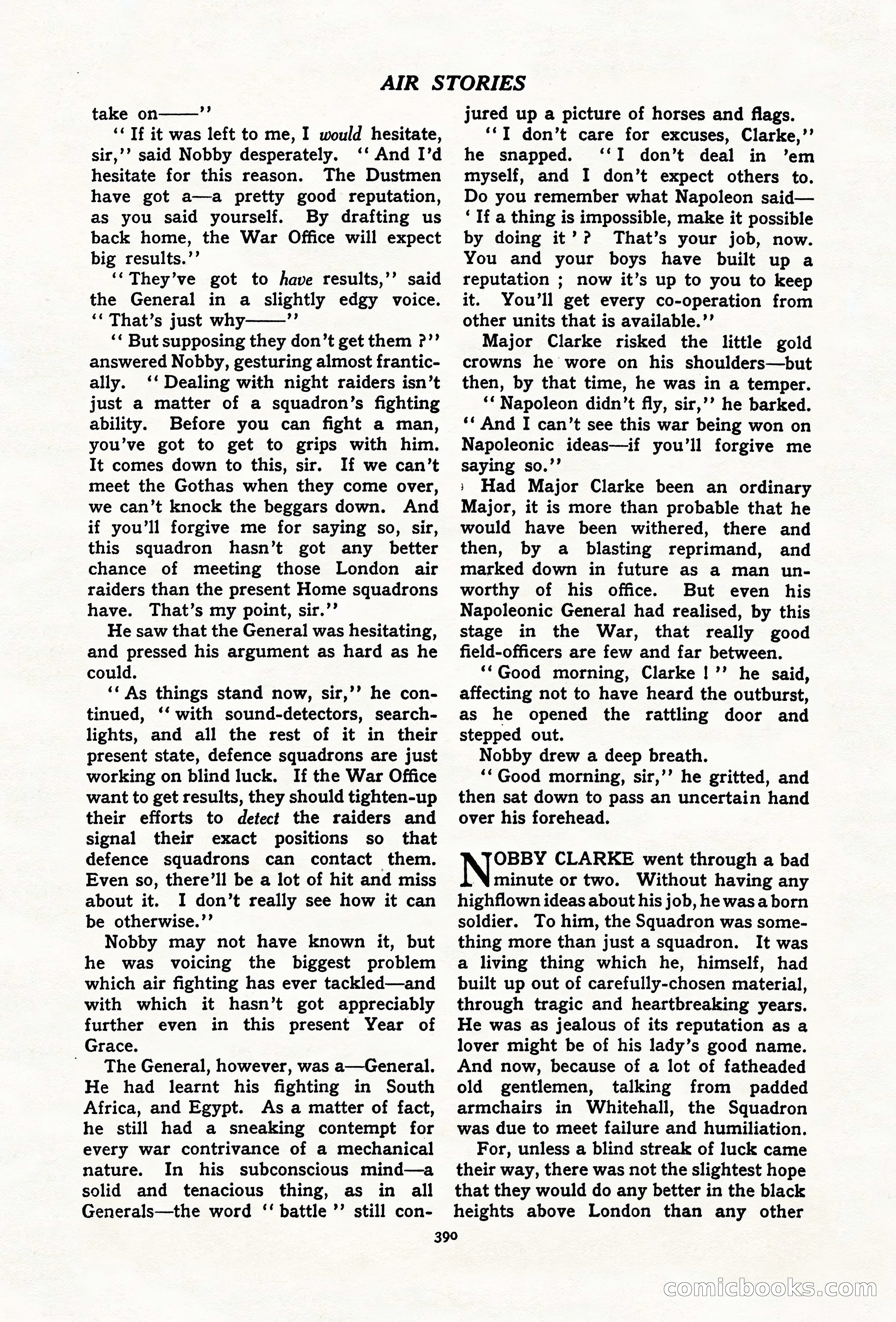
AIR STORIES 99 take on ‘Tf it was left to me, I would hesitate, sir,’’? said Nobby desperately. ‘‘ And I’d hesitate for this reason. The Dustmen have got a—a pretty good reputation, as you said yourself. By drafting us back home, the War Office will expect big results.’’ ‘‘They’ve got to have results,’’ said the General in a slightly edgy voice. ‘‘ That’s just why ts ‘‘ But supposing they don’t get them ?’’ answered Nobby, gesturing almost frantic- ally. ‘‘ Dealing with night raiders isn’t just a matter of a squadron’s fighting ability. Before you can fight a man, you’ve got to get to grips with him. It comes down to this, sir. If we can’t meet the Gothas when they come over, we can’t knock the beggars down. And if you’ll forgive me for saying so, sir, this squadron hasn’t got any better chance of meeting those London air raiders than the present Home squadrons have. That’s my point, sir.’’ He saw that the General was hesitating, and pressed his argument as hard as he could. ‘‘ As things stand now, sir,’’ he con- tinued, ‘‘ with sound-detectors, search- lights, and all the rest of it in their present state, defence squadrons are just working on blind luck. If the War Office want to get results, they should tighten-up their efforts to detect the raiders and signal their exact positions so that defence squadrons can contact them. Even so, there’ll be a lot of hit and miss about it. I don’t really see how it can be otherwise.’’ Nobby may not have known it, but he was voicing the biggest problem which air fighting has ever tackled—and with which it hasn’t got appreciably further even in this present Year of Grace. ' The General, however, was a—General. He had learnt his fighting in South Africa, and Egypt. As a matter of fact, he still had a sneaking contempt for every war contrivance of a mechanical nature. In his subconscious mind—a solid and tenacious thing, as in all Generals—the word “‘ battle ’’ still con- jured up a picture of horses and flags. ‘I don’t care for excuses, Clarke,’’ he snapped. ‘‘I don’t deal in ’em myself, and I don’t expect others to. Do you remember what Napoleon said— ‘ If a thing is impossible, make it possible by doing it’? That’s your job, now. You and your boys have built up a reputation ; now it’s up to you to keep it. You’ll get every co-operation from other units that is available.’’ Major Clarke risked the little gold crowns he wore on his shoulders—but then, by that time, he was in a temper. ‘* Napoleon didn’t fly, sir,’? he barked. ‘‘ And I can’t see this war being won on Napoleonic ideas—if you’ll forgive me saying so.’’ : Had Major Clarke been an ordinary Major, it is more than probable that he would have been withered, there and then, by a blasting reprimand, and marked down in future as a man un- worthy of his office. But even his Napoleonic General had realised, by this stage in the War, that really good field-officers are few and far between. ‘‘Good morning, Clarke !’’ he said, affecting not to have heard the outburst, as he opened the rattling door and stepped out. Nobby drew a deep breath. ‘‘Good morning, sir,’’ he gritted, and then sat down to pass an uncertain hand over his forehead. OBBY CLARKE went through a bad Nminute or two. Without having any highflown ideas about his job, he was a born soldier. To him, the Squadron was some- thing more than just a squadron. It was a living thing which he, himself, had built up out of carefully-chosen material, through tragic and heartbreaking years. He was as jealous of its reputation as a lover might be of his lady’s good name. And now, because of a lot of fatheaded old gentlemen, talking from padded armchairs in Whitehall, the Squadron was due to meet failure and humiliation. For, unless a blind streak of luck came their way, there was not the slightest hope that they would do any better in the black heights above London than any other 390 CoOmicloo (©