
Pulp Fiction, 1936 · page 91 of 98
Air Stories, April 1936 — page 91: what you’re looking at
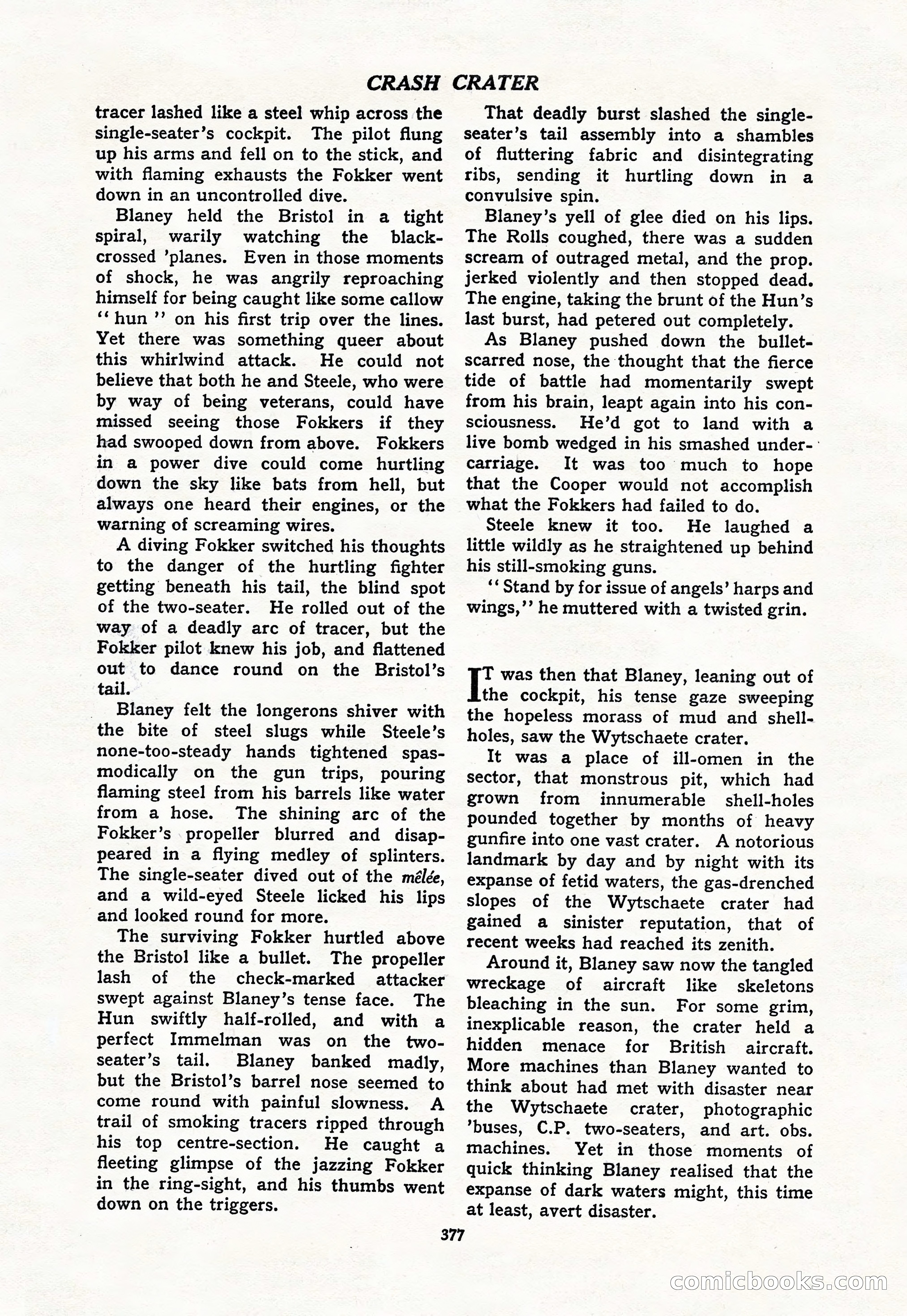
A restored page from Pulp Fiction, 1936. Page through the whole issue in the reader above.
📄 Transcribed text from this page (OCR, searchable)
Machine-transcribed from the original scan — historical spelling and the odd misread are preserved.
CRASH CRATER tracer lashed like a steel whip across the single-seater’s cockpit. The pilot flung up his arms and fell on to the stick, and with flaming exhausts the Fokker went down in an uncontrolled dive. Blaney held the Bristol in a tight spiral, warily watching the black- crossed ’planes. Even in those moments of shock, he was angrily reproaching himself for being caught like some callow ‘‘hun ’”’ on his first trip over the lines. Yet there was something queer about this whirlwind attack. He could not believe that both he and Steele, who were by way of being veterans, could have missed seeing those Fokkers if they had swooped down from above. Fokkers in a power dive could come hurtling down the sky like bats from hell, but always one heard their engines, or the warning of screaming wires. A diving Fokker switched his thoughts to the danger of the hurtling fighter getting beneath his tail, the blind spot of the two-seater. He rolled out of the way of a deadly arc of tracer, but the Fokker pilot knew his job, and flattened out to dance round on the Bristol’s tail. _ Blaney felt the longerons shiver with the bite of steel slugs while Steele’s none-too-steady hands tightened spas- modically on the gun trips, pouring flaming steel from his barrels like water from a hose. The shining arc of the Fokker’s propeller blurred and disap- peared in a flying medley of splinters. The single-seater dived out of the mélée, and a wild-eyed Steele licked his lips and looked round for more. The surviving Fokker hurtled above the Bristol like a bullet. The propeller lash of the check-marked attacker swept against Blaney’s tense face. The Hun swiftly half-rolled, and with a perfect Immelman was on the two- seater’s tail. Blaney banked madly, but the Bristol’s barrel nose seemed to come round with painful slowness. A trail of smoking tracers ripped through his top centre-section. He caught a fleeting glimpse of the jazzing Fokker in the ring-sight, and his thumbs went down on the triggers. 377 That deadly burst slashed the single- seater’s tail assembly into a shambles of fluttering fabric and disintegrating ribs, sending it hurtling down in a convulsive spin. Blaney’s yell of glee died on his lips. The Rolls coughed, there was a sudden scream of outraged metal, and the prop. jerked violently and then stopped dead. The engine, taking the brunt of the Hun’s last burst, had petered out completely. As Blaney pushed down the bullet- scarred nose, the thought that the fierce tide of battle had momentarily swept from his brain, leapt again into his con- sciousness. He’d got to land with a live bomb wedged in his smashed under- ' carriage. It was too much to hope that the Cooper would not accomplish what the Fokkers had failed to do. Steele knew it too. He laughed a little wildly as he straightened up behind his still-smoking guns. ‘* Stand by for issue of angels’ harps and wings,’’ he muttered with a twisted grin. T was then that Blaney, leaning out of the cockpit, his tense gaze sweeping the hopeless morass of mud and shell- holes, saw the Wytschaete crater. It was a place of ill-omen in the sector, that monstrous pit, which had grown from innumerable shell-holes pounded together by months of heavy gunfire into one vast crater. A notorious landmark by day and by night with its expanse of fetid waters, the gas-drenched slopes of the Wytschaete crater had gained a sinister reputation, that of recent weeks had reached its zenith. Around it, Blaney saw now the tangled wreckage of aircraft like skeletons bleaching in the sun. For some grim, inexplicable reason, the crater held a hidden menace for British aircraft. More machines than Blaney wanted to think about had met with disaster near the Wytschaete crater, photographic *buses, C.P. two-seaters, and art. obs. machines. Yet in those moments of quick thinking Blaney realised that the expanse of dark waters might, this time at least, avert disaster. GOMIGIOO SJ (Cl Q)