
Pulp Fiction, 1936 · page 89 of 98
Air Stories, April 1936 — page 89: what you’re looking at
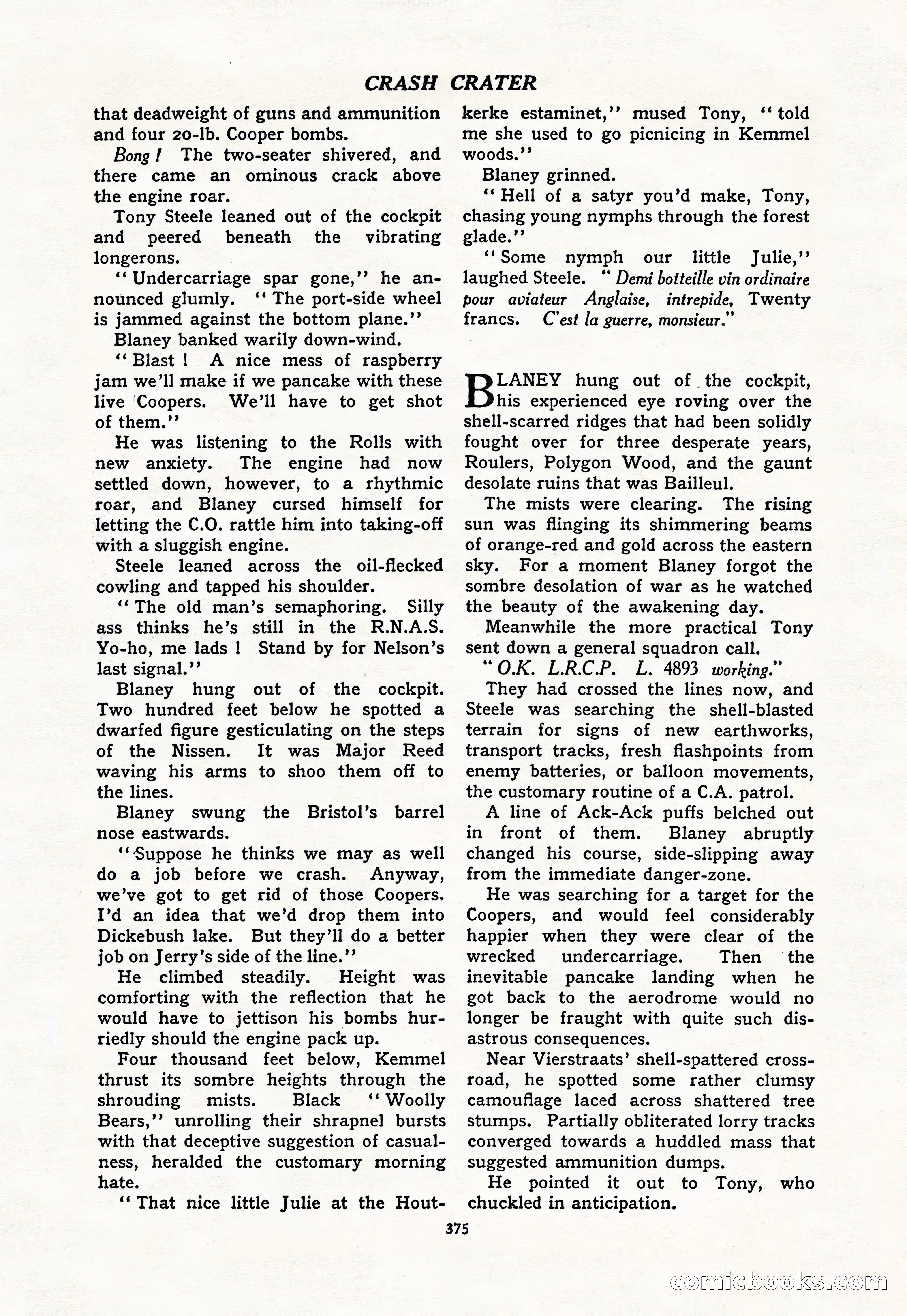
A restored page from Pulp Fiction, 1936. Page through the whole issue in the reader above.
📄 Transcribed text from this page (OCR, searchable)
Machine-transcribed from the original scan — historical spelling and the odd misread are preserved.
CRASH CRATER that deadweight of guns and ammunition and four 20-lb. Cooper bombs. Bong! The two-seater shivered, and there came an ominous crack above the engine roar. Tony Steele leaned out of the cockpit and peered beneath the _ vibrating longerons. ‘‘Undercarriage spar gone,’’ he an- nounced glumly. ‘‘ The port-side wheel is jammed against the bottom plane.’’ Blaney banked warily down-wind. ‘‘Blast ! A nice mess of raspberry jam we’ll make if we pancake with these live ‘Coopers. We’ll have to get shot of them.”’ He was listening to the Rolls with new anxiety. The engine had now settled down, however, to a rhythmic roar, and Blaney cursed himself for letting the C.O. rattle him into taking-off with a sluggish engine. Steele leaned across the oil-flecked cowling and tapped his shoulder. ‘*The old man’s semaphoring. Silly ass thinks he’s still in the R.N.A.S. Yo-ho, me lads ! Stand by for Nelson’s last signal.’’ Blaney hung out of the cockpit. Two hundred feet below he spotted a dwarfed figure gesticulating on the steps of the Nissen. It was Major Reed waving his arms to shoo them off to the lines. Blaney swung the Bristol’s barrel nose eastwards. ‘“Suppose he thinks we may as well do a job before we crash. Anyway, we’ve got to get rid of those Coopers. I’d an idea that we’d drop them into Dickebush lake. But they’ll do a better job on Jerry’s side of the line.’’ He climbed steadily. Height was comforting with the reflection that he would have to jettison his bombs hur- riedly should the engine pack up. Four thousand feet below, Kemmel thrust its sombre heights through the shrouding mists. Black ‘‘ Woolly Bears,’’ unrolling their shrapnel bursts with that deceptive suggestion of casual- ness, heralded the customary morning hate. ‘‘ That nice little Julie at the Hout- kerke estaminet,’’ mused Tony, ‘‘ told me she used to go picnicing in Kemmel woods.”’ , Blaney grinned. ‘‘ Hell of a satyr you’d make, Tony, chasing young nymphs through the forest glade.’’ ‘‘Some nymph our little Julie,’’ laughed Steele. ‘ Demi botteille vin ordinaire pour aviateur Anglaise, intrepide, Twenty francs. C'est la guerre, monsieur.” LANEY hung out of the cockpit, his experienced eye roving over the shell-scarred ridges that had been solidly fought over for three desperate years, Roulers, Polygon Wood, and the gaunt desolate ruins that was Bailleul. The mists were clearing. The rising sun was flinging its shimmering beams of orange-red and gold across the eastern sky. For a moment Blaney forgot the sombre desolation of war as he watched the beauty of the awakening day. Meanwhile the more practical Tony sent down a general squadron call. “O.K. L.R.C.P. L. 4893 working.” They had crossed the lines now, and Steele was searching the shell-blasted terrain for signs of new earthworks, transport tracks, fresh flashpoints from enemy batteries, or balloon movements, the customary routine of a C.A. patrol. A line of Ack-Ack puffs belched out in front of them. Blaney abruptly changed his course, side-slipping away from the immediate danger-zone. He was searching for a target for the Coopers, and would feel considerably happier when they were clear of the wrecked undercarriage. Then the inevitable pancake landing when he got back to the aerodrome would no longer be fraught with quite such dis- astrous consequences. Near Vierstraats’ shell-spattered cross- road, he spotted some rather clumsy camouflage laced across shattered tree stumps. Partially obliterated lorry tracks converged towards a huddled mass that suggested ammunition dumps. He pointed it out to Tony, who chuckled in anticipation. 375 InOO SJ (Cl QO)