
Pulp Fiction, 1936 · page 73 of 98
Air Stories, April 1936 — page 73: what you’re looking at
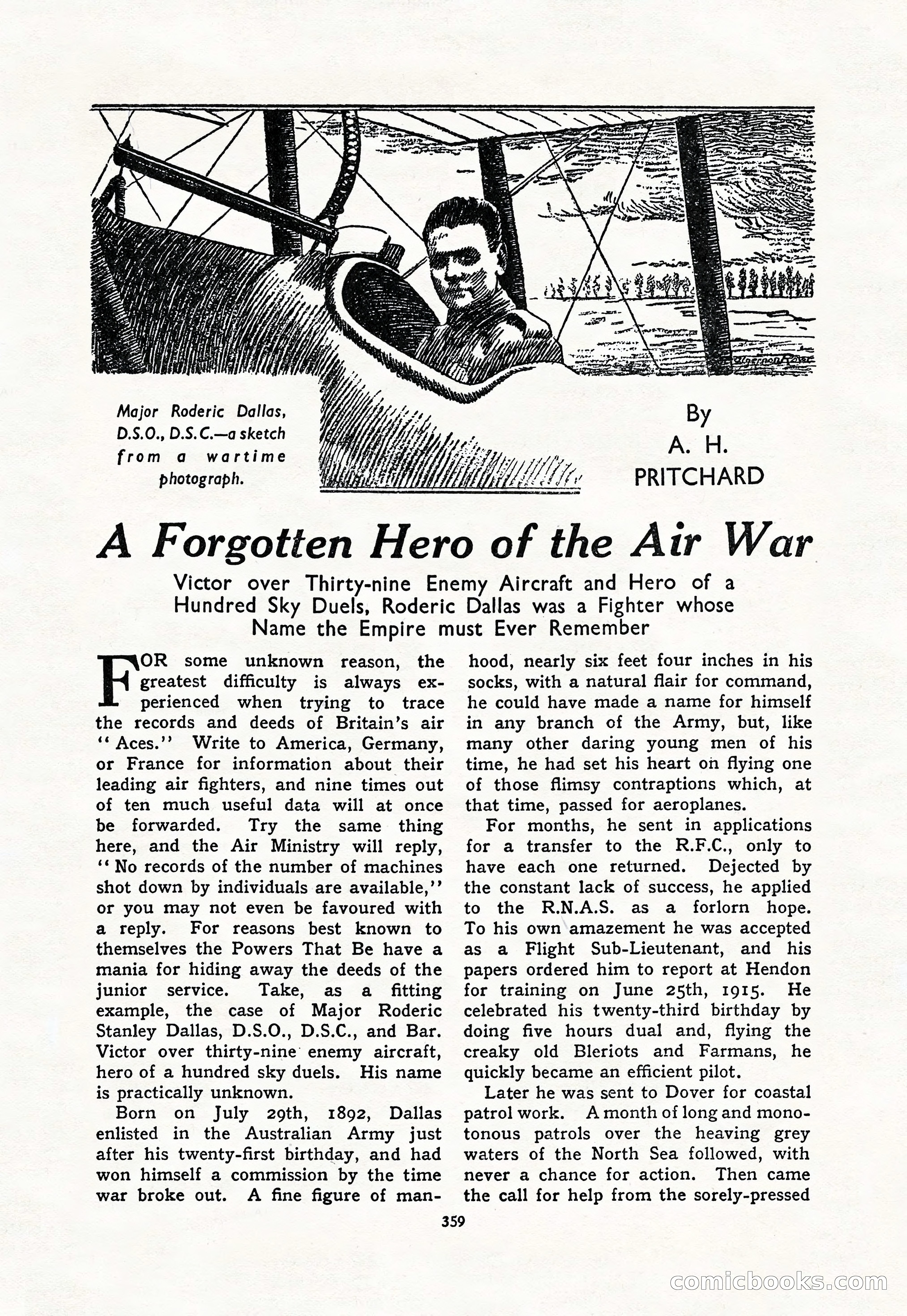
A restored page from Pulp Fiction, 1936. Page through the whole issue in the reader above.
📄 Transcribed text from this page (OCR, searchable)
Machine-transcribed from the original scan — historical spelling and the odd misread are preserved.
Major Roderic Dallas, D.S.0., D.S.C.—a sketch from a wartime photograph. o- Sa Se oe x " —~sa_-— ‘< 55 es) oe EE SIS = 25 OY eas SS rl ae Seek ~~, -f CHa te c ° iS f a rae we @ S A Forgotten Hero of the Air War Victor over Thirty-nine Enemy Aircraft and Hero of a Hundred Sky Duels, Roderi c Dallas was a Fighter whose Name the Empire must Ever Remember OR some unknown reason, the Pe ecestes difficulty is always ex- perienced when trying to trace the records and deeds of Britain’s air ‘* Aces.’’? Write to America, Germany, or France for information about their leading air fighters, and nine times out of ten much useful data will at once be forwarded. Try the same thing here, and the Air Ministry will reply, ‘No records of the number of machines shot down by individuals are available,’’ or you may not even be favoured with a reply. For reasons best known to themselves the Powers That Be have a mania for hiding away the deeds of the junior service. Take, as a fitting example, the case of Major Roderic Stanley Dallas, D.$.O., D.S.C., and Bar. Victor over thirty-nine enemy aircraft, hero of a hundred sky duels. His name is practically unknown. Born on July 29th, 1892, Dallas enlisted in the Australian Army just after his twenty-first birthday, and had won himself a commission by the time war broke out. A fine figure of man- hood, nearly six feet four inches in his socks, with a natural flair for command, he could have made a name for himself in any branch of the Army, but, like many other daring young men of his time, he had set his heart on flying one of those flimsy contraptions which, at that time, passed for aeroplanes. For months, he sent in applications for a transfer to the R.F.C., only to have each one returned. Dejected by the constant lack of success, he applied to the R.N.A.S. as a forlorn hope. To his own amazement he was accepted as a Flight Sub-Lieutenant, and his papers ordered him to report at Hendon for training on June 25th, 1915. He celebrated his twenty-third birthday by doing five hours dual and, flying the creaky old Bleriots and Farmans, he quickly became an efficient pilot. Later he was sent to Dover for coastal patrol work. A month of long and mono- tonous patrols over the heaving grey waters of the North Sea followed, with never a chance for action. Then came the call for help from the sorely-pressed 359 comiclooolkks (C(O)