
Pulp Fiction, 1936 · page 69 of 98
Air Stories, April 1936 — page 69: what you’re looking at
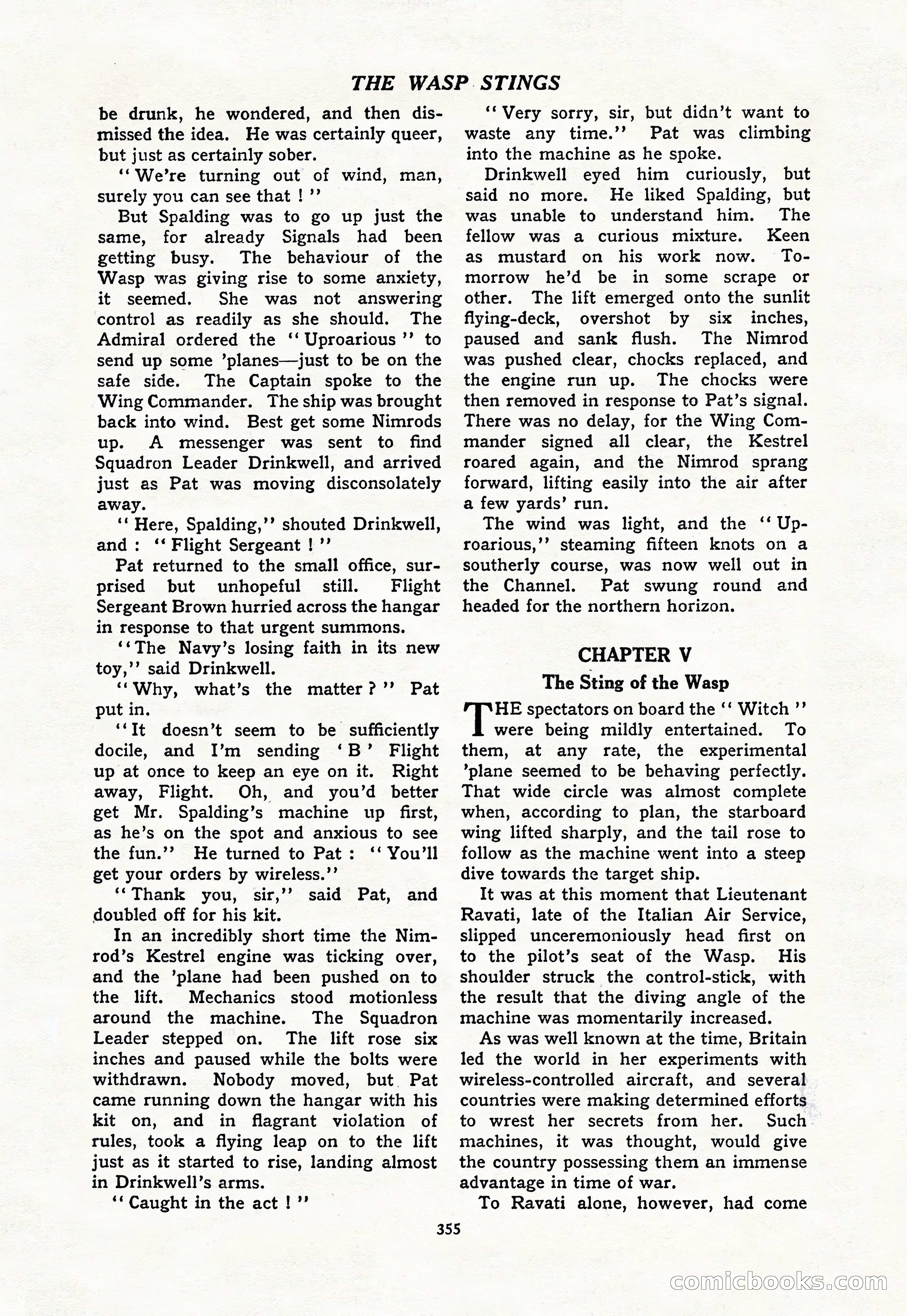
A restored page from Pulp Fiction, 1936. Page through the whole issue in the reader above.
📄 Transcribed text from this page (OCR, searchable)
Machine-transcribed from the original scan — historical spelling and the odd misread are preserved.
THE WASP. STINGS be drunk, he wondered, and then dis- missed the idea. He was certainly queer, but just as certainly sober. ‘‘We’re turning out of wind, man, surely you can see that !’’ But Spalding was to go up just the same, for already Signals had been getting busy. The behaviour of the Wasp was giving rise to some anxiety, it seemed. She was not answering control as readily as she should. The Admiral ordered the ‘‘ Uproarious ’’ to send up some ’planes—just to be on the safe side. The Captain spoke to the Wing Commander. The ship was brought back into wind. Best get some Nimrods up. A messenger was sent to find Squadron Leader Drinkwell, and arrived just as Pat was moving disconsolately away. ‘* Here, Spalding,’’ shouted Drinkwell, and: ‘‘ Flight Sergeant ! ”’ Pat returned to the small office, sur- prised but unhopeful still. Flight Sergeant Brown hurried across the hangar in response to that urgent summons. ‘*The Navy’s losing faith in its new toy,’’ said Drinkwell. ‘*Why, what’s the matter? ’”’ put in. ‘‘It doesn’t seem to be sufficiently docile, and I’m sending ‘B’ Flight up at once to keep an eye on it. Right away, Flight. Oh, and you’d better get Mr. Spalding’s machine up first, as he’s on the spot and anxious to see Pat the fun.’’ He turned to Pat: ‘‘ You’ll get your orders by wireless.’’ ‘‘Thank you, sir,’’ said Pat, and doubled off for his kit. In an incredibly short time the Nim- rod’s Kestrel engine was ticking over, and the ’plane had been pushed on to the lift. Mechanics stood motionless around the machine. The Squadron Leader stepped on. The lift rose six inches and paused while the bolts were withdrawn. Nobody moved, but. Pat came running down the hangar with his kit on, and in flagrant violation of rules, took a flying leap on to the lift just as it started to rise, landing almost in Drinkwell’s arms. ‘Caught in the act !’’ said no more. ‘‘Very sorry, sir, but didn’t want to waste any time.’’ Pat was climbing into the machine as he spoke. Drinkwell eyed him curiously, but He liked Spalding, but was unable to understand him. The fellow was a curious mixture. Keen as mustard on his work now. To- morrow he’d be in some scrape or other. The lift emerged onto the sunlit flying-deck, overshot by six inches, paused and sank flush. The Nimrod was pushed clear, chocks replaced, and the engine run up. The chocks were then removed in response to Pat’s signal. There was no delay, for the Wing Com- mander signed all clear, the Kestrel roared again, and the Nimrod sprang forward, lifting easily into the air after a few yards’ run. The wind was light, and the ‘‘ Up- roarious,’’ steaming fifteen knots on a southerly course, was now well out in the Channel. Pat swung round and headed for the northern horizon. CHAPTER V The Sting of the Wasp HE spectators on board the ‘‘ Witch ”’ were being mildly entertained. To them, at any rate, the experimental ’plane seemed to be behaving perfectly. That wide circle was almost complete when, according to plan, the starboard wing lifted sharply, and the tail rose to follow as the machine went into a steep dive towards the target ship. It was at this moment that Lieutenant Ravati, late of the Italian Air Service, slipped unceremoniously head first on to the pilot’s seat of the Wasp. His shoulder struck the control-stick, with the result that the diving angle of the machine was momentarily increased. As was well known at the time, Britain led the world in her experiments with wireless-controlled aircraft, and several countries were making determined efforts to wrest her secrets from her. Such machines, it was thought, would give the country possessing them an immense advantage in time of war. To Ravati alone, however, had come 355 COnniclooo S (SO)