
Pulp Fiction, 1936 · page 65 of 98
Air Stories, April 1936 — page 65: what you’re looking at
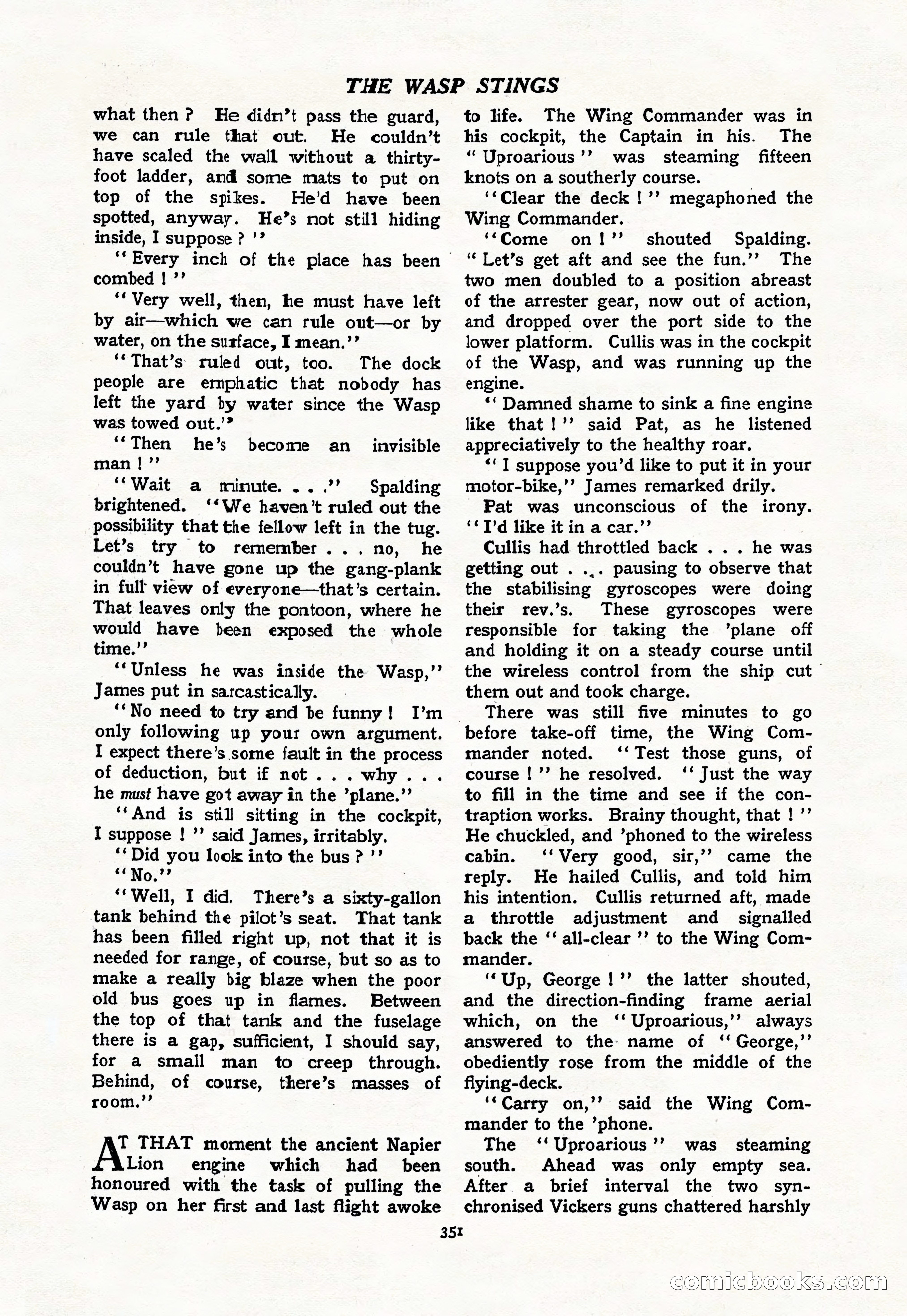
A restored page from Pulp Fiction, 1936. Page through the whole issue in the reader above.
📄 Transcribed text from this page (OCR, searchable)
Machine-transcribed from the original scan — historical spelling and the odd misread are preserved.
THE WASP STINGS what then? He didn’t pass the guard, we can rule that out. He couldn’t have scaled the wall without a thirty- foot ladder, and some mats to put on top of the spikes. He’d have been spotted, anyway. He’s not still hiding inside, I suppose ? ’?” ‘‘Every inch of the place has been combed |”? ** Very well, then, he must have left by air—which we can rule out—or by water, on the surface, I mean.’’ “*That’s ruled out, too. The dock people are emphatic that nobody has left the yard by water since the Wasp was towed out.’” ‘‘Then he’s become an_ invisible man!’ ‘“‘Wait a minute. ...’’ Spalding brightened. ‘‘We haven't ruled out the possibility that the fellow left in the tug. Let’s try to remember...no, he couldn’t have gone up the gang-plank in full view of everyone—that’s certain. That leaves only the pontoon, where he would have been exposed the whole time.’’ ‘Unless he was inside the Wasp,”’ James put in sarcastically. ‘*No need to try and be funny! I’m only following up your own argument. I expect there's some fault in the process of deduction, but if not ...why... he must have got away in the ’plane.”’ ‘‘And is still sitting in the cockpit, I suppose ! ”’ said James, irritably. ** Did you look into the bus ? ’’ éé No. 99 “*Well, I did. There’s a sixty- asiva tank behind the pilot’s seat. That tank has been filled right up, not that it is needed for range, of course, but so as to make a really big blaze when the poor old bus goes up in flames. Between the top of that tank and the fuselage there is a gap, sufficient, I should say, for a small man to creep through. Behind, of course, there’s masses of room.’’ T THAT morment the ancient Napier Lion engine which had _ been honoured with the task of pulling the Wasp on her first and last flight awoke to life. The Wing Commander was in his cockpit, the Captain in his. The “‘Uproarious’’ was steaming fifteen knots on a southerly course. ‘€Clear the deck !’’ megaphoned the Wing Commander. ‘‘Come on!’’ shouted Spalding. ‘Let’s get aft and see the fun.’’ The two men doubled to a position abreast of the arrester gear, now out of action, and dropped over the port side to the lower platform. Cullis was in the cockpit of the Wasp, and was running up the engine. ‘‘ Damned shame to sink a fine engine like that !’’ said Pat, as he listened appreciatively to the healthy roar. “‘T suppose you’d like to put it in your motor-bike,’’ James remarked drily. Pat was unconscious of the irony. ‘¢T’d like it in a car.’’ Cullis had throttled back ... he was getting out . ... pausing to observe that the stabilising gyroscopes were doing their rev.’s. These gyroscopes were responsible for taking the ’plane off and holding it on a steady course until the wireless control from the ship cut therm out and took charge. There was still five minutes to go ‘before take-off time, the Wing Com- mander noted. ‘‘ Test those guns, of course !|’’ he resolved. ‘‘ Just the way to fill in the time and see if the con- traption works. Brainy thought, that ! ’’ He chuckled, and ’phoned to the wireless cabin. ‘‘ Very good, sir,’’ came the reply. He hailed Cullis, and told him his intention. Cullis returned aft, made a throttle adjustment and_ signalled back the ‘‘ all-clear ’’ to the Wing Com- mander. ‘Up, George !’’ the latter shouted, and the direction-finding frame aerial which, on the ‘‘ Uproarious,’’ always answered to the: name of ‘‘ George,’’ obediently rose from the middle of the flying-deck. ‘‘Carry on,’’ said the Wing Com- mander to the ’phone. The ‘‘Uproarious’’ was steaming south. Ahead was only empty sea. After a brief interval the two syn- chronised Vickers guns chattered harshly 35! lONOOLK