
Pulp Fiction, 1936 · page 35 of 98
Air Stories, April 1936 — page 35: what you’re looking at
A restored page from Pulp Fiction, 1936. Page through the whole issue in the reader above.
📄 Transcribed text from this page (OCR, searchable)
Machine-transcribed from the original scan — historical spelling and the odd misread are preserved.
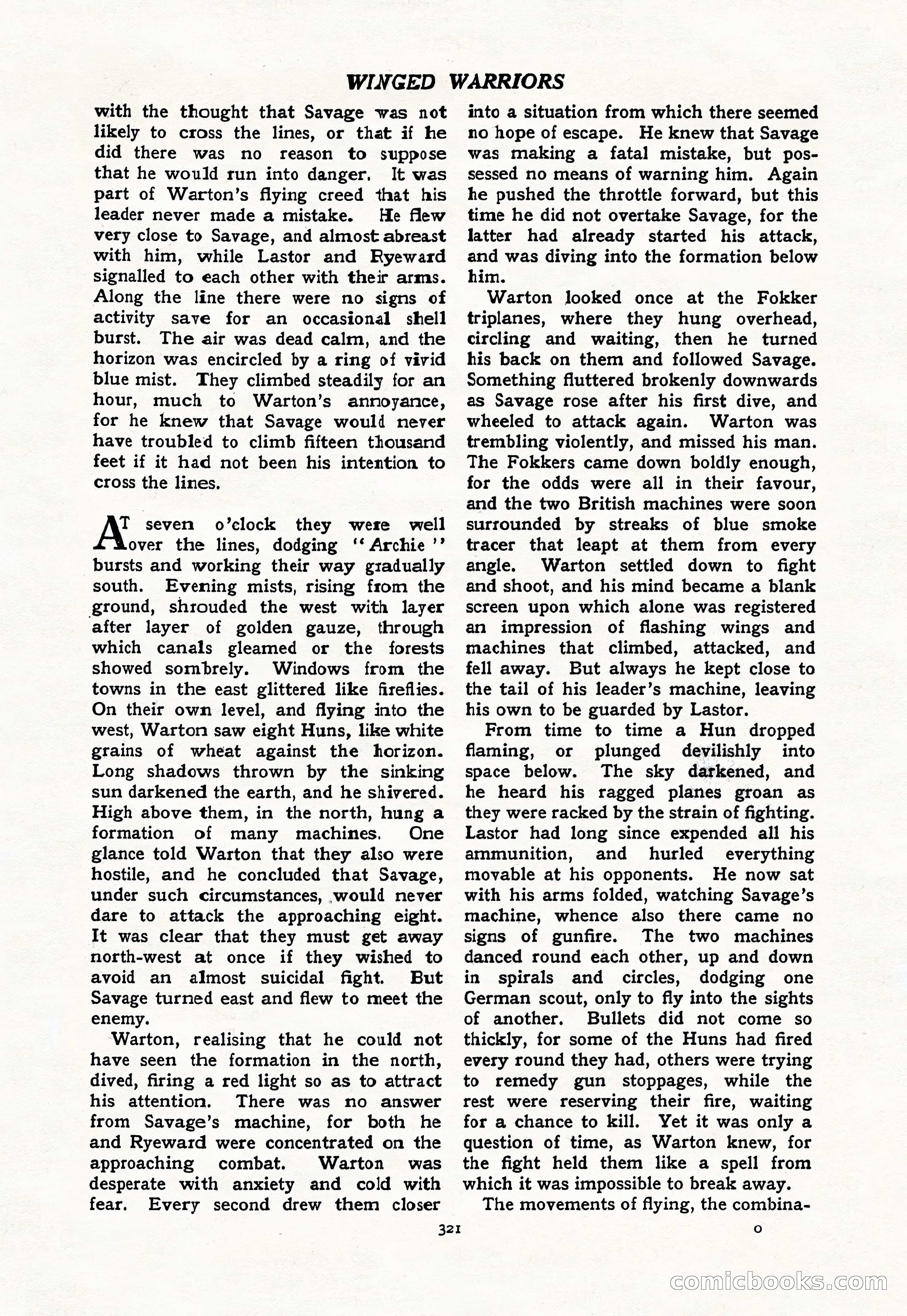
WINGED WARRIORS with the thought that Savage was not likely to cross the lines, or that if he did there was no reason to suppose that he would run into danger. It was part of Warton’s flying creed that his leader never made a mistake. He flew very close to Savage, and almost abreast with him, while Lastor and Ryeward signalled to each other with their arms. Along the line there were no signs of activity save for an occasional shell burst. The air was dead calm, and the horizon was encircled by a ring of vivid blue mist. They climbed steadily for an hour, much to Warton’s annoyance, for he knew that Savage would never have troubled to climb fifteen thousand feet if it had not been his intention to cross the lines. T seven o’clock they were well over the lines, dodging ‘‘ Archie ’’ bursts and working their way gradually south. Evening mists, rising from the ground, shrouded the west with layer after layer of golden gauze, through which canals gleamed or the forests showed sombrely. Windows from the towns in the east glittered like fireflies. On their own level, and flying into the west, Warton saw eight Huns, like white grains of wheat against the horizon. Long shadows thrown by the sinking sun darkened the earth, and he shivered. High above them, in the north, hung a formation of many machines. One glance told Warton that they also were hostile, and he concluded that Savage, under such circumstances, would never dare to attack the approaching eight. It was clear that they must get away north-west at once if they wished to avoid an almost suicidal fight. But Savage turned east and flew to meet the enemy. Warton, realising that he could not have seen the formation in the north, dived, firing a red light so as to attract his attention. There was no answer from Savage’s machine, for both he and Ryeward were concentrated on the approaching combat. Warton was desperate with anxiety and cold with fear. Every second drew them closer 321 into a situation from which there seemed no hope of escape. He knew that Savage was making a fatal mistake, but pos- sessed no means of warning him. Again he pushed the throttle forward, but this time he did not overtake Savage, for the latter had already started his attack, and was diving into the formation below him. Warton looked once at the Fokker triplanes, where they hung overhead, circling and waiting, then he turned his back on them and followed Savage. Something fluttered brokenly downwards as Savage rose after his first dive, and wheeled to attack again. Warton was trembling violently, and missed his man. The Fokkers came down boldly enough, for the odds were all in their favour, and the two British machines were soon surrounded by streaks of blue smoke tracer that leapt at them from every angle. Warton settled down to fight and shoot, and his mind became a blank screen upon which alone was registered an impression of flashing wings and machines that climbed, attacked, and fell away. But always he kept close to the tail of his leader’s machine, leaving his own to be guarded by Lastor. From time to time a Hun dropped flaming, or plunged devilishly into space below. The sky darkened, and he heard his ragged planes groan as they were racked by the strain of fighting. Lastor had long since expended all his ammunition, and hurled everything movable at his opponents. He now sat with his arms folded, watching Savage’s machine, whence also there came no signs of gunfire. The two machines danced round each other, up and down in spirals and circles, dodging one German scout, only to fly into the sights of another. Bullets did not come so thickly, for some of the Huns had fired every round they had, others were trying to remedy gun stoppages, while the rest were reserving their fire, waiting for a chance to kill. Yet it was only a question of time, as Warton knew, for the fight held them like a spell from which it was impossible to break away. The movements of flying, the combina- O lDOOLK