
Pulp Fiction, 1936 · page 27 of 98
Air Stories, April 1936 — page 27: what you’re looking at
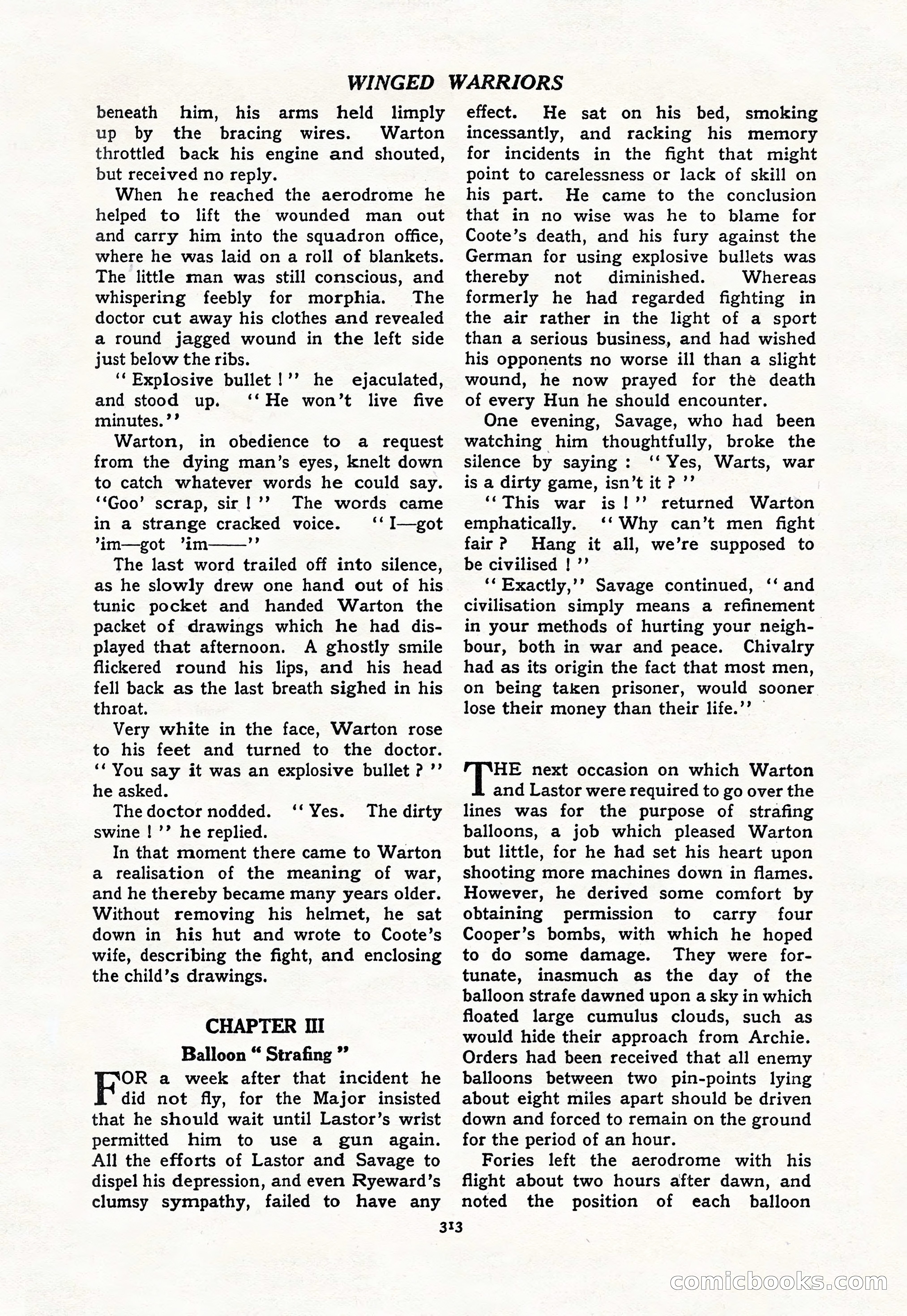
A restored page from Pulp Fiction, 1936. Page through the whole issue in the reader above.
📄 Transcribed text from this page (OCR, searchable)
Machine-transcribed from the original scan — historical spelling and the odd misread are preserved.
WINGED WARRIORS beneath him, his arms held limply up by the bracing wires. Warton throttled back his engine and shouted, but received no reply. . When he reached the aerodrome he helped to lift the wounded man out and carry him into the squadron office, where he was laid on a roll of blankets. The little man was still conscious, and whispering feebly for morphia. The doctor cut away his clothes and revealed a round jagged wound in the left side just below the ribs. ‘‘ Explosive bullet !’’ he ejaculated, and stood up. ‘‘ He won’t live five minutes. ’”’ Warton, in obedience to a request from the dying man’s eyes, knelt down to catch whatever words he could say. ‘Goo’ scrap, sir!’’ The words came in a strange cracked voice. ‘‘ I—got ’im—got ’im . The last word trailed off into silence, as he slowly drew one hand out of his tunic pocket and handed Warton the packet of drawings which he had dis- played that afternoon. A ghostly smile flickered round his lips, and his head fell back as the last breath sighed in his throat. Very white in the face, Warton rose to his feet and turned to the doctor. ‘‘ You say it was an explosive bullet ? ’’ he asked. The doctor nodded. swine !|’’ he replied. In that moment there came to Warton a realisation of the meaning of war, and he thereby became many years older. Without removing his helmet, he sat down in his hut and wrote to Coote’s wife, describing the fight, and enclosing the child’s drawings. ‘‘Yes. The dirty CHAPTER Il Balloon “ Strafing ”’ OR a week after that incident he did not fly, for the Major insisted that he should wait until Lastor’s wrist permitted him to use a gun again. All the efforts of Lastor and Savage to dispel his depression, and even Ryeward’s clumsy sympathy, failed to have any effect. He sat on his bed, smoking incessantly, and racking his memory for incidents in the fight that might point to carelessness or lack of skill on his part. He came to the conclusion that in no wise was he to blame for Coote’s death, and his fury against the German for using explosive bullets was thereby not diminished. Whereas formerly he had regarded fighting in the air rather in the light of a sport than a serious business, and had wished his opponents no worse ill than a slight wound, he now prayed for the death of every Hun he should encounter. One evening, Savage, who had been watching him thoughtfully, broke the silence by saying: ‘‘ Yes, Warts, war is a dirty game, isn’t it P ’’ ‘‘This war is!’’ returned Warton emphatically. ‘‘ Why can’t men fight fair? Hang it all, we’re supposed to be civilised | ’’ ‘* Exactly,’’ Savage continued, ‘‘ and civilisation simply means a refinement in your methods of hurting your neigh- bour, both in war and peace. Chivalry had as its origin the fact that most men, on being taken prisoner, would sooner lose their money than their life.’’ — HE next occasion on which Warton and Lastor were required to go over the lines was for the purpose of strafing balloons, a job which pleased Warton but little, for he had set his heart upon shooting more machines down in flames. However, he derived some comfort by obtaining permission to carry four Cooper’s bombs, with which he hoped to do some damage. They were for- tunate, inasmuch as the day of the balloon strafe dawned upon a sky in which floated large cumulus clouds, such as would hide their approach from Archie. Orders had been received that all enemy balloons between two pin-points lying about eight miles apart should be driven down and forced to remain on the ground for the period of an hour. Fories left the aerodrome with his flight about two hours after dawn, and noted the position of each balloon 313 COnniclooo SJ (Cl QO)