
Pulp Fiction, 1936 · page 14 of 98
Air Stories, April 1936 — page 14: what you’re looking at
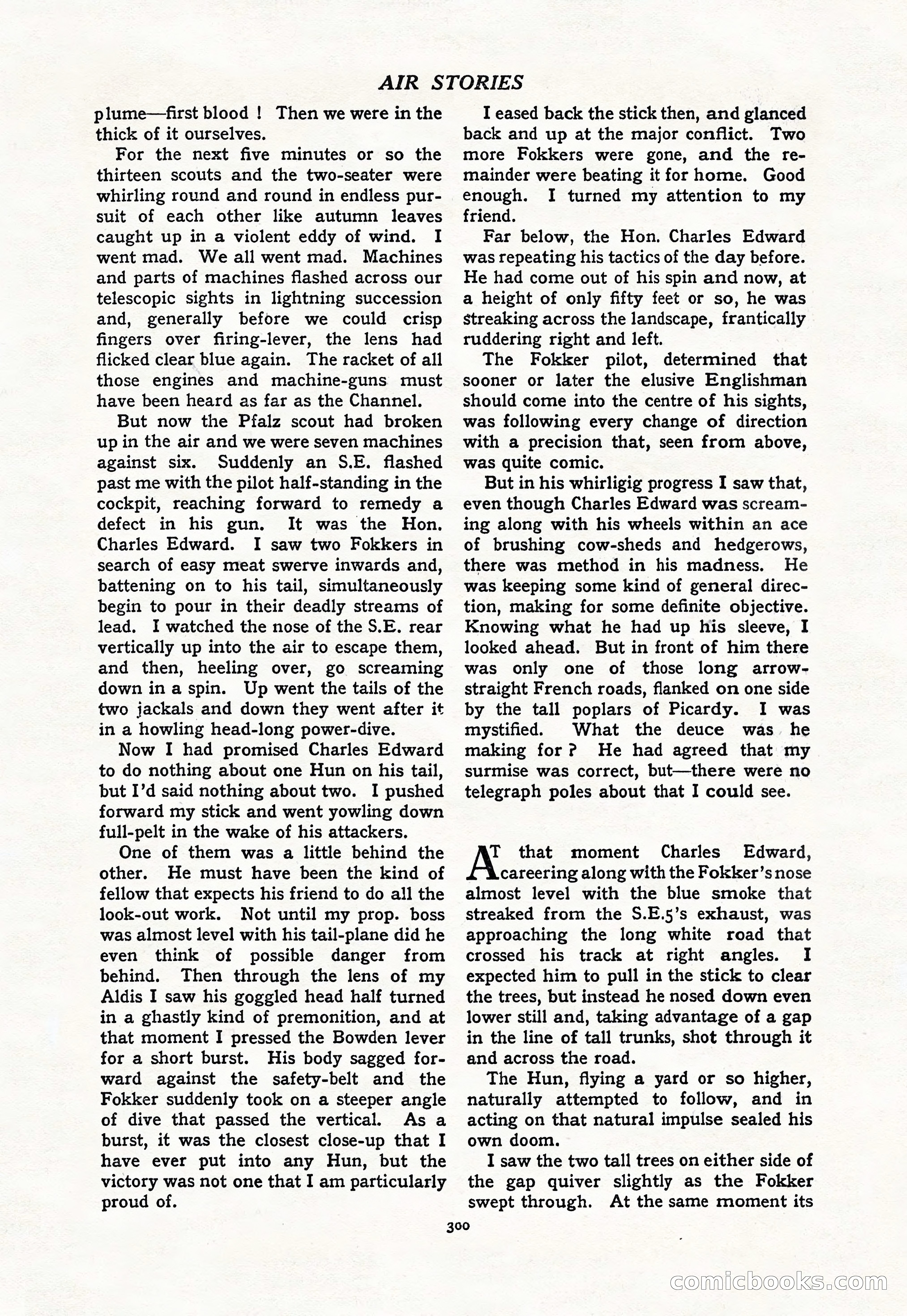
A restored page from Pulp Fiction, 1936. Page through the whole issue in the reader above.
📄 Transcribed text from this page (OCR, searchable)
Machine-transcribed from the original scan — historical spelling and the odd misread are preserved.
AIR STORIES plume—first blood ! Then we were in the thick of it ourselves. For the next five minutes or so the thirteen scouts and the two-seater were whirling round and round in endless pur- suit of each other like autumn leaves caught up in a violent eddy of wind. I went mad. We all went mad. Machines and parts of machines flashed across our telescopic sights in lightning succession and, generally before we could crisp fingers over firing-lever, the lens had flicked clear blue again. The racket of all those engines and machine-guns must have been heard as far as the Channel. But now the Pfalz scout had broken up in the air and we were seven machines against six. Suddenly an $.E. flashed past me with the pilot half-standing in the cockpit, reaching forward to remedy a defect in his gun. It was the Hon. Charles Edward. I saw two Fokkers in search of easy meat swerve inwards and, battening on to his tail, simultaneously begin to pour in their deadly streams of lead. I watched the nose of the S.E. rear vertically up into the air to escape them, and then, heeling over, go screaming down ina spin. Up went the tails of the two jackals and down they went after it in a howling head-long power-dive. Now I had promised Charles Edward to do nothing about one Hun on his tail, but I’d said nothing about two. I pushed forward my stick and went yowling down full-pelt in the wake of his attackers. One of them was a little behind the other. He must have been the kind of fellow that expects his friend to do all the look-out work. Not until my prop. boss was almost level with his tail-plane did he even think of possible danger from behind. Then through the lens of my Aldis I saw his goggled head half turned in a ghastly kind of premonition, and at that moment I pressed the Bowden lever for a short burst. His body sagged for- ward against the safety-belt and the Fokker suddenly took on a steeper angle of dive that passed the vertical. As a burst, it was the closest close-up that I have ever put into any Hun, but the victory was not one that I am particularly proud of. I eased back the stick then, and glanced back and up at the major conflict. Two more Fokkers were gone, and the re- mainder were beating it for home. Good enough. I turned my attention to my friend. Far below, the Hon. Charles Edward was repeating his tactics of the day before. He had come out of his spin and now, at a height of only fifty feet or so, he was streaking across the landscape, frantically ruddering right and left. The Fokker pilot, determined that sooner or later the elusive Englishman should come into the centre of his sights, was following every change of direction with a precision that, seen from above, was quite comic. But in his whirligig progress I saw that, even though Charles Edward was scream- ing along with his wheels within an ace of brushing cow-sheds and hedgerows, there was method in his madness. He was keeping some kind of general direc- tion, making for some definite objective. Knowing what he had up his sleeve, I looked ahead. But in front of him there was only one of those long arrow- straight French roads, flanked on one side by the tall poplars of Picardy. I was mystified. What the deuce was he making fore He had agreed that my surmise was correct, but—there were no telegraph poles about that I could see. T that moment Charles Edward, careering along with the Fokker’s nose almost level with the blue smoke that streaked from the S.E.5’s exhaust, was approaching the long white road that crossed his track at right angles. I expected him to pull in the stick to clear the trees, but instead he nosed down even lower still and, taking advantage of a gap in the line of tall trunks, shot through it and across the road. The Hun, flying a yard or so higher, naturally attempted to follow, and in acting on that natural impulse sealed his own doom. I saw the two tall trees on either side of the gap quiver slightly as the Fokker swept through. At the same moment its 300 IaOO SJ (Cl QO)