
Pulp Fiction, 1913 · page 81 of 192
Ainslee's Magazine, February 1913 — page 81: what you’re looking at
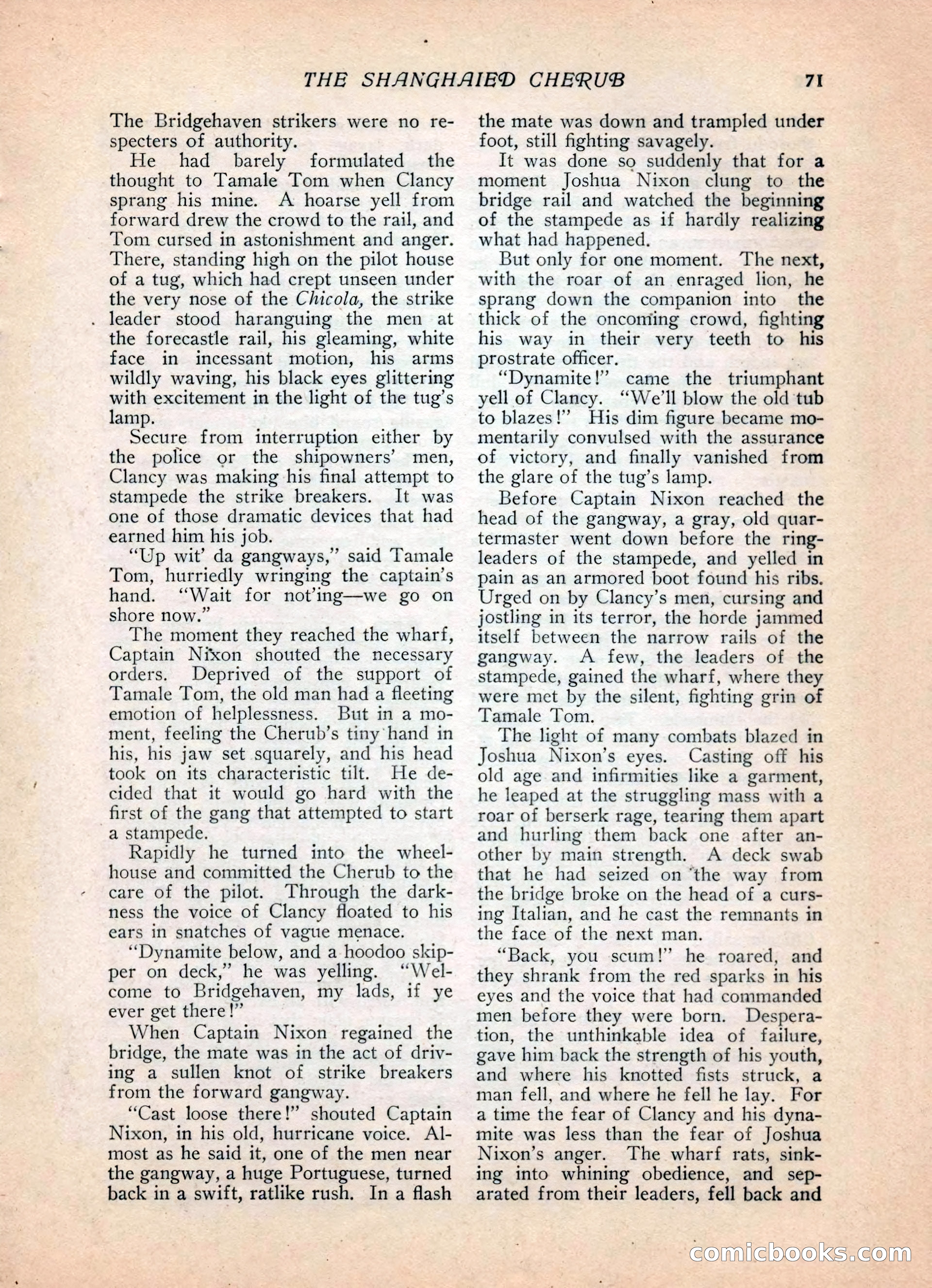
A restored page from Pulp Fiction, 1913. Page through the whole issue in the reader above.
📄 Transcribed text from this page (OCR, searchable)
Machine-transcribed from the original scan — historical spelling and the odd misread are preserved.
THE SHANGHAIED CHERUB The Bridgehaven strikers were no re- specters of authority. He had barely formulated the thought to Tamale Tom when Clancy sprang his mine. A hoarse yell from forward drew the crowd to the rail, and Tom cursed in astonishment and anger. There, standing high on the pilot house of a tug, which had crept unseen under the very nose of the Chicola, the strike . leader stood haranguing the men at the forecastle rail, his gleaming, white face in incessant motion, his arms wildly waving, his black eyes glittering with excitement in the light of the tug’s lamp. Secure from interruption either by the police or the shipowners’ men, Clancy was making his final attempt to stampede the strike breakers. It was one of those dramatic devices that had earned him his job. “Up wit’ da gangways,”’ said Tamale Tom, hurriedly wringing the captain’s hand. ‘Wait for not’ing—we go on shore now.” The moment they reached the wharf, Captain Nixon shouted the necessary orders. Deprived of the support of Tamale Tom, the old man had a fleeting emotion of helplessness. But in a mo- ment, feeling the Cherub’s tiny hand in his, his jaw set squarely, and his head took on its characteristic tilt. He de- cided that it would go hard with the first of the gang that attempted to start a stampede. Rapidly he turned into the wheel- house and committed the Cherub to the care of the pilot. Through the dark- ness the voice of Clancy floated to his ears in snatches of vague menace. “Dynamite below, and a hoodoo skip- per on deck,” he was yelling. “Wel- come to Bridgehaven, my lads, if ye ever get there!” When Captain Nixon regained the bridge, the mate was in the act of driv- ing a sullen knot of strike breakers from the forward gangway. “Cast loose there!” shouted Captain Nixon, in his old, hurricane voice. AI- most as he said it, one of the men near the gangway, a huge Portuguese, turned back in a swift, ratlike rush. In a flash ? 71 the mate was down and trampled under foot, still fighting savagely. It was done so suddenly that for a moment Joshua Nixon clung to the bridge rail and watched the beginning of the stampede as if hardly realizing what had happened. But only for one moment. The next, with the roar of an enraged lion, he sprang down the companion into the thick of the oncoming crowd, fighting his way in their very teeth to his prostrate officer. } “Dynamite!” came the triumphant yell of Clancy. “We’ll blow the old tub to blazes!” His dim figure became mo- mentarily convulsed with the assurance of victory, and finally vanished from the glare of the tug’s lamp. Before Captain Nixon reached the head of the gangway, a gray, old quar- termaster went down before the ring- leaders of the stampede, and yelled in pain as an armored boot found his ribs. Urged on by Clancy’s men, cursing and jostling in its terror, the horde jammed itself between the narrow rails of the gangway. A few, the leaders of the stampede, gained the wharf, where they were met by the silent, fighting grin of Tamale Tom. The light of many combats blazed in Joshua Nixon’s eyes. Casting off his old age and infirmities like a garment, he leaped at the struggling mass with a roar of berserk rage, tearing them apart and hurling them back one after an- other by main strength. A deck swab that he had seized on ‘the way from the bridge broke on the head of a curs- ing Italian, and he cast the remnants in the face of the next man. “Back, you scum!” he roared, and they shrank from the red sparks in his eyes and the voice that had commanded men before they were born. Despera- tion, the unthinkable idea of failure, gave him back the strength of his youth, and where his knotted fists struck, a man fell, and where he fell he lay. For a time the fear of Clancy and his dyna- mite was less than the fear of Joshua Nixon’s anger. The wharf rats, sink- ing into whining obedience, and sep- arated from their leaders, fell back and CO ANCE .OoOk (EO)