
Pulp Fiction, 1913 · page 64 of 192
Ainslee's Magazine, February 1913 — page 64: what you’re looking at
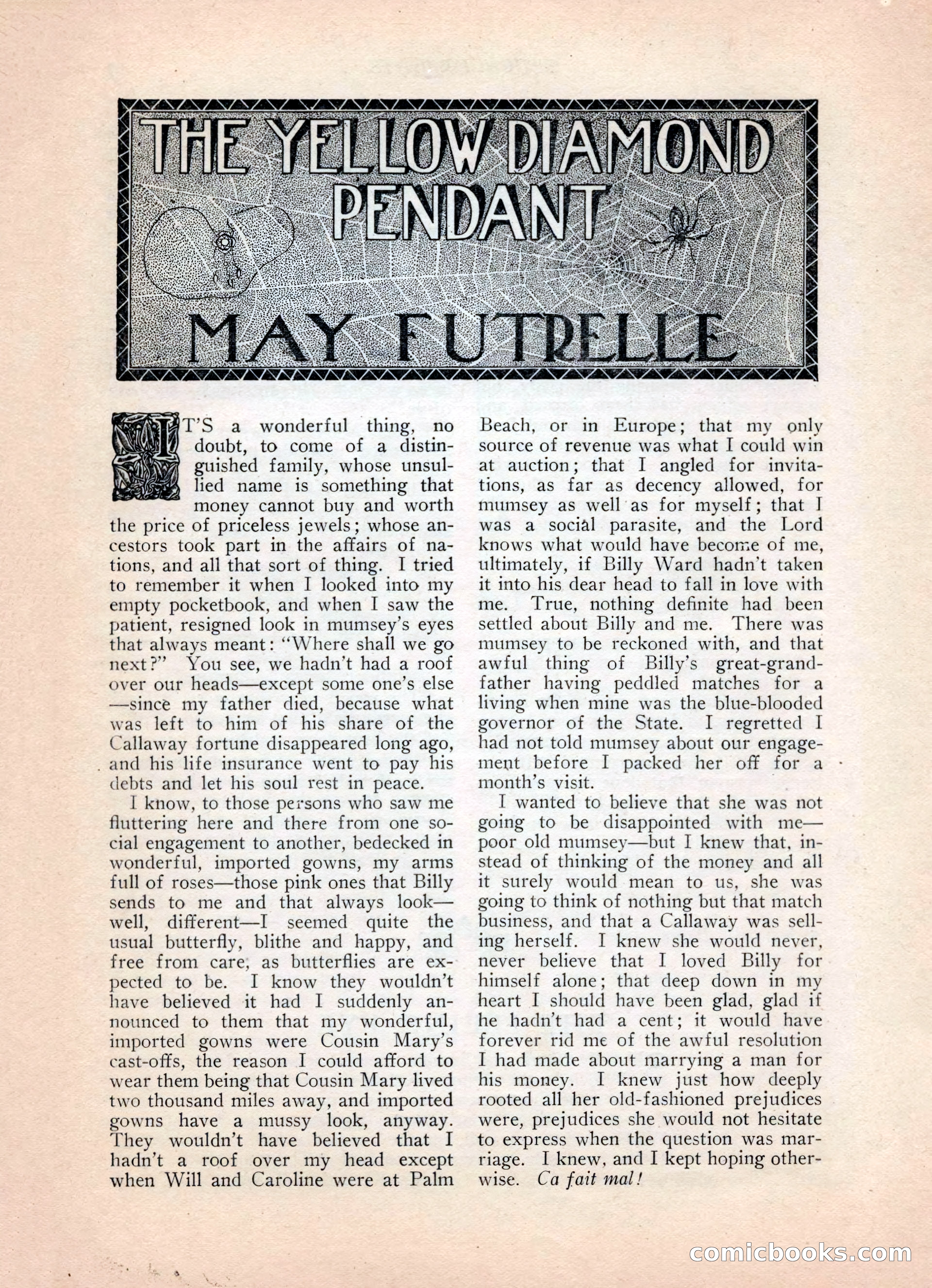
A restored page from Pulp Fiction, 1913. Page through the whole issue in the reader above.
📄 Transcribed text from this page (OCR, searchable)
Machine-transcribed from the original scan — historical spelling and the odd misread are preserved.
#1’S a wonderful thing, no doubt, to come of a distin- guished family, whose unsul- lied name is something that money cannot buy and worth the price of priceless jewels; whose an- cestors took part in the affairs of na- tions, and all that sort of thing. I tried to remember it when I| looked into my empty pocketbook, and when I saw the patient, resigned look in mumsey’s eyes that always meant: “Where shall we go next?” You see, we hadn’t had a roof over our heads—except some one’s else —since my father died, because what was left to him of his share of the Callaway fortune disappeared long ago, _and his life insurance went to pay his debts and let his soul rest in peace. I know, to those persons who saw me fluttering here and there from one so- cial engagement to another, bedecked in wonderful, imported gowns, my arms full of roses—those pink ones that Billy sends to me and that always look— well, different—I seemed quite the usual butterfly, blithe and happy, and free from care, as butterflies are ex- pected to be. I know they wouldn’t have believed it had I suddenly an- nounced to them that my wonderful, imported gowns were Cousin Mary’s cast-offs, the reason I could afford to wear them being that Cousin Mary lived two thousand miles away, and imported gowns have a mussy look, anyway. They wouldn’t have believed that I hadn’t a roof over my head except when Will and Caroline were at Palm Beach, or in Europe; that my only source of revenue was what I could win at auction; that I angled for invita- tions, as far as decency allowed, for mumsey as well as for myself; that |] was a social parasite, and the Lord knows what would have become of me, ultimately, if Billy Ward hadn't taken it into his dear head to fall in love with me. True, nothing definite had been settled about Billy and me. There was mumsey to be reckoned with, and that awful thing of Billy’s great-grand- father having peddled matches for a living when mine was the blue-blooded governor of the State. I regretted I had not told mumsey about our engage- ment before I packed her off for a month’s visit. I wanted to believe that she was not going to be disappointed with me— poor old mumsey—but I knew that, in- stead of thinking of the money and all it surely would mean to us, she was going to think of nothing but that match business, and that a Callaway was sell- ing herself. I knew she would never, never believe that I loved Billy for himself alone; that deep down in my heart I should have been glad, glad if he hadn’t had a cent; it would have forever rid me of the awful resolution I had made about marrying a man for his money. I knew just how deeply rooted all her old-fashioned prejudices were, prejudices she would not hesitate to express when the question was mar- riage. I knew, and I kept hoping other- wise. Ca fatt mal! (E00) 0)(0)(0) (F@