
Pulp Fiction, 1913 · page 61 of 192
Ainslee's Magazine, February 1913 — page 61: what you’re looking at
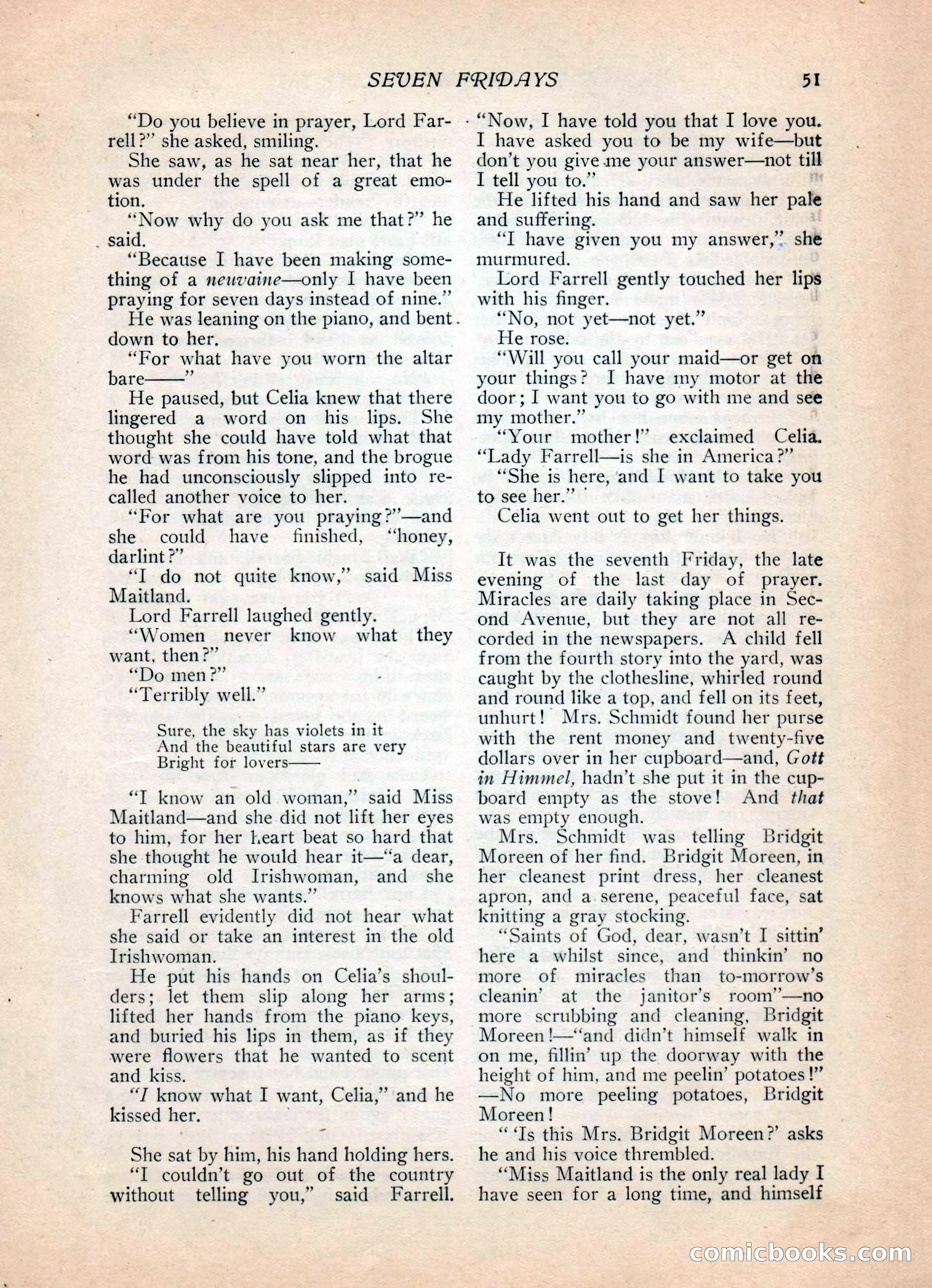
A restored page from Pulp Fiction, 1913. Page through the whole issue in the reader above.
📄 Transcribed text from this page (OCR, searchable)
Machine-transcribed from the original scan — historical spelling and the odd misread are preserved.
SEVEN FRIDAYS “Do you believe in prayer, Lord Far- rell?” she asked, smiling. She saw, as he sat near her, that he was under the spell of a great emo- tion, ‘Now why do you ask me that?” he _ Said, “Because I have been making some- thing of a neuvaine—only I have been praying for seven days instead of nine.” He was leaning on the piano, and bent. down to her. “For what have you worn the altar bare s He paused, but Celia knew that there lingered a word on his lips. She thought she could have told what that word was from his tone, and the brogue he had unconsciously slipped into re- called another voice to her. “For what are you praying?’’—and she could have finished, “honey, darlint ?” “T do not quite know,’ said Miss Maitland. Lord Farrell laughed gently. “Women never know what they want, then?” “Do men?” “Terribly well.” Sure, the sky has violets in it And the beautiful stars are very Bright for lovers “T know an old woman,” said Miss Maitland—and she did not lift her eyes to him, for her heart beat so hard that she thought he would hear it—“a dear, charming old Irishwoman, and_ she knows what she wants.” Farrell evidently did not hear what she said or take an interest in the old Trishwoman. He put his hands on Celia’s shoul- ders; let them slip along her arms; lifted her hands from the piano keys, and buried his lips in them, as if they were flowers that he wanted to scent and kiss. “T know what I want, Celia,” and he kissed her. 3 She sat by him, his hand holding hers. “TI couldn’t go out of the country without telling you,” said Farrell. 51 - “Now, I have told you that I love you. I have asked you to be my wife—but don’t you give me your answer—not till I tell you to.” be He lifted his hand and saw her pale and suffering. “T have given you my answer,” she murmured. Lord Farrell gently touched her lips with his finger. “No, not yet—not yet.” He rose. “Will you call your maid—or get on your things? I have my motor at the door; I want you to go with me and see my mother.” “Your mother!’ exclaimed Celia. “Lady Farrell—is she in America?” “She is here, and | want to take you to see her.” Celia went out to get her things. It was the seventh Friday, the late evening of the last day of prayer. Miracles are daily taking place in Sec- ond Avenue, but they are not all re- corded in the newspapers. A child fell from the fourth story into the yard, was caught by the clothesline, whirled round and round like a top, and fell on its feet, unhurt! Mrs. Schmidt found her purse with the rent money and twenty-five dollars over in her cupboard—and, Gott in Himmel, hadn't she put it in the cup- board empty as the stove! And that was empty enough. Mrs. Schmidt was telling Bridgit Moreen of her find. Bridgit Moreen, in her cleanest print dress, her cleanest apron, and a serene, peaceful face, sat knitting a gray stocking. “Saints of God, dear, wasn’t I sittin’ here a whilst since, and thinkin’ no more of miracles than to-morrow’s cleanin’ at the janitor’s room’—no more scrubbing and cleaning, Bridgit Moreen !—‘‘and didn’t himself walk in on me, fillin’ up the doorway with the height of him, and me peelin’ potatoes !” —No more peeling potatoes, Bridgit Moreen! “Ts this Mrs. Bridgit Moreen?’ asks he and his voice thrembled. “Miss Maitland is the only real lady I have seen for a long time, and himself (E(0) .OO ANIC co